Berberine Food Sources: Barberry, Goldenseal and Plant Extracts
Berberine food sources explained: barberry fruit vs roots, goldenseal, Oregon grape, tree turmeric, tea and why plant lists do not establish doses.
 By
Dr. Khaled Mahmoud, MBBCh
Critical Care Medicine, Longevity Science & Editorial Direction
 Reviewed by
Dr. Amr Yasser, PhD
Cardiometabolic, Musculoskeletal, Gut & Bioavailability
 Reviewed by
Dr. Abdulla Mostafa, PhD
Cellular Senescence, Neurological, Mitochondrial & Brain-Ageing Biology
- Published
- Last reviewed
- Reading time
- 6 min
- Sources cited
- 6

On this page
A reliable “berberine foods” list needs more than the names of plants. Food sources are often described through botanical lists, but a plant list is not a reliable dietary-dose table. Berberine occurs in several medicinal species, with concentrations that depend on the species, tissue and preparation. Culinary barberry fruit is not equivalent to a concentrated root extract or a standardized capsule. [1]
If your aim is to reproduce a clinical supplement dose through food, the evidence does not support a simple conversion. It is especially misleading to rank ordinary foods by invented berberine amounts or recommend eating medicinal roots to reach a research exposure.
Which plants contain berberine?
A botanical review identifies sources across several plant families, including Berberis species, Coptis species, goldenseal and Oregon grape. Different roots, rhizomes, stems, bark and other tissues have been studied. [1]
| Source commonly discussed | Botanical distinction | Practical interpretation |
|---|---|---|
| Barberry species | Several Berberis species and tissues | Culinary fruit and medicinal root material differ |
| Indian barberry or tree turmeric | Berberis aristata | Not the same plant as culinary turmeric |
| Goldenseal | Hydrastis canadensis | A medicinal botanical with other constituents |
| Oregon grape | Berberis aquifolium and related naming conventions | Not ordinary edible grapes |
| Coptis species | Medicinal rhizome preparations | Not a routine food serving with a standardized dose |
The table identifies sources, not recommendations to consume the listed plant parts. Botanical identity and safe use require more than a common name.
Barberry fruit vs barberry root
Barberries are used in food, including dried fruit in some cuisines. The fact that a plant species can contain berberine does not mean every edible serving delivers an amount resembling a supplement trial.
Species, cultivar, growing conditions, tissue, processing and analytical method can influence measured composition. Root or bark findings should not be assigned to fruit without a direct assay. [1]
This is why “eat a bowl of barberries instead of a 500 mg capsule” is not a defensible conversion. It ignores both composition and the rest of the food. Enjoying a culinary ingredient and using a concentrated pharmacological preparation are different decisions.
Tree turmeric is not kitchen turmeric
Berberis aristata is sometimes called tree turmeric. Culinary turmeric generally refers to Curcuma longa, associated with curcuminoids. A shared common-name element does not make them interchangeable sources of berberine. [1]
This naming confusion can produce inaccurate food lists. An article should identify the species and constituent rather than imply that adding ordinary turmeric powder supplies a studied berberine dose.
Likewise, Oregon grape is a botanical name, not evidence that table grapes, raisins or grape juice are meaningful berberine-dose sources.
Goldenseal is not simply a weaker berberine capsule
Goldenseal contains additional constituents and has its own composition and interaction questions. A clinical trial of isolated berberine cannot establish the same result for a whole goldenseal preparation. [1]
The NCCIH goldenseal overview discusses the limits of its clinical evidence and the possibility of medicine interactions. “Natural source” should not be interpreted as a reason to prefer an uncertain botanical exposure over a clearly specified product.
A product labeled goldenseal, a standardized berberine HCl capsule and a multicomponent herbal complex need separate evaluation.
Why food-content rankings are unreliable
To rank foods accurately, you need a defined species, edible portion, preparation, assay method, units and a representative sample. A result expressed per gram of dry medicinal root cannot be copied as milligrams per serving of fresh fruit.
Extraction studies also use solvents and laboratory conditions that do not necessarily resemble cooking or digestion. A high extraction yield in a paper does not tell you what reaches the body after a meal. [1]
When a website gives a precise “top ten foods high in berberine” table without these details, the apparent precision may be false. It is better to acknowledge a missing reliable food-dose database than invent numbers.
Can tea provide the same amount as a capsule?
There is no universal conversion from a spoonful of root or a cup of tea to a standardized capsule. Plant identity, particle size, water, temperature, time and concentration all influence extraction, and the active amount may remain unknown.
One fatty-liver trial in the Data Center used a boiled preparation described through dried-material weight, with unclear standardized active-berberine content. Its gram amount should not be copied as though it were grams of isolated berberine. [2]
That example shows why a traditional preparation can be studied without becoming interchangeable with a conventional supplement. Do not recreate an uncertain pharmacological dose from a tea recipe.
Barberry studies and berberine studies are not identical
Some evidence syntheses combine or compare berberine and barberry interventions. A favorable pooled finding may therefore involve different ingredients and preparation types. [3] [4]
The result should retain that distinction. Fruit, juice, plant extract and isolated alkaloid can have different constituents and different exposure. They cannot be treated as independent confirmations of one precise capsule's effect.
Our benefits guide separates clinical outcomes, and the HCl article explains salt and extract labels.
What food can do without supplying a supplement dose
A food does not need to deliver a pharmacological berberine amount to be a useful part of eating. Overall dietary quality, fiber, energy balance and appropriate clinical nutrition can matter to metabolic goals without being reduced to one compound.
Equally, a supplement should not replace those broader considerations. The research question is whether a specified intervention adds benefit in a defined setting, not whether a capsule can substitute for a healthy dietary pattern.
This article does not prescribe a diet for diabetes or liver disease. Those decisions depend on the person and should be coordinated with the relevant clinical team.
Safety: concentrated botanicals are not ordinary food portions
Medicinal roots, bark and concentrated extracts can be biologically active. Berberine's CYP and cyclosporine interaction findings are reasons to include botanical preparations in the medication history, not just products labeled “supplement.” [5] [6]
Pregnancy and breastfeeding require particular care with medicinal preparations. A traditional-use history does not establish a safe dose. See the pregnancy guide for the distinction between planned use and an exposure that has already happened.
Avoid foraging or ingesting medicinal plant parts based solely on an online list. Species identification, contamination and uncertain potency add problems that a food-source article cannot resolve.
If a standardized product is the actual goal
Choose an identifiable ingredient, clear amount and useful testing documentation. Clinical evidence is easier to interpret when the product specification is known, although that still does not guarantee benefit.
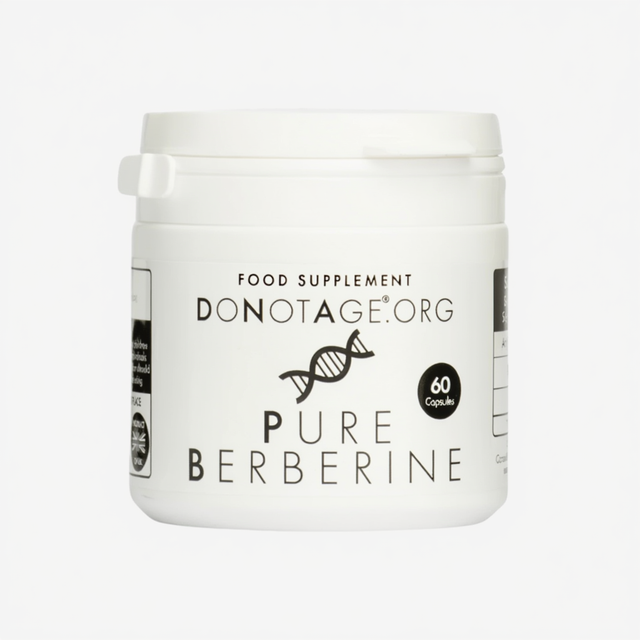
Our buying guide compares product approaches. The DoNotAge review covers a conventional 500 mg capsule; Biohack Blueprint may earn commission from qualifying purchases.
The Data Center includes botanical and clinical research separately. A source plant can explain where an ingredient comes from without establishing how much to eat or which outcome to expect.
Frequently asked questions
What foods are high in berberine?
Can barberries replace berberine capsules?
Does turmeric contain berberine?
Can berberine tea match a 500 mg capsule?
Is goldenseal equivalent to pure berberine?
Sources & article history
Sources (6)
-
Berberine: Botanical Occurrence, Traditional Uses, Extraction Methods, and Relevance in Cardiovascular, Metabolic, Hepatic, and Renal Disorders Frontiers in pharmacology. 2018;9:557.
-
The Effect of Berberine on Lipid Profile, Liver Enzymes, and Fasting Blood Glucose in Patients with Non-alcoholic Fatty Liver Disease (NAFLD): A Randomized Controlled Trial Medical journal of the Islamic Republic of Iran. 2022;36:39.
-
Effects of berberine and barberry on anthropometric measures: A systematic review and meta-analysis of randomized controlled trials Complementary therapies in medicine. 2020;49:102337.
-
Effects of berberine and barberry on selected inflammatory biomarkers in adults: A systematic review and dose-response meta-analysis of randomized clinical trials Phytotherapy research : PTR. 2023;37(12):5541-5557.
-
Repeated administration of berberine inhibits cytochromes P450 in humans European journal of clinical pharmacology. 2012;68(2):213-217.
-
Effects of berberine on the blood concentration of cyclosporin A in renal transplanted recipients: clinical and pharmacokinetic study European journal of clinical pharmacology. 2005;61(8):567-572.
Article history (1)
- Published with current study results, formulation distinctions, safety information and linked original sources.