Berberine, AMPK and Longevity: Mechanisms vs Human Outcomes
Berberine longevity evidence: AMPK, mitochondrial mechanisms, mouse and worm lifespan studies, senescence claims, human outcomes and supplement stacks.
 By
Dr. Khaled Mahmoud, MBBCh
Critical Care Medicine, Longevity Science & Editorial Direction
 Reviewed by
Dr. Amr Yasser, PhD
Cardiometabolic, Musculoskeletal, Gut & Bioavailability
 Reviewed by
Dr. Abdulla Mostafa, PhD
Cellular Senescence, Neurological, Mitochondrial & Brain-Ageing Biology
- Published
- Last reviewed
- Reading time
- 6 min
- Sources cited
- 9

On this page
Berberine longevity claims rest mainly on mechanistic research and animal experiments, with human metabolic trials providing a different kind of evidence. There is no established finding that ordinary berberine supplementation extends human lifespan or adds a predictable number of healthy years. [1] [2]
That does not make the biology uninteresting. It means the evidence should be translated carefully: a cellular pathway, an animal lifespan curve and a human LDL change answer different questions.
What is AMPK?
AMP-activated protein kinase, or AMPK, helps cells respond to energy availability. It participates in coordinating energy-consuming and energy-producing processes. Its activity depends on tissue, context and the wider physiological state.
Calling AMPK a “master switch” can be an accessible introduction, but it becomes misleading when it suggests one button controls healthy aging. Sustained benefit cannot be inferred from activation alone.
How berberine is linked to energy signaling
Experimental work has connected berberine and the related compound dihydroberberine with inhibition of mitochondrial respiratory complex I and subsequent changes in cellular energy signaling. This can help explain AMPK-related effects in the tested systems. [3]
That mechanism should not be simplified to “berberine gives mitochondria more energy.” A perturbation of energy production can trigger adaptive signaling; the final physiological outcome depends on dose, tissue and context.
Similarly, a molecular overlap with exercise or calorie restriction does not establish equivalent improvements in strength, fitness, body composition or lifespan. The human outcome still needs to be measured.
The mouse lifespan study
A 2020 paper reported that berberine affected cellular-senescence-related pathways and extended lifespan in mice under its experimental conditions. It investigated p16 and cyclin-related biology as part of the proposed mechanism. [1]
The result is a reason for replication and further research. It is not a human clinical trial, a validated longevity dose or proof that a particular retail product extends life.
Species, strain, sex, starting age, diet, husbandry and exposure can influence animal lifespan results. A percentage from one model should not be converted into extra human years or assigned to another supplement formulation.
The worm study
A 2025 C. elegans paper reported lifespan effects associated with antioxidant-related mechanisms. Worm models are useful for investigating pathways, but they are far removed from a clinical intervention in an older adult with several medicines. [2]
An effect in worms and an effect in mice can strengthen a research hypothesis without establishing a human outcome. They should also not be counted as human confirmations in a benefits table.
| Evidence level | What it can contribute | What it cannot establish alone |
|---|---|---|
| Cells | Pathway and target hypotheses | Effective and safe human dosing |
| Worms | Model-specific lifespan and stress responses | Extra human lifespan |
| Mice | Mammalian biological and lifespan observations | General human efficacy |
| Short human metabolic trials | Changes in defined biomarkers | Longer life or comprehensive rejuvenation |
| Appropriate long-term human outcomes | Clinically meaningful benefit and harm | Not yet supplied for a general berberine longevity claim |
A cautionary AMPK example from the Data Center
A mouse experiment reported berberine-associated hepatic lipid accumulation linked to CD36 under its particular conditions, despite the AMPK-related framework. [4]
This does not prove that human berberine use generally causes fatty liver. It demonstrates why one pathway cannot be used as a universal certificate of benefit. Biological responses can be tissue- and context-dependent.
A responsible synthesis includes this kind of counterexample alongside favorable experiments. Otherwise, the mechanism becomes a marketing story that cannot be challenged by an actual result.
Do human metabolic benefits count as longevity evidence?
Glucose and lipid abnormalities are relevant to health, and berberine has shown improvements in selected markers in some trials. Those findings support specific metabolic claims more directly than a broad life-extension claim. [5] [6]
However, a favorable biomarker is not the same as fewer clinical events or longer survival. The magnitude, durability, harms and availability of better-supported interventions also matter.
BRAVO illustrates the need for endpoint-specific interpretation. It reported some favorable secondary lipid and inflammatory signals while failing to improve the primary visceral-fat and liver-fat outcomes. It cannot be summarized as a general reversal of metabolic aging. [7]
Senescence, senolytics and biological age
A change in a senescence-related marker does not automatically establish selective removal of harmful senescent cells in humans. The terms senolytic, senomorphic and anti-aging describe different propositions and need appropriate evidence.
The mouse p16 findings cannot establish that a conventional capsule is a clinically validated human senolytic. Nor do these studies supply a verified biological-age reduction for a current retail product. [1]
A commercial claim should name the actual endpoint, assay, comparator and preparation. Otherwise, “rejuvenation” can conceal anything from an enzyme change to an uncontrolled before-and-after measurement.
Berberine with resveratrol, quercetin or NMN
These compounds are often grouped into longevity routines because they are associated with different pathways. A pathway map is not a clinical trial of the stack.
The sources reviewed here do not establish that combining berberine with resveratrol, quercetin or NMN extends human lifespan or produces a defined additive benefit. Results for one ingredient, species or regimen cannot simply be added together.
More ingredients also complicate dose interpretation, tolerability and interactions. A person's medicines and clinical goals should be reviewed before constructing a multi-product routine. Berberine's demonstrated CYP effects remain relevant even when the purpose is labeled “healthy aging.” [8]
Is there a longevity dose?
No berberine regimen has been established to extend human lifespan. Doses from diabetes studies, animal experiments or an absorption pilot should not be relabeled as a validated anti-aging protocol. [5] [9]
The dosage guide organizes actual human study exposures. Body-size conversions from animal experiments are not clinical instructions and cannot resolve long-term efficacy or safety.
Similarly, no universal cycling schedule has been shown to preserve longevity benefits or eliminate risks. A sophisticated-looking routine still needs evidence.
How to make a healthy-aging decision useful
Start with a measurable clinical objective rather than the hope of affecting every aging pathway. If glucose or lipids are the concern, use the relevant human evidence and established clinical care. If the goal is simply longer life, recognize that the supplement evidence cannot quantify that outcome.
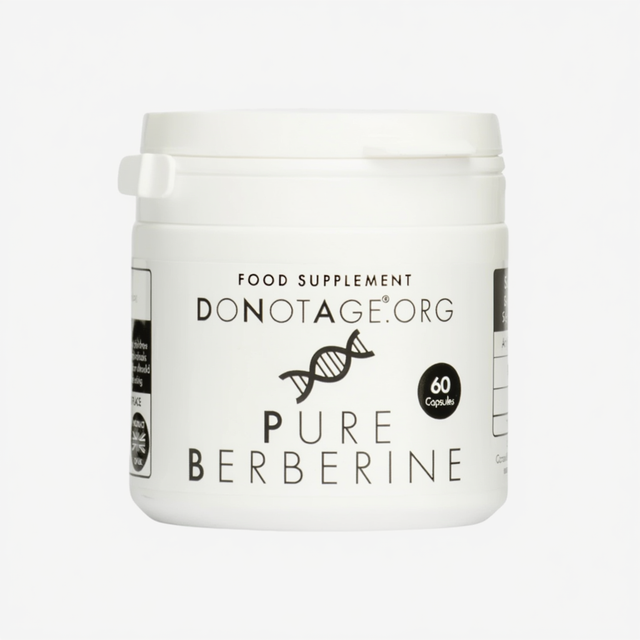
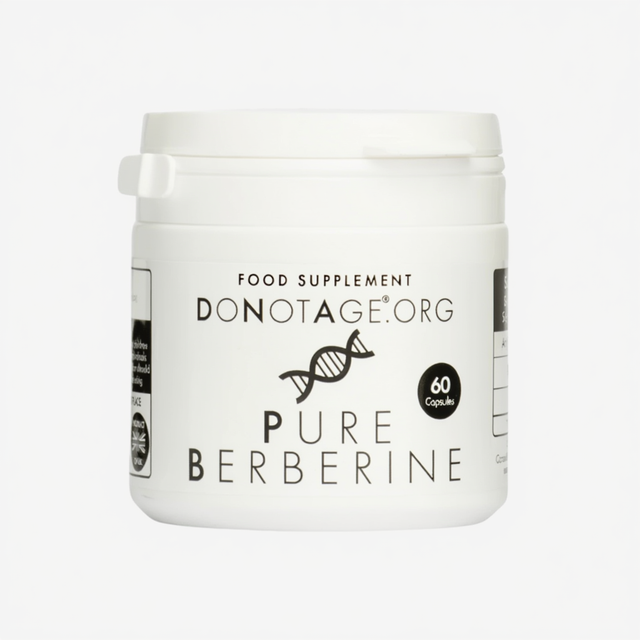
For readers considering a conventional product after that assessment, our DoNotAge Berberine review explains its current label and manufacturer information. Biohack Blueprint may earn commission from qualifying purchases. The recommendation does not imply proven human lifespan extension.
The Berberine Data Center keeps the cells, animals, pharmacokinetics and human outcomes distinguishable. That separation allows genuine scientific interest without turning every promising mechanism into a finished longevity claim.
Frequently asked questions
Does berberine extend lifespan?
Is berberine an AMPK activator?
Is berberine a human senolytic?
What is the best berberine longevity dose?
Does combining berberine with resveratrol or quercetin improve longevity?
Sources & article history
Sources (9)
-
Berberine ameliorates cellular senescence and extends the lifespan of mice via regulating p16 and cyclin protein expression Aging cell. 2020;19(1):e13060.
-
Berberine Extends Lifespan in C. elegans Through Multi-Target Synergistic Antioxidant Effects Antioxidants (Basel, Switzerland). 2025;14(4):450.
-
Berberine and its more biologically available derivative, dihydroberberine, inhibit mitochondrial respiratory complex I: a mechanism for the action of berberine to activate AMP-activated protein kinase and improve insulin action Diabetes. 2008;57(5):1414-1418.
-
Activation of AMPK by berberine induces hepatic lipid accumulation by upregulation of fatty acid translocase CD36 in mice Toxicology and applied pharmacology. 2017;316:74-82.
-
Treatment of type 2 diabetes and dyslipidemia with the natural plant alkaloid berberine The Journal of clinical endocrinology and metabolism. 2008;93(7):2559-2565.
-
Sex-Specific Lipid, Apolipoprotein B, and Lipoprotein(a) Responses to Berberine Based on 2 Randomized Placebo-Controlled Trials JACC. Asia. 2026;6(10 Pt 1):2204-2216.
-
Berberine and Adiposity in Diabetes-Free Individuals With Obesity and MASLD: A Randomized Clinical Trial JAMA network open. 2026;9(1):e2554152.
-
Repeated administration of berberine inhibits cytochromes P450 in humans European journal of clinical pharmacology. 2012;68(2):213-217.
-
Absorption Kinetics of Berberine and Dihydroberberine and Their Impact on Glycemia: A Randomized, Controlled, Crossover Pilot Trial Nutrients. 2021;14(1):124.
Article history (1)
- Published with current study results, formulation distinctions, safety information and linked original sources.