
Apigenin vs Melatonin: Which Is Better for Sleep?
Apigenin vs melatonin for sleep: mechanisms, evidence, timing, grogginess, vivid dreams, circadian use, stacking and how to choose based on the actual sleep problem.
 By
Dr. Khaled Mahmoud, MBBCh
Critical Care Medicine, Longevity Science & Editorial Direction
 Reviewed by
Dr. Amr Yasser, PhD
Cardiometabolic, Musculoskeletal, Gut & Bioavailability
 Reviewed by
Dr. Abdulla Mostafa, PhD
Cellular Senescence, Neurological, Mitochondrial & Brain-Ageing Biology
- Published
- Last reviewed
- Reading time
- 10 min
- Sources cited
- 7
On this page
Apigenin and melatonin are not interchangeable sleep supplements. Melatonin is a hormone and circadian signal with much stronger human evidence for jet lag and circadian-timing problems. Apigenin is a flavone studied for GABA-related relaxation, chamomile-associated sleep effects and broader longevity biology. If the problem is a shifted body clock, melatonin has the clearer rationale. If the goal is exploring a non-melatonin relaxation pathway, apigenin is the more relevant compound.
Apigenin vs melatonin: quick comparison
| Question | Apigenin | Melatonin |
|---|---|---|
| What is it? | Plant flavone | Endogenous hormone |
| Main sleep rationale | GABA-related relaxation and sedative signaling | Circadian timing and sleep-onset signaling |
| Direct human sleep evidence | Limited for isolated apigenin | Much larger evidence base |
| Jet lag/circadian use | Not established | Strongest use case |
| Popular dose | 50 mg in common sleep protocols | Often much lower than many retail mega-dose products; dose depends on goal |
| Longevity research | CD38/NAD+ and senescence pathways | Different biological literature |
| Hormone? | No | Yes |
How melatonin works
Melatonin is produced by the pineal gland in response to darkness and helps communicate biological night to the body. Supplemental melatonin can shift circadian timing, which is why it is especially relevant for jet lag, delayed sleep timing and other circadian problems.
It is often marketed as a generic sedative, but thinking of it as a timing signal is more accurate.
How apigenin works
Apigenin has experimental activity across benzodiazepine/GABA-related pathways and produces sedative or anxiolytic-like effects in animal models. It is also researched for CD38 inhibition, NAD+ biology, inflammation and cellular senescence.
That broader biology makes apigenin attractive to longevity-oriented users, but it does not give it melatonin’s direct circadian evidence.

Which is better for falling asleep?
It depends on why sleep onset is difficult.
- Jet lag, delayed schedule or circadian misalignment: melatonin has the clearer evidence-based role.
- Bedtime rumination or a desire for a non-melatonin relaxation supplement: apigenin has a plausible rationale but less direct clinical evidence.
- Chronic insomnia: neither supplement should replace evaluation of causes or cognitive behavioral therapy for insomnia when indicated.
Which is better for staying asleep?
Apigenin has not been proven in isolated human trials to reliably increase total sleep time or reduce awakenings. Melatonin’s impact on sleep maintenance is also not universally dramatic and depends on formulation and condition. Claims that either supplement guarantees “deep sleep” should be treated cautiously.
Which causes more morning grogginess?
Both can cause unwanted next-day effects in susceptible users, but high-dose melatonin is especially notorious for being used at doses far above what many people need for circadian signaling. Apigenin can also be sedating, particularly in combination with other sleep agents.
The useful principle is not “natural equals no grogginess”; it is to use the lowest complexity needed for the goal and test one variable at a time.
What about vivid dreams?
Melatonin is commonly associated with vivid dreams in user reports. In popular apigenin stacks, vivid dreams are often attributed to L-theanine rather than apigenin itself. For either supplement, individual experience matters more than internet certainty.
Is apigenin safer because it is not a hormone?
Not automatically. Apigenin being a flavone does not eliminate medication interactions or dose-related uncertainty. It has laboratory interaction signals involving drug-metabolizing enzymes and transporters, and high-dose long-term isolated-apigenin safety data are limited.
See Apigenin Side Effects & Drug Interactions.
Can you take apigenin and melatonin together?
People do combine them, but a combination is not automatically more effective. If you start both at the same time and sleep improves—or worsens—you will not know which ingredient was responsible. Additive drowsiness is also possible.
A more rational self-testing strategy is to establish the goal, try one change at a time, and only stack ingredients when there is a reason.
Apigenin dosage vs melatonin dosage
They are chemically incomparable by milligrams. Fifty milligrams of apigenin is not “50 times stronger” than 1 mg melatonin; molecular potency and mechanism are completely different.
For apigenin, 50 mg is the widely discussed bedtime protocol. High-strength products range to 200–250 mg per capsule. Read Apigenin Dosage.
What Andrew Huberman uses
Andrew Huberman has repeatedly discussed 50 mg apigenin as part of an evening sleep stack with magnesium and L-theanine, typically around 30–60 minutes before bed. That protocol is one reason search interest in apigenin exploded.
It is a personal protocol, not a clinical guideline. A 2026 placebo-controlled human trial tested a similar three-ingredient stack and did not find a clear sleep advantage over placebo in healthy adults over two weeks.
Read Apigenin Sleep Stack.
Which is better for longevity-focused users?
Apigenin has the more direct longevity-mechanism story because of CD38 inhibition, NAD+ preservation in experimental models and senescence-related research. That is distinct from proving human lifespan extension.
If longevity biology is the reason you are considering apigenin, see Apigenin, CD38 & NAD+.

Our practical decision tree
- Is the main issue jet lag or circadian timing? Melatonin is the more evidence-aligned tool.
- Is the goal a non-melatonin relaxation experiment? Apigenin may be more relevant.
- Is chronic insomnia the problem? Look beyond supplements and evaluate the sleep disorder itself.
- Already taking sedatives or multiple sleep agents? Review the combination with a clinician or pharmacist.
- Interested in apigenin for CD38/NAD+ rather than sleep? This comparison becomes less relevant; melatonin is not an equivalent substitute.
Best apigenin product if you choose apigenin
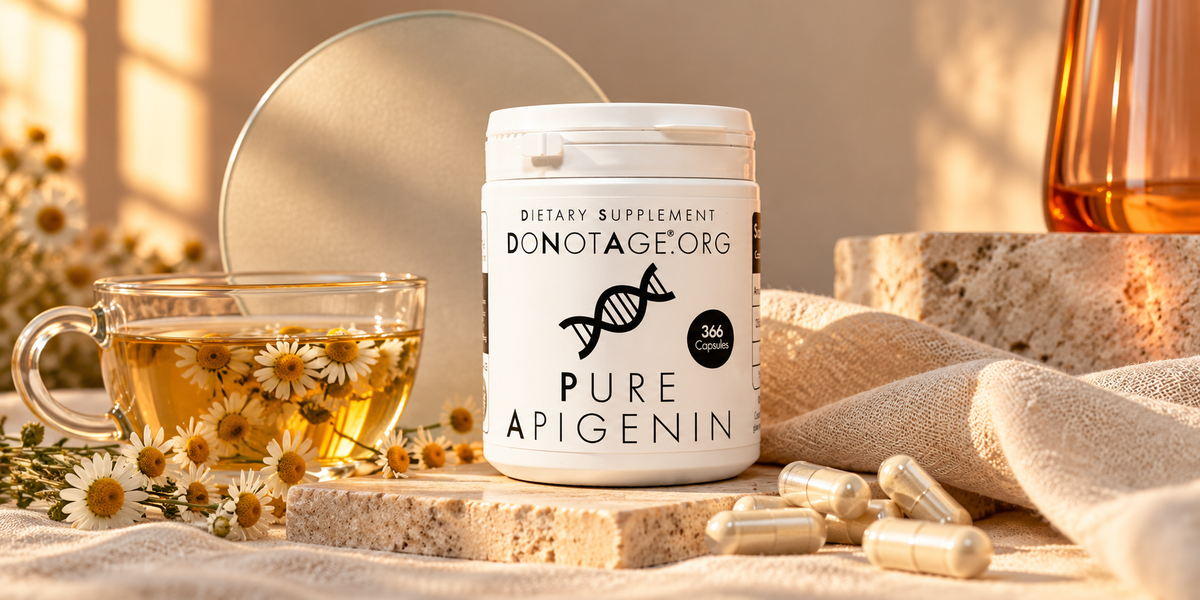
Our #1 overall choice is DoNotAge Pure Apigenin, which earns a 5/5 formula rating for its 250 mg single-ingredient capsule, stated >99% batch-purity threshold, no listed fillers beyond the capsule, batch testing, disclosed sourcing and GMP/ISO9001 manufacturing.
Read our DoNotAge Pure Apigenin Review. Biohack Blueprint may earn a commission from qualifying purchases at no extra cost to you.
Bottom line
Melatonin wins on direct circadian evidence; apigenin wins on being a distinct non-hormonal flavone with relaxation and longevity research. The better choice depends on the problem you are trying to solve, not which supplement sounds more natural.
For the full apigenin sleep evidence, see Apigenin for Sleep and our Apigenin Research Data Center.
Sources & article history
Sources (7)
-
Enhancement of pentobarbital-induced sleep by apigenin through chloride ion channel activation Archives of Pharmacal Research. 2012;35(2):367-373.
-
Apigenin, a component of Matricaria recutita flowers, is a central benzodiazepine receptors-ligand with anxiolytic effects Planta Medica. 1995;61(3):213-216.
-
Pharmacological profile of apigenin, a flavonoid isolated from Matricaria chamomilla Biochemical Pharmacology. 2000;59(11):1387-1394.
-
Flavonoid modulation of ionic currents mediated by GABA(A) and GABA(C) receptors European Journal of Pharmacology. 2003;461(2-3):79-87.
-
Specific Dietary (Poly)phenols Are Associated with Sleep Quality in a Cohort of Italian Adults Nutrients. 2020;12(5):1226.
-
Modulating stress and sleep through a multi-compound dietary supplement: a randomized, double-blind, placebo-controlled trial Journal of the International Society of Sports Nutrition. 2026;23(1):2740227.
-
Apigenin: a natural molecule at the intersection of sleep and aging Frontiers in Nutrition. 2024;11:1359176.


