
Apigenin, CD38 & NAD+: What It Could Mean for Longevity
A deep 2026 analysis of apigenin, CD38 and NAD+: the Escande study, senescence, NMN combinations, human evidence gaps, longevity claims and what a decisive clinical trial would need.
 By
Dr. Khaled Mahmoud, MBBCh
Critical Care Medicine, Longevity Science & Editorial Direction
 Reviewed by
Dr. Amr Yasser, PhD
Cardiometabolic, Musculoskeletal, Gut & Bioavailability
 Reviewed by
Dr. Abdulla Mostafa, PhD
Cellular Senescence, Neurological, Mitochondrial & Brain-Ageing Biology
- Published
- Last reviewed
- Reading time
- 12 min
- Sources cited
- 7
On this page
Apigenin is one of the most interesting natural compounds in CD38/NAD+ research because it inhibits the NAD+-consuming enzyme CD38 in experimental systems. The landmark 2013 study showed that apigenin increased NAD+ in mice and improved metabolic outcomes in a diet-induced obesity model. Newer work has connected CD38 biology with cellular senescence, neuroinflammation and tissue regeneration.
The headline needs one crucial qualifier: we still do not have a human trial showing that oral apigenin meaningfully inhibits CD38 and raises NAD+ in people. The mechanism is compelling; the clinical translation is unfinished.
Apigenin, CD38 and NAD+: the pathway in one table
| Step | What happens | Evidence |
|---|---|---|
| 1. CD38 consumes NAD+ | CD38 acts as an NADase and participates in calcium/immune signaling | Established biology |
| 2. CD38 activity rises in aging contexts | Age-related inflammation and immune-cell changes can increase NAD+ consumption | Strong preclinical/biological evidence |
| 3. Apigenin inhibits CD38 | Experimental studies demonstrate direct CD38 inhibition | Cells/biochemical systems |
| 4. NAD+ can rise downstream | Apigenin increased NAD+ in mouse models | Animal evidence |
| 5. Does oral apigenin raise human NAD+? | Not yet established | Human evidence gap |
What is CD38?
CD38 is a multifunctional enzyme expressed on several immune and other cell types. One of its important actions is consuming NAD+ to generate signaling molecules including ADP-ribose and cyclic ADP-ribose. Because NAD+ is central to metabolism, redox reactions, sirtuin activity and cellular repair biology, increased NAD+ consumption is a major longevity research target.
Why NAD+ declines with age
NAD+ decline is not caused by a single pathway. Reduced synthesis, increased DNA-damage responses, inflammatory signaling and NAD+-consuming enzymes all contribute. CD38 became especially interesting because age-associated immune changes can increase its activity and therefore accelerate NAD+ consumption.
This creates two broad longevity strategies:
- Increase supply: provide NAD+ precursors such as NMN or NR.
- Reduce consumption: target enzymes that break NAD+ down, including CD38.
The landmark Escande 2013 apigenin study
Escande and colleagues identified apigenin and quercetin as flavonoid inhibitors of CD38. In mice, apigenin increased NAD+ and altered protein acetylation consistent with downstream sirtuin biology. In a high-fat-diet obesity model, it also improved glucose homeostasis and reduced liver lipid accumulation.
This study is the foundation of the modern “apigenin preserves NAD+” narrative. It is strong mechanistic evidence, but it is still not a human oral-supplement trial.

Apigenin, cellular senescence and the SASP
Senescent cells can contribute to chronic inflammatory signaling through the senescence-associated secretory phenotype (SASP). Research has linked CD38 expression and NAD+ consumption with senescence-associated immune changes, while apigenin has been studied as a senomorphic compound capable of modulating aspects of senescence-related signaling.
That is different from calling apigenin a classic senolytic. A senolytic aims to kill senescent cells; a senomorphic aims to modify their harmful phenotype or signaling.
For a direct comparison, see Fisetin vs Apigenin.
Apigenin and neuroinflammation
Later experimental work examined CD38 in neuroinflammatory models and found apigenin-related modulation of CD38/NAD+ biology. This expands the mechanism beyond metabolism and shows why CD38 is relevant to immune and nervous-system research.
Not every apigenin effect is caused by CD38
This is an important scientific correction. A 2025 study of inflammasome biology reported apigenin effects that were not dependent on CD38. Apigenin is a pleiotropic flavone; it also interacts with inflammatory, redox and kinase pathways.
So “apigenin = CD38 inhibitor” is useful but incomplete.
The 2026 NMN + apigenin regeneration study
A 2026 Aging Cell paper used a “double-pronged NAD preservation” concept combining NMN with apigenin in musculoskeletal-aging/regeneration models. The logic was elegant: increase NAD+ supply with a precursor while reducing consumption with a CD38 inhibitor.
The experimental results add momentum to the pathway, but the regimen remains preclinical. It should not be marketed as a proven human anti-aging stack.
Apigenin vs NMN or NR
They target different sides of NAD+ metabolism. NMN and NR are precursor strategies. Apigenin is primarily discussed as a consumption-side strategy through CD38 inhibition.
That means they are not substitutes in a simple “which raises NAD+ more?” contest. A future human trial could test them separately and together with direct NAD+ and CD38 target-engagement measurements.
Apigenin vs quercetin for CD38
Both apigenin and quercetin inhibited CD38 in the landmark experimental work. They also have different pharmacology, metabolism and broader research profiles. There is no robust human trial proving one is the superior oral CD38 inhibitor for raising NAD+.
Does apigenin increase NAD+ in humans?
Not proven yet. Human studies confirm that apigenin and its metabolites reach the human system after isolated, parsley and chamomile exposure. But no completed clinical trial has established a reproducible rise in human NAD+ attributable to clinically meaningful CD38 inhibition after oral apigenin supplementation.
This is the single most important evidence gap for the longevity claim.

What human trial would settle the question?
An ideal study would measure:
- Baseline and post-supplement NAD+ in relevant blood/tissue compartments.
- CD38 activity or direct target engagement.
- Apigenin/metabolite pharmacokinetics.
- Multiple doses to establish dose-response.
- Placebo control and adequate duration.
- Clinical or validated functional outcomes beyond biomarkers.
Does apigenin extend lifespan?
Animal and C. elegans longevity models are interesting, but human lifespan extension has not been demonstrated. Longevity should not be reduced to one biomarker or pathway.
What dose is used for CD38?
There is no validated human CD38-inhibition dose. Animal doses and cell concentrations should not be directly converted into a consumer capsule recommendation. High-strength products exist because users may want a dedicated apigenin regimen, not because 250 or 500 mg has been proven to produce a specific degree of human CD38 inhibition.
See Apigenin Dosage.
Our preferred high-strength apigenin formula
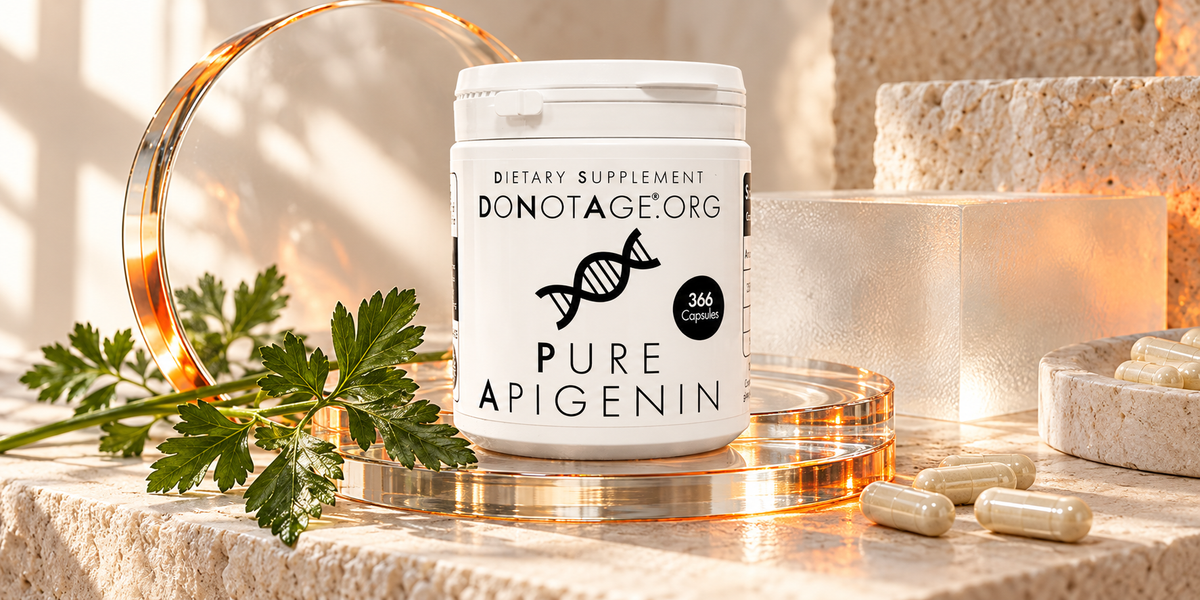
For readers interested in apigenin as a dedicated longevity compound, we rank DoNotAge Pure Apigenin #1 overall. It provides 250 mg per capsule, a stated >99% batch-purity release threshold, no listed fillers beyond the vegetable cellulose capsule, batch testing, disclosed sourcing and GMP/ISO9001 manufacturing.
Our product rating is based on formula and quality—not on pretending the finished product has already proven human NAD+ elevation. Read the 5/5 DoNotAge Pure Apigenin Review. Biohack Blueprint may earn a commission from qualifying purchases at no extra cost to you.
Bottom line
Apigenin’s CD38 story is one of the strongest mechanistic reasons to take the molecule seriously in longevity research. The sequence is coherent: CD38 consumes NAD+; apigenin inhibits CD38 experimentally; NAD+ rises in animal models; downstream metabolic and senescence-related biology changes. The missing bridge is direct human target engagement.
Explore every paper behind that pathway in our Apigenin Research Data Center.
Sources & article history
Sources (7)
-
Flavonoid apigenin is an inhibitor of the NAD+ ase CD38: implications for cellular NAD+ metabolism, protein acetylation, and treatment of metabolic syndrome Diabetes. 2013;62(4):1084-93.
-
Inhibition of CD38 and supplementation of nicotinamide riboside ameliorate lipopolysaccharide-induced microglial and astrocytic neuroinflammation by increasing NAD+ Journal of Neurochemistry. 2021;158(2):311-327.
-
Apigenin Alleviates Oxidative Stress-Induced Cellular Senescence via Modulation of the SIRT1-NAD+-CD38 Axis American Journal of Chinese Medicine. 2021;49(5):1235-1250.
-
Apigenin inhibits NLRP3 inflammasome activation in monocytes and macrophages independently of CD38 Frontiers in Immunology. 2025;15:1497984.
-
Targeting Senescence with Apigenin Improves Chemotherapeutic Efficacy and Ameliorates Age-Related Conditions in Mice Advanced Science. 2025;12(20):e2412950.
-
Double-Pronged NAD Preservation: Delaying Cellular Senescence and Initiating Musculoskeletal Regeneration Aging Cell. 2026;25(4):e70468.
-
Apigenin enhancing oxidative resistance and proteostasis to extend lifespan via PTEN-mediated AKT signalling pathway BBA - Molecular Basis of Disease. 2025;1871(3):167670.


