
Apigenin for Anxiety and Relaxation: What Does the Evidence Show?
Does apigenin help anxiety? A 2026 evidence review of GABA mechanisms, chamomile trials, preclinical systematic-review data, dose, timing, medications and relaxation stacks.
 By
Dr. Khaled Mahmoud, MBBCh
Critical Care Medicine, Longevity Science & Editorial Direction
 Reviewed by
Dr. Amr Yasser, PhD
Cardiometabolic, Musculoskeletal, Gut & Bioavailability
 Reviewed by
Dr. Abdulla Mostafa, PhD
Cellular Senescence, Neurological, Mitochondrial & Brain-Ageing Biology
- Published
- Last reviewed
- Reading time
- 11 min
- Sources cited
- 8
On this page
Apigenin has a credible anxiety and relaxation mechanism, but the direct human evidence for isolated apigenin is still thin. Animal studies repeatedly show anxiolytic-like effects, a 2026 systematic review found a consistent preclinical signal, and human randomized trials of chamomile extract provide supportive botanical evidence. The missing step is a well-designed clinical trial of purified apigenin by itself.
That distinction matters because search results often say “apigenin reduces anxiety” as if a chamomile trial and an isolated-apigenin capsule were the same intervention. They are not.
Apigenin for anxiety: quick answers
| Question | Answer |
|---|---|
| Does apigenin reduce anxiety? | Preclinical evidence is promising; direct isolated-apigenin human treatment evidence is insufficient. |
| How might it work? | GABA/benzodiazepine-related signaling is one leading mechanism, alongside anti-inflammatory and neurobiological pathways. |
| What human evidence exists? | Mostly chamomile-extract trials rather than purified apigenin trials. |
| What dose is used? | 50 mg is commonly discussed for evening relaxation/sleep, but no anxiety-specific human dose has been validated. |
| When should you take it? | Evening use is common when relaxation or sleep is the goal; there is no proven anxiety-treatment timing schedule. |
| Can it replace anxiety medication? | No. It should not replace prescribed treatment or psychotherapy. |
Why apigenin is linked to anxiety
The strongest mechanistic story involves inhibitory neurotransmission. Apigenin has been studied for interaction with benzodiazepine-sensitive/GABA-related pathways, which are directly relevant to neuronal excitability, relaxation and anxiety-like behavior.
This does not make apigenin a “natural benzodiazepine.” The phrase is pharmacologically sloppy. A compound can interact with overlapping pathways without matching the potency, clinical effects, dependence potential or evidence base of a prescription benzodiazepine.
What the 2026 systematic review found
A 2026 systematic review of preclinical anxiety- and depression-related studies identified 21 rodent studies and found a recurring anxiolytic/antidepressant-like signal across multiple models. That breadth strengthens biological plausibility.
But a systematic review of animal studies is still a systematic review of animal studies. It cannot tell us how many humans with generalized anxiety disorder would respond to 50 mg, 100 mg or 250 mg of oral apigenin.
Human evidence: chamomile is important, but it is not purified apigenin
Chamomile-extract randomized trials are the main human evidence often cited in support of apigenin and anxiety. Studies in generalized anxiety disorder have reported clinically interesting outcomes, including longer-term follow-up work.
Chamomile contains apigenin, but it also contains many other compounds. So the correct conclusion is:
Chamomile provides human evidence that an apigenin-containing botanical can influence anxiety outcomes; it does not prove that isolated apigenin produces the same effect.
For the botanical details, see Apigenin in Chamomile.

Does apigenin work through GABA?
GABA is the brain’s major inhibitory neurotransmitter. Experimental research suggests apigenin can influence GABA-related signaling and benzodiazepine-sensitive receptors. That provides a coherent explanation for calming and sedative effects in animal models.
What remains unknown is how oral supplement doses translate into receptor-level effects in humans, especially because apigenin is extensively metabolized after absorption.
Does apigenin cross the blood-brain barrier?
Central nervous system effects in animal models suggest biologically relevant brain exposure or signaling. However, precise human brain concentrations after routine oral supplementation are not established. “Crosses the blood-brain barrier” should not be treated as proof of clinical anxiolytic efficacy.
How fast does apigenin work for anxiety?
There is no validated human onset time for isolated apigenin as an anxiety treatment. Some people report same-evening relaxation, but anecdotal onset should not be converted into a clinical promise.
Human pharmacokinetic studies also show that absorption timing depends on form: isolated apigenin, parsley glycosides and chamomile tea do not produce identical metabolite curves.
Apigenin dosage for anxiety
No anxiety-specific dose has been established in human trials. Fifty milligrams is commonly discussed because of sleep and relaxation protocols, while high-strength supplements range to 200–250 mg per capsule.
If you are evaluating apigenin for relaxation rather than a diagnosed anxiety disorder, dose should be interpreted through the same framework as the rest of the cluster: goal, product strength, medications, tolerance and evidence source.
See Apigenin Dosage.
Daytime vs bedtime apigenin
Evening use is popular because relaxation and drowsiness can be useful near bedtime. Daytime use is possible, but anyone who feels sedated should avoid driving or work that requires full alertness.
If sleep is the main reason you are considering it, our dedicated guide is Apigenin for Sleep.
Apigenin vs L-theanine for anxiety
Both are used for relaxation, but their evidence bases and mechanisms differ. L-theanine has its own human stress/attention literature, while apigenin has stronger flavone/GABA/preclinical longevity biology. There is no high-quality head-to-head trial proving one is better for anxiety.
Apigenin vs benzodiazepines
They should not be treated as equivalent. Benzodiazepines are prescription drugs with established clinical anxiolytic and sedative effects, known tolerance/dependence risks and specific dosing. Apigenin is a dietary flavone with far less direct human anxiety evidence.
Do not stop benzodiazepines abruptly or substitute apigenin without medical guidance.
Apigenin vs SSRIs
SSRIs have a much larger clinical evidence base for anxiety disorders and are used within established treatment frameworks. Apigenin has not demonstrated comparable efficacy in controlled human trials. It may be of interest as a supplement, but that is a different category from evidence-based psychiatric treatment.
Can apigenin make anxiety worse?
Paradoxical anxiety is discussed anecdotally. It is not a well-characterized common adverse effect in isolated-apigenin clinical research. If anxiety, agitation, palpitations or insomnia clearly begin after starting a supplement, stop and reassess rather than assuming the dose is too low.
See Apigenin Side Effects & Drug Interactions.

Can you combine apigenin with magnesium or L-theanine?
That combination is popular in sleep stacks. A 2026 placebo-controlled trial tested magnesium L-threonate, 200 mg L-theanine and 50 mg apigenin together in healthy adults and did not show a clear sleep advantage over placebo over two weeks. The trial was about a combination and sleep—not anxiety treatment—but it is a useful reminder that popular stacks still need testing.
Read Apigenin Sleep Stack.
Best apigenin supplement for relaxation-focused users
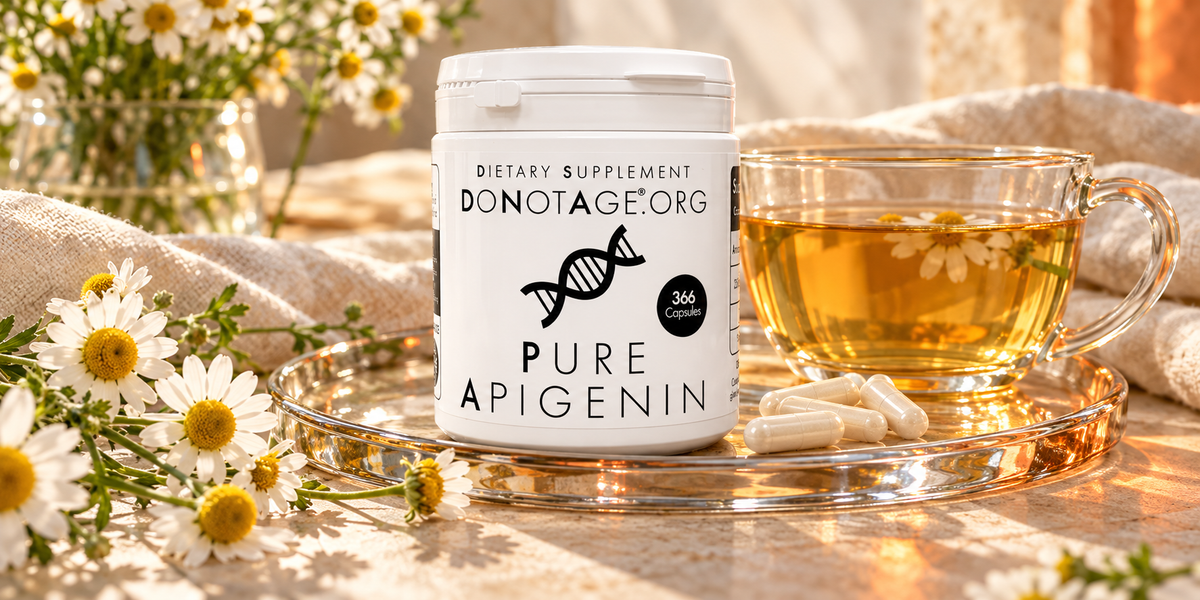
Our #1 overall apigenin supplement is DoNotAge Pure Apigenin, which earns a 5/5 formula rating for its 250 mg single-ingredient capsule, stated >99% batch-purity threshold, no listed fillers beyond the vegetable cellulose capsule, batch testing, disclosed sourcing and GMP/ISO9001 manufacturing.
This is a high-strength format rather than a 50 mg-only bedtime product. Read the DoNotAge Pure Apigenin Review and our Best Apigenin Supplements comparison. Biohack Blueprint may earn a commission from qualifying DoNotAge purchases at no extra cost to you.
Bottom line
Apigenin has a legitimate anxiety-research story: a coherent GABA-related mechanism, a broad preclinical signal and supportive human chamomile data. What it does not yet have is a definitive isolated-apigenin clinical anxiety trial. That makes it promising, not proven.
Inspect the supporting studies in our Apigenin Research Data Center.
Sources & article history
Sources (8)
-
Apigenin for Depression and Anxiety: A Systematic Review of Preclinical Studies Iranian Journal of Pharmaceutical Research. 2026;25(1):e167153.
-
Apigenin, a component of Matricaria recutita flowers, is a central benzodiazepine receptors-ligand with anxiolytic effects Planta Medica. 1995;61(3):213-216.
-
Pharmacological profile of apigenin, a flavonoid isolated from Matricaria chamomilla Biochemical Pharmacology. 2000;59(11):1387-1394.
-
Behavioral characterisation of the flavonoids apigenin and chrysin Fitoterapia. 2000;71 Suppl 1:S117-S123.
-
Flavonoid modulation of ionic currents mediated by GABA(A) and GABA(C) receptors European Journal of Pharmacology. 2003;461(2-3):79-87.
-
A randomized, double-blind, placebo-controlled trial of oral Matricaria recutita (chamomile) extract therapy for generalized anxiety disorder Journal of Clinical Psychopharmacology. 2009;29(4):378-382.
-
Long-term chamomile (Matricaria chamomilla L.) treatment for generalized anxiety disorder: A randomized clinical trial Phytomedicine. 2016;23(14):1735-1742.
-
Therapeutic efficacy and safety of chamomile for state anxiety, generalized anxiety disorder, insomnia, and sleep quality: A systematic review and meta-analysis of randomized trials and quasi-randomized trials Phytotherapy Research. 2019;33(6):1604-1615.


