
What Is SIRT6? Function, Aging, DNA Repair & Human Evidence
SIRT6 is an NAD+-dependent nuclear enzyme involved in DNA repair, chromatin, metabolism and aging. Mouse studies show lifespan effects; human studies now include aging biomarkers, frailty associations and direct SIRT6-activator trials, but no proven anti-aging benefit.
 By
Dr. Khaled Mahmoud, MBBCh
Critical Care Medicine, Longevity Science & Editorial Direction
By
Dr. Khaled Mahmoud, MBBCh
Critical Care Medicine, Longevity Science & Editorial Direction
 Reviewed by
Dr. Amr Yasser, PhD
Cardiometabolic, Musculoskeletal, Gut & Bioavailability
Reviewed by
Dr. Amr Yasser, PhD
Cardiometabolic, Musculoskeletal, Gut & Bioavailability
 Reviewed by
Dr. Abdulla Mostafa, PhD
Cellular Senescence, Neurological, Mitochondrial & Brain-Ageing Biology
Reviewed by
Dr. Abdulla Mostafa, PhD
Cellular Senescence, Neurological, Mitochondrial & Brain-Ageing Biology
- Published
- Last reviewed
- Reading time
- 14 min
- Sources cited
- 19
On this page
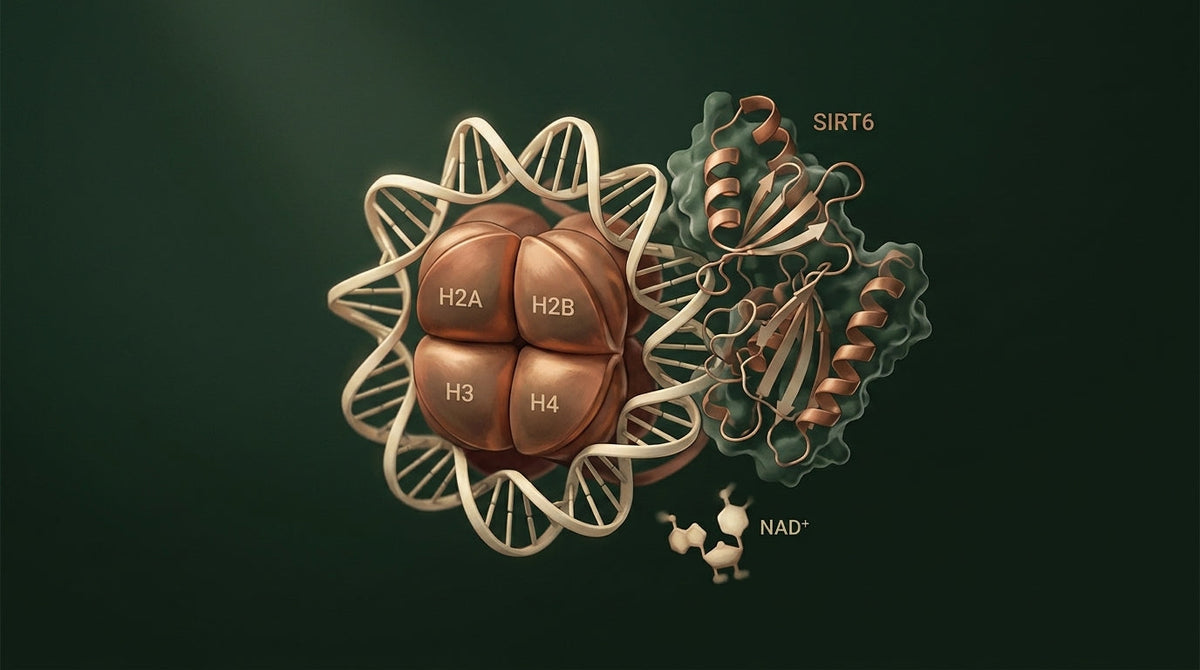
SIRT6 (sirtuin 6) is a nuclear NAD+-dependent enzyme that helps cells maintain chromatin, repair DNA, regulate metabolism and control stress-responsive gene expression. It is one of seven mammalian sirtuins, but it is unusually tied to genome maintenance: mice lacking SIRT6 develop severe metabolic and genomic-instability phenotypes, while increasing SIRT6 can extend lifespan in several mouse models.
The important 2026 distinction is that SIRT6 is a compelling aging-biology target, not a proven human anti-aging treatment. Human studies link SIRT6 with age, frailty and rare longevity-associated genetics, and direct SIRT6 activators have now entered human trials, but no study has shown that raising SIRT6 extends human lifespan.
| Question | Current answer |
|---|---|
| What is SIRT6? | A predominantly nuclear sirtuin enzyme encoded by the SIRT6 gene on chromosome 19p13.3. |
| What powers it? | NAD+ is a required co-substrate. |
| What does it do enzymatically? | Deacetylation, long-chain deacylation and mono-ADP-ribosylation. |
| What biology is most established? | DNA repair, chromatin/telomere regulation, metabolism and stress-response signaling. |
| Does it extend lifespan? | Genetic SIRT6 overexpression extends lifespan in mice; human lifespan extension is unproven. |
| Can it be drugged? | Yes. Natural and synthetic activators exist, and forvisirvat/SP-624 has human Phase 1/2 data. |
What kind of protein is SIRT6?
SIRT6 belongs to the sirtuin family, SIRT1 through SIRT7. All sirtuins use NAD+, but they occupy different cellular compartments and prefer different substrates. SIRT6 is strongly associated with chromatin and damaged DNA, which is why its literature is dominated by genome stability, DNA repair and transcriptional control rather than by a single metabolic pathway.
The original knockout study showed how fundamental this biology is: SIRT6-deficient mice developed genomic instability, metabolic abnormalities and an accelerated aging-like phenotype [1].
For the detailed protein fold, catalytic pocket and structural pharmacology, see SIRT6 mechanism and structure.
What are SIRT6's three catalytic activities?
Deacetylation
SIRT6 removes acetyl groups from histone and non-histone proteins. Well-studied chromatin targets include H3K9ac and H3K56ac. These reactions help regulate chromatin accessibility, gene expression, telomeres and DNA-damage responses.
Long-chain deacylation
SIRT6 is also an efficient long-chain deacylase. Biochemical work showed that fatty-acyl substrates can be preferred over simple acetyl-lysine peptides and that free long-chain fatty acids can alter SIRT6 catalytic behavior [2].
Mono-ADP-ribosylation
SIRT6 can transfer ADP-ribose from NAD+ to protein targets. PARP1 is the classic example: SIRT6-dependent PARP1 activation supports DNA repair under stress [3].
NAD+ is the co-substrate for SIRT6 chemistry; it is not a separate SIRT6 function. Raising NAD+ can support many NAD+-dependent enzymes and should not be described as selective SIRT6 activation.
Why is SIRT6 important for DNA repair?
Genome maintenance is the strongest mechanistic part of the SIRT6 story. SIRT6 is recruited rapidly to double-strand breaks and can function as an early DNA-damage sensor [4]. It helps organize repair proteins, supports PARP1 signaling and participates in both homologous recombination and non-homologous end joining.
SIRT6 also contributes to telomere stability and retrotransposon repression. At telomeres, SIRT6 deacetylates H3K9 and helps preserve chromatin structure [5]. Elsewhere in the genome, SIRT6 helps silence LINE1 retrotransposons, connecting chromatin failure with age-related innate immune activation.
See SIRT6 and DNA repair and SIRT6, LINE1 and inflammation for those mechanisms in depth.
How does SIRT6 affect metabolism?
SIRT6 is not only a DNA-repair enzyme. It regulates metabolic gene programs, including HIF-1α-dependent glycolysis. Loss of SIRT6 increases glucose uptake and glycolysis and reduces mitochondrial respiration in experimental systems [6].
In skeletal muscle, SIRT6 also interacts with AMPK-linked energy sensing and oxidative muscle programming. In the liver, SIRT6 influences lipogenesis and nutrient-response pathways. These are strong mechanistic and animal findings; they are not evidence that a SIRT6 supplement treats diabetes or fatty liver in people.
For disease-focused evidence, see SIRT6, metabolism and diabetes and SIRT6, muscle and exercise.
How does SIRT6 affect inflammation?
A classic model is NF-κB regulation: SIRT6 can deacetylate chromatin at a subset of NF-κB-responsive genes and restrain inflammatory transcription [7]. LINE1 repression provides another route by which SIRT6 can limit sterile inflammatory signaling.
But this is now clearly context-dependent. A 2026 asthma study found that macrophage SIRT6 promoted allergic inflammation through ATG3 deacetylation and autophagy; myeloid SIRT6 deletion or pharmacological inhibition reduced inflammation [8]. By contrast, a 2026 pulmonary-hypertension study found that SIRT6 activation suppressed LINE1-cGAS-STING signaling and cellular senescence [9].
That is a recurring theme across SIRT6 biology: the enzyme is not a universal “anti-inflammatory switch.” Cell type and disease context matter.
What is the evidence that SIRT6 matters for longevity?
Mouse genetics provide the strongest causal lifespan evidence. In 2012, SIRT6-overexpressing male mice lived longer, with median lifespan increases of 14.5% and 9.9% in two transgenic lines [10]. In 2021, another model reported median lifespan extension of 27% in males and 15% in females, together with improved frailty and energy homeostasis [11].
Comparative biology strengthens the connection. SIRT6 from longer-lived rodent species supports more efficient double-strand-break repair, and a 2026 study found that long-lived mammals carry and use more phosphorylation sites in the SIRT6 C-terminal region; greater phosphorylation strengthened PARP1 interaction and oxidative-stress resistance [12].
These findings make SIRT6 unusually interesting for geroscience. They do not establish that pharmacologically raising SIRT6 will reproduce genetic lifespan extension in humans.
See SIRT6 longevity research for the full lifespan evidence.
What do human studies show?
Human evidence is supportive but much weaker than mouse causality. Serum SIRT6 was lower with older age in a 155-person cross-sectional study [13], and lower serum SIRT6 was associated with frailty in 540 older adults [14]. Rare centenarian genetics also identified a SIRT6 variant with enhanced genome-stability functions in laboratory testing [15].
None of these studies shows that treating a person with low SIRT6 reverses aging. Serum SIRT6 is not an established clinical aging test.
Have direct SIRT6 activators reached humans?
Yes. The synthetic activator SP-624/forvisirvat has published Phase 1 safety/pharmacokinetic data and a 319-person randomized Phase 2 trial in major depressive disorder [16] [17]. The Phase 2 study did not significantly beat placebo on its prespecified primary endpoint overall.
That proves direct pharmacological SIRT6 activation has entered human clinical development. It does not prove an anti-aging effect. Fucoidan-based SIRT6Activator is also being studied prospectively in healthy-aging programs.
For compounds and drug development, use our SIRT6 activator guide. For study-by-study human evidence, use SIRT6 clinical trials.
Is more SIRT6 always better?
No. The newest literature makes this particularly clear. SIRT6 can suppress tumor metabolism in some cancers yet support tumor growth in others. In 2026, SIRT6 was shown to drive intrahepatic cholangiocarcinoma through GLUL-dependent glutamine metabolism [18]. In inflammatory disease, SIRT6 can be protective in one cell type and pro-inflammatory in another.
The scientifically mature model is therefore context-specific modulation, not maximization.
New 2026 evidence: better DNA repair does not automatically mean longer life
A 2026 mouse preprint provides one of the clearest warnings against reducing SIRT6 to a single output. A phosphomimetic Ser10 SIRT6 mutation improved DNA-repair capacity but weakened LINE1 suppression and shortened male lifespan [19]. The result is preprint-level and genetic rather than pharmacological, but it reinforces a central point: SIRT6 function is a balance among genome repair, chromatin control and retrotransposon repression—not a single activity to maximize.
Bottom line
SIRT6 is a nuclear NAD+-dependent enzyme with unusually strong links to genome stability, DNA repair and mammalian longevity biology. Genetic overexpression extends lifespan in mice, comparative biology ties stronger SIRT6 regulation to longer-lived species, and direct activators have now reached human trials.
What remains unproven is the consumer-facing claim that deliberately increasing SIRT6 slows human aging or extends human lifespan. The target is real; the human geroscience intervention is still being tested.
Explore the complete evidence map in the SIRT6 Data Center.
Frequently asked questions
What does SIRT6 do?
How can I increase SIRT6 naturally?
What foods activate SIRT6?
Does resveratrol activate SIRT6?
Is SIRT6 the same as SIRT1?
Are there any human clinical trials of SIRT6 activators?
What is the strongest evidence that SIRT6 matters for ageing?
Sources & article history
Sources (19)
-
Genomic Instability and Aging-like Phenotype in the Absence of Mammalian SIRT6 Cell. 2006;Volume 124, Issue 2, pages 315–329.
-
Activation of the protein deacetylase SIRT6 by long-chain fatty acids and widespread deacylation by mammalian sirtuins Journal of Biological Chemistry. 2013;Volume 288, issue 43, pages 31350–31356.
-
SIRT6 promotes DNA repair under stress by activating PARP1 Science. 2011;Volume 332, Issue 6036, Pages 1443–1446.
-
SIRT6 is a DNA double-strand break sensor eLife. 2020;Volume 9, article e51636.
-
SIRT6 is a histone H3 lysine 9 deacetylase that modulates telomeric chromatin Nature. 2008;Volume 452, issue 7186, pages 492–496.
-
The histone deacetylase Sirt6 regulates glucose homeostasis via Hif1alpha Cell. 2010;140(2):280-293.
-
SIRT6 links histone H3 lysine 9 deacetylation to NF-kappaB-dependent gene expression and organismal life span Cell. 2009;136(1):62-74.
-
Macrophage SIRT6 promotes allergic airway inflammation through ATG3 deacetylation-mediated autophagy Mucosal Immunology. 2026;19(3):100335.
-
Nuclear SIRT6 depletion activates LINE1-cGAS-STING pathway to induce PASMCs senescence in hypoxic pulmonary hypertension Cellular Signalling. 2026;139:112351.
-
The sirtuin SIRT6 regulates lifespan in male mice Nature. 2012;Volume 483, issue 7388, pages 218–221.
-
Restoration of energy homeostasis by SIRT6 extends healthy lifespan Nature Communications. 2021;Volume 12, Issue 1, Article 3208.
-
Long-lived mammals contain more phosphorylation sites in the SIRT6 C-terminus that enhance PARP1 interaction and resistance to oxidative stress GeroScience. 2026;Online ahead of print.
-
Age-related changes of human serum Sirtuin6 in adults BMC Geriatrics. 2021;21(1):452.
-
Serum SIRT6 Levels Are Associated with Frailty in Older Adults The Journal of Nutrition, Health & Aging. 2023;27(9):719-725.
-
A rare human centenarian variant of SIRT6 enhances genome stability and interaction with Lamin A The EMBO Journal. 2022;Volume 41, Issue 21, Article e110393.
-
Phase 1, Single-Center, Double-Blind, Randomized, Placebo-Controlled Studies of the Safety, Tolerability, and Pharmacokinetics of Single and Multiple Ascending Oral Doses of the Sirtuin 6 Activator SP-624 in Healthy Adults Clinical Pharmacology in Drug Development. 2025;14(1):18-25.
-
A phase 2, multicenter, double-blind, randomized, placebo-controlled study of the safety and efficacy of forvisirvat (SP-624) in the treatment of adults with major depressive disorder Current Medical Research and Opinion. 2025;41(9):1723-1734.
-
SIRT6 promotes intrahepatic cholangiocarcinoma development by reprogramming glutamine metabolism via enhanced GLUL Gut. 2026;75(7):1383-1396.
-
Balance between DNA repair, LINE1 suppression and lifespan in mice with SIRT6 Serine 10 phosphorylation site mutations bioRxiv. 2026;Preprint.
Article history (2)
- v1.1 — Added citation to Li, Jin & Wang 2022 (Frontiers in Oncology) as [13] in the "What we still don't know" section, tightening the SIRT6-in-cancer nuance with the reference synthesis of SIRT6's context-dependent (oncogene vs tumour suppressor) role across 14 cancer types.
- Added 2026 human SIRT6 studies and updated the mechanism, inflammation and cancer sections.