
SIRT6 Mechanism & Structure: Catalytic Activities, Regulation and Activators
SIRT6 has one active site and three distinct enzymatic activities. Here's how the enzyme is built, how it works, and what activators actually change.
 By
Dr. Khaled Mahmoud, MBBCh
Critical Care Medicine, Longevity Science & Editorial Direction
By
Dr. Khaled Mahmoud, MBBCh
Critical Care Medicine, Longevity Science & Editorial Direction
 Reviewed by
Dr. Amr Yasser, PhD
Cardiometabolic, Musculoskeletal, Gut & Bioavailability
Reviewed by
Dr. Amr Yasser, PhD
Cardiometabolic, Musculoskeletal, Gut & Bioavailability
 Reviewed by
Dr. Abdulla Mostafa, PhD
Cellular Senescence, Neurological, Mitochondrial & Brain-Ageing Biology
Reviewed by
Dr. Abdulla Mostafa, PhD
Cellular Senescence, Neurological, Mitochondrial & Brain-Ageing Biology
- Published
- Last reviewed
- Reading time
- 13 min
- Sources cited
- 12
On this page
SIRT6 is a multifunctional NAD+-dependent enzyme whose biology cannot be reduced to “histone deacetylation.” Its catalytic core supports deacetylation, long-chain deacylation and mono-ADP-ribosylation, while the protein also participates in DNA-damage sensing and protein-protein interactions that regulate genome maintenance.
For pharmacology, an equally important point is that SIRT6 activity is shaped by substrate, chromatin context, endogenous binding partners, post-translational modifications and allosteric compounds. A large fold-change in a purified-enzyme assay is therefore not the same thing as a large effect inside a human tissue.
What does SIRT6 look like?
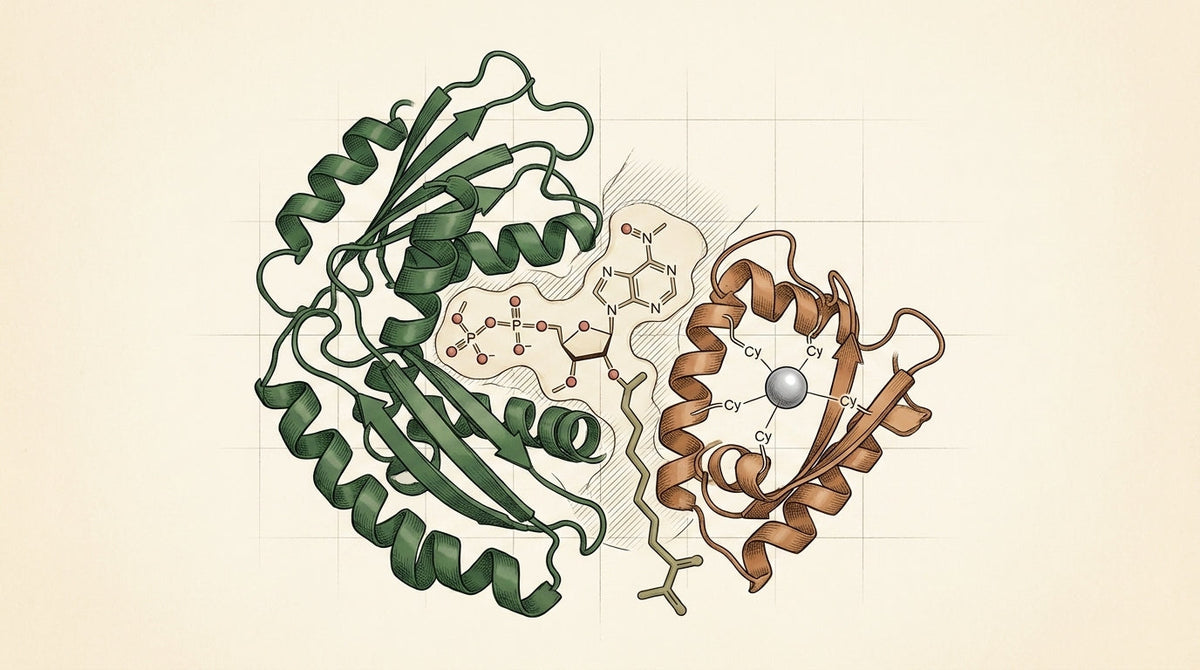
Human SIRT6 is a roughly 39-kDa sirtuin with the conserved catalytic architecture of the family: a Rossmann-fold-like NAD+-binding domain and a smaller zinc-binding domain. Early crystal structures revealed distinctive features, including a differently arranged zinc-binding region and structural differences around the NAD+-binding machinery [1].
SIRT6 is predominantly nuclear and strongly associated with chromatin. Its natural environment therefore differs substantially from a soluble peptide-enzyme assay.
Activity 1: deacetylation
SIRT6 removes acetyl groups from lysine residues on histones and non-histone proteins. Well-established chromatin targets include H3K9ac and H3K56ac; H3K18ac is also important in specific genomic contexts.
The reaction consumes NAD+ and produces nicotinamide plus an acyl-ADP-ribose product. SIRT6 can appear relatively weak against short synthetic acetyl-peptides while performing much more effectively in nucleosomal/chromatin contexts, which is one reason assay choice matters.
Activity 2: long-chain deacylation
SIRT6 is an efficient long-chain lysine deacylase. The discovery that it removes long fatty-acyl groups efficiently changed the biochemical view of the enzyme and helped reveal its deep hydrophobic acyl channel [2].
Long-chain fatty acids can also stimulate SIRT6 deacetylation in biochemical systems. This is an endogenous regulatory mechanism, not evidence that eating more of a particular fatty acid produces clinically meaningful SIRT6 activation.
Activity 3: mono-ADP-ribosylation
SIRT6 can transfer a single ADP-ribose group from NAD+ to protein substrates. PARP1 is the best-known example: SIRT6 mono-ADP-ribosylates PARP1 and increases DNA-repair signaling under oxidative stress [3].
This activity is especially relevant to longevity because some SIRT6 variants and regulatory states appear to alter PARP1 interaction and stress resistance.
DNA sensing is not the same as catalytic activation
SIRT6 can bind rapidly to broken DNA and participate in early double-strand-break signaling [4]. Experiments with catalytically impaired SIRT6 indicate that aspects of damage recognition can be separated from enzymatic catalysis.
This does not mean a catalytic activator has “no effect” on DNA sensing. It means the two functions are mechanistically distinct, and current activator assays usually measure catalytic output rather than improved break recognition itself.
Endogenous regulation: lamin A
A 2015 study identified lamin A as an endogenous SIRT6 activator that promotes SIRT6 recruitment and DNA-repair signaling [5]. Progerin impaired this relationship, linking abnormal nuclear-lamina biology to weakened SIRT6 function in progeroid cells.
This is a good example of why SIRT6 regulation is more complex than concentration alone: binding partners can alter activity and localization.
How synthetic allosteric activators work
Structure-guided chemistry demonstrated that SIRT6 contains a druggable pocket in its acyl channel. Synthetic compounds can bind this region and increase deacetylation [6].
Subsequent kinetic work showed that activation can accelerate a catalytic step after substrate binding and before NAD+ cleavage. Arg65 is important for this conformational activation mechanism [7].
UBCS039, MDL-800 and later compounds exploit this pharmacological principle with different potency, selectivity and cellular behavior.
Post-translational regulation: phosphorylation now matters more
A 2026 study mapped SIRT6 C-terminal phosphorylation across mammals and found that longer-lived species had more phosphosites and greater phosphosite use [8].
Hyperphosphorylation strengthened interaction with PARP1. In human fibroblasts, a phospho-null T294A mutation reduced oxidative-stress survival, whereas phospho-mimetic T294E improved it. The study does not establish a druggable human anti-aging intervention, but it makes clear that post-translational state is part of functional SIRT6 biology.
Ursolic acid: a new 2026 direct activator candidate
A 2026 biochemical study reported that ursolic acid binds and stabilizes purified human SIRT6 and alters enzyme kinetics and protein conformation [9].
The reported kinetic changes included lower Km and higher Vmax/Kcat under the assay conditions. This adds ursolic acid to the direct-activator landscape, but the evidence stops at purified protein and molecular simulation. There is no human SIRT6 target-engagement trial for ursolic acid.
Why potency numbers cannot be compared casually
Cyanidin, fucoidan, MDL-800, UBCS039 and other compounds are often ranked by headline fold-activation. That can be misleading because studies use different substrates, SIRT6 constructs, compound concentrations and catalytic readouts.
Some compounds increase deacetylation while having a different effect on mono-ADP-ribosylation. Others alter protein stability or expression rather than directly activating the catalytic core.
The current medicinal-chemistry literature therefore focuses on structure-activity relationships, selectivity, cellular target engagement and drug-like properties—not simply the largest fold-change [10].
Does SIRT6 simply decline with age?
That statement is too simple. Age-associated differences in SIRT6 abundance have been reported in multiple models and in human observational data, but SIRT6 function also depends on NAD+ availability, chromatin context, localization, phosphorylation, ubiquitination and interacting proteins.
The 2026 phosphorylation work is particularly important because it shows that an enzyme with the same amino-acid sequence can have different functional output depending on regulatory state.
A better formulation is: SIRT6 regulation and some measures of abundance/function change with aging, but there is no single universally measured “SIRT6 activity decline” across all human tissues.
Ser10 phosphorylation: when activating one function can impair another
A 2026 mouse preprint tested phospho-null and phosphomimetic mutations at SIRT6 Ser10 [11]. The S10E phosphomimetic increased DNA-repair capacity but impaired LINE1 repression and shortened male lifespan.
This makes post-translational regulation more than a potency issue. Different SIRT6 states can redistribute functional output across repair, chromatin and retrotransposon control. For drug development, the goal may be the right SIRT6 state in the right tissue, not the largest possible increase in a single enzyme assay.
The N-terminal domain is part of the allosteric machinery
A 2026 structural/biochemical study found that the SIRT6 N-terminal domain helps preserve the geometry of the NAD+ pocket and substrate-binding arrangement [12]. Removing the N-terminal domain produced a more open NAD+ pocket, weaker NAD+ binding and roughly a twofold reduction in deacetylation efficiency.
This adds another layer to SIRT6 drug design: allostery is not limited to the better-known acyl-channel activator pocket. The N-terminal domain participates in the conformational network that makes catalysis efficient.
What is still unknown?
- How catalytic activation changes each SIRT6 activity in the same human tissue.
- Which activator pharmacology best predicts beneficial tissue-level effects.
- Whether natural compounds achieve sufficient free concentrations at relevant intracellular sites.
- How chronic activation changes non-catalytic interactions and DNA-damage sensing.
- Which post-translational SIRT6 states should be increased—or inhibited—in different diseases.
- How much isoform and tissue selectivity is needed for long-term human therapy.
Bottom line
SIRT6 is best understood as a regulated chromatin enzyme with multiple catalytic and non-catalytic functions, not as a simple on/off longevity switch.
Modern activators can genuinely increase SIRT6 catalysis, and the drug-development field has matured from screening hits into structure-guided medicinal chemistry. The next problem is biological precision: which activity, in which cell, at which dose, for which disease or aging phenotype.
See SIRT6 activators for compound classes and SIRT6 therapeutic development for the current pipeline.
Frequently asked questions
What is the mechanism of SIRT6?
What is the structure of SIRT6?
How many enzymatic activities does SIRT6 have?
What activates SIRT6?
Why does SIRT6 require NAD+?
What is the SIRT6 catalytic mechanism at the chemical level?
How do MDL-800 and UBCS039 work at the molecular level?
Sources & article history
Sources (12)
-
Structure and biochemical functions of SIRT6 Journal of Biological Chemistry. 2011;Volume 286, issue 16, pages 14575–14587.
-
Activation of the protein deacetylase SIRT6 by long-chain fatty acids and widespread deacylation by mammalian sirtuins Journal of Biological Chemistry. 2013;Volume 288, issue 43, pages 31350–31356.
-
SIRT6 promotes DNA repair under stress by activating PARP1 Science. 2011;Volume 332, Issue 6036, Pages 1443–1446.
-
SIRT6 is a DNA double-strand break sensor eLife. 2020;Volume 9, article e51636.
-
Lamin A Is an Endogenous SIRT6 Activator and Promotes SIRT6-Mediated DNA Repair Cell Reports. 2015;13(7):1396-1406.
-
Mechanism of activation for the sirtuin 6 protein deacylase Journal of Biological Chemistry. 2020;Volume 295, issue 5, pages 1385–1399.
-
Deciphering the allosteric activation mechanism of SIRT6 using molecular dynamics simulations Journal of Chemical Information and Modeling. 2023;Volume 63, issue 18, pages 5896–5902.
-
Long-lived mammals contain more phosphorylation sites in the SIRT6 C-terminus that enhance PARP1 interaction and resistance to oxidative stress GeroScience. 2026;Online ahead of print.
-
Ursolic acid activates SIRT6 by enhancing enzyme-substrate interactions and promoting protein structural rearrangement Biochimica et Biophysica Acta (BBA) - General Subjects. 2026;1870(2):130890.
-
Targeting SIRT6: the design and therapeutic implications of activators and inhibitors Bioorganic & Medicinal Chemistry. 2026;142:118781.
-
Balance between DNA repair, LINE1 suppression and lifespan in mice with SIRT6 Serine 10 phosphorylation site mutations bioRxiv. 2026;Preprint.
-
Mechanistic basis of N-terminal domain-mediated allostery in SIRT6: integrating molecular dynamics simulations and biochemical assays Molecular Diversity. 2026;30(3):3845-3856.