
Resveratrol Supplement: Benefits, Dosage, Safety & Evidence (2026)
An evidence-first 2026 guide to resveratrol supplements: human benefits, dosage, safety, bioavailability, longevity claims, SIRT1 and where the science remains uncertain.
 By
Dr. Khaled Mahmoud, MBBCh
Critical Care Medicine, Longevity Science & Editorial Direction
 Reviewed by
Dr. Amr Yasser, PhD
Cardiometabolic, Musculoskeletal, Gut & Bioavailability
 Reviewed by
Dr. Abdulla Mostafa, PhD
Cellular Senescence, Neurological, Mitochondrial & Brain-Ageing Biology
- Published
- Last reviewed
- Reading time
- 11 min
- Sources cited
- 10
On this page
Resveratrol is a plant polyphenol found in grapes, berries and peanuts that became famous because of its links to red wine, sirtuins and longevity. The biology is fascinating. The human evidence is much less dramatic.
Across clinical trials, resveratrol has produced some favorable signals for insulin resistance, blood pressure, lipids and inflammatory markers in selected populations. But results vary substantially by dose, formulation, health condition and study design. Human lifespan extension has not been demonstrated, and a 2026 umbrella review found that many commonly repeated health claims still rest on low-certainty or inconsistent evidence.
This guide separates what resveratrol does in cells and animals from what has actually been shown in people.
Resveratrol at a glance
| Question | Evidence-based answer |
|---|---|
| What is it? | A naturally occurring stilbene polyphenol, usually sold as trans-resveratrol. |
| Does it extend human lifespan? | Not proven. Lifespan extension comes mainly from preclinical models, not human longevity trials. |
| Does it activate SIRT1 in humans? | Mechanistically plausible, but human trials do not establish consistent systemic SIRT1 activation. |
| Does it improve metabolic health? | Some pooled analyses show modest biomarker improvements, but benefits are not universal and several well-designed trials are null. |
| Is it well absorbed? | Absorption can be substantial, but unchanged parent resveratrol has low systemic bioavailability because it is rapidly metabolized. |
| Is it safe? | Short-term use has generally been tolerated in trials. Gastrointestinal adverse effects become more relevant at higher doses, and drug interactions matter. |
| Best dose? | There is no single clinically established dose. Human studies span roughly tens of milligrams to grams per day depending on the question being tested. |
What is resveratrol?
Resveratrol is a phytoalexin: a compound plants produce partly in response to stress. It occurs in both cis and trans forms, with trans-resveratrol being the form most often used in supplements and clinical research.
Interest accelerated after animal and cellular work linked resveratrol with pathways involved in energy sensing, mitochondrial biology, oxidative stress, inflammation and sirtuin signaling. One landmark mouse study reported improved health and survival in obese mice fed a high-calorie diet. That study helped create the modern “longevity molecule” narrative, but it did not demonstrate that supplemental resveratrol extends human life.
For the mechanism specifically, see resveratrol and SIRT1. For the lifespan question, see resveratrol and longevity.
What human evidence actually supports
The most useful way to interpret resveratrol is outcome by outcome rather than treating it as one intervention with one verdict.
| Outcome | 2026 evidence position | Interpretation |
|---|---|---|
| Insulin resistance | Possible modest benefit | Some meta-analyses and small trials are positive; high-level diabetes reviews find inconsistent effects on core glycemic outcomes. |
| Blood pressure | Possible modest benefit | Pooled effects can favor resveratrol, but individual trials vary and this is not a substitute for antihypertensive care. |
| Lipids | Mixed to modest | Recent pooled evidence reports reductions in selected lipid measures, while other syntheses find inconsistent or condition-dependent results. |
| Inflammatory markers | Promising but heterogeneous | hs-CRP, TNF-α and IL-6 may improve in some pooled analyses; this does not prove prevention of inflammatory disease. |
| Body weight / fat loss | Not established | Recent large synthesis does not support a consistent clinically meaningful weight-loss effect. |
| NAFLD / liver fat | Mixed or null | Several controlled trials failed to show clear benefit; dose and population differences do not resolve the uncertainty. |
| Cognition | Mixed | Some earlier studies are encouraging, while a 2026 randomized trial in adults with overweight/obesity was largely null across biological outcomes and had baseline cognitive imbalance. |
| Knee osteoarthritis | Conflicting | Newer smaller trials report benefits, but the 2024 multicenter phase 3 ARTHROL trial found no superiority over placebo for pain. |
| Human longevity | Unproven | No evidence demonstrates lifespan extension in humans. |
See the deeper outcome-by-outcome analysis in our Resveratrol Benefits guide.
Why the human evidence is so inconsistent
Resveratrol research has several recurring problems. Trials often enroll small samples, study different diseases, use widely different doses and formulations, measure dozens of biomarkers, and last only weeks or months. A positive signal in one endpoint is therefore not automatically replicated in another population.
There is also a pharmacokinetic problem. Human studies show that oral resveratrol is absorbed and then rapidly converted into glucuronide and sulfate metabolites. The blood concentration of unchanged resveratrol can therefore be low even after much larger oral doses. Modern pharmacokinetic evidence also shows that dose and formulation can materially alter exposure. That is important for product design, but greater exposure has not yet been proven to mean greater longevity or disease benefit.
Read our full guide to resveratrol bioavailability.

Resveratrol dosage: there is no universal clinical dose
Clinical research has used everything from low double-digit milligram doses to several grams per day. That range exists because the trials were asking different questions, not because every dose is interchangeable.
- Lower-dose studies have investigated vascular, cognitive and metabolic endpoints.
- Many modern trials use doses in the few-hundred-milligram range.
- Some pharmacokinetic and safety studies have used gram-level doses.
- Higher dose does not automatically mean greater biological benefit.
At high doses, gastrointestinal intolerance becomes more relevant. Anyone using prescription medicines should also consider interaction risk before chasing the largest dose used in a research paper. See resveratrol dosage for a trial-by-trial framework.
Resveratrol safety and side effects
Resveratrol has generally been tolerated in short clinical trials, but “natural” does not mean interaction-free. Reported adverse effects at higher intakes are predominantly gastrointestinal, including nausea, abdominal discomfort and diarrhea.
More important for some users is its potential to alter drug metabolism. Controlled human research has shown effects on cytochrome P450 enzymes. This creates a reasonable interaction concern for medicines with narrow therapeutic windows or metabolism through affected pathways. Antiplatelet or anticoagulant use also deserves medical review because resveratrol can influence platelet-related biology.
See resveratrol side effects and resveratrol drug interactions.
Does resveratrol mimic calorie restriction?
This is one of the most persistent claims. Resveratrol influences several pathways that overlap with energy sensing, including AMPK, mitochondrial signaling and sirtuin-related biology in experimental systems. But “mimics calorie restriction” is much stronger than “touches some overlapping pathways.”
Human trials do not show that taking resveratrol reproduces the full physiological effects of sustained calorie restriction. A small 2011 study in men with obesity produced a metabolic profile that attracted attention because some changes resembled calorie-restriction biology. A later trial in otherwise healthy men with obesity failed to reproduce a broad metabolic benefit. That contrast is exactly why single-trial storytelling is dangerous.
Does resveratrol activate SIRT1?
SIRT1 is central to the resveratrol story, but the phrase “resveratrol activates SIRT1” compresses a complicated mechanistic literature into a marketing slogan. Cell-free assays, cellular models, animals and human supplementation studies answer different questions.
A 2025 meta-analysis of human randomized trials did not establish a clear overall increase in circulating SIRT1. Some individual studies report higher SIRT1-related markers, including recent knee-osteoarthritis work, but biomarker changes in selected cohorts are not proof that oral resveratrol consistently activates SIRT1 throughout the human body.
Does red wine provide a supplement dose?
No practical comparison should imply that drinking more wine is a sensible way to reproduce supplement doses. The amount of resveratrol in wine varies and is far below many clinical-trial doses. Alcohol brings its own health risks, so “resveratrol is in red wine” should never become an argument for using wine as a longevity supplement.

How to judge a resveratrol supplement
Evidence-based product evaluation should focus on what is actually in the finished product rather than vague “anti-aging” language.
- Form: look for a clearly disclosed amount of trans-resveratrol rather than an unspecified plant blend.
- Dose: compare the serving with the dose range relevant to the intended outcome, not with the highest dose ever tested.
- Testing: independent identity/purity testing and a current certificate of analysis are more meaningful than generic laboratory imagery.
- Formulation claims: enhanced exposure is a pharmacokinetic claim; it should not be presented as proof of superior health outcomes without clinical data.
- Interactions: medication use can matter more than small theoretical differences between formulations.
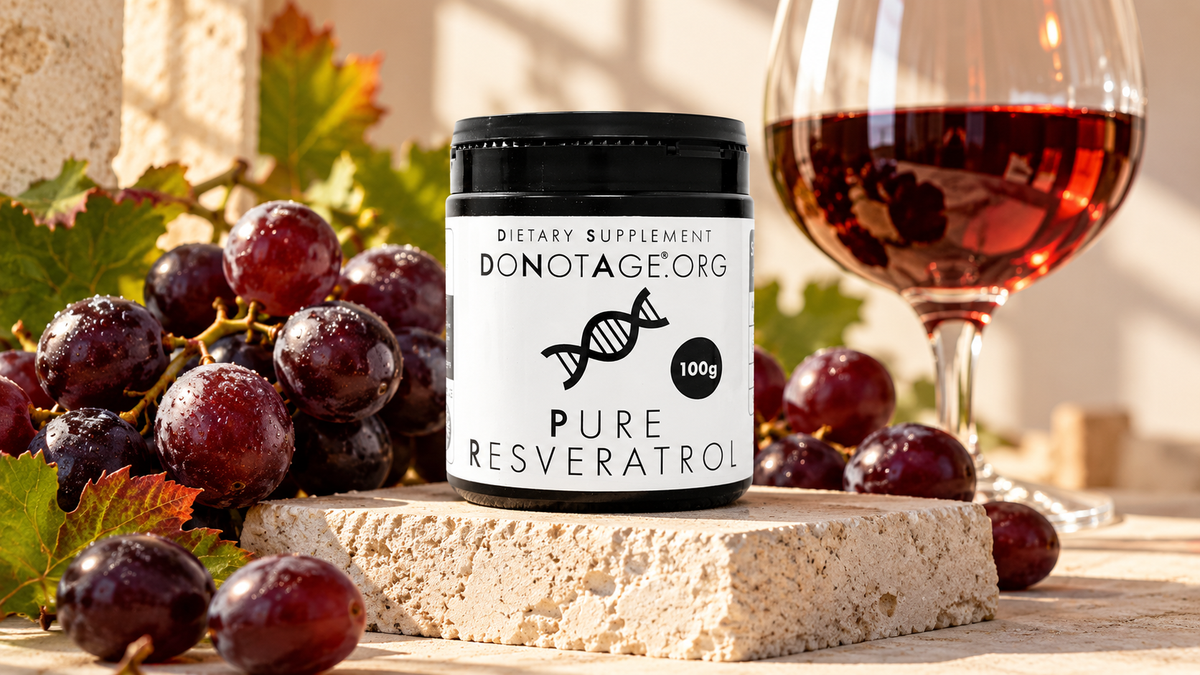
For our product-level assessment, see the DoNotAge Pure Resveratrol review. We rank the finished product separately from the much less certain claims around systemic SIRT1 activation, anti-aging effects and human lifespan extension.
Who should be particularly cautious?
People who are pregnant or breastfeeding, preparing for surgery, taking anticoagulant or antiplatelet therapy, or using medicines strongly dependent on affected CYP pathways should discuss supplementation with a qualified clinician. Disease-specific treatment should never be replaced by resveratrol based on a biomarker study.
What resveratrol has not been proven to do
- Extend human lifespan.
- Reverse biological aging in humans.
- Reliably produce weight loss.
- Replace diabetes, cardiovascular, cancer or neurodegenerative-disease treatment.
- Produce the same effect at every dose or in every formulation.
- Consistently activate SIRT1 systemically in humans.
The 2026 bottom line
Resveratrol is biologically interesting and clinically active enough to justify serious research. It is not a proven human longevity drug. The strongest modern interpretation is narrower: selected metabolic, vascular and inflammatory biomarkers may improve in some populations, while many outcomes remain inconsistent or null.
The right question is therefore not “does resveratrol work?” but “for which outcome, in which population, at which dose, using which formulation, and with what level of evidence?”
For paper-level details rather than headline summaries, explore the Biohack Blueprint Resveratrol Data Center, organized around human trials, systematic reviews, pharmacokinetic studies and landmark preclinical evidence.
Continue the Resveratrol evidence cluster
- Resveratrol benefits
- Resveratrol dosage
- Resveratrol side effects
- Resveratrol drug interactions
- Resveratrol bioavailability
- Resveratrol and longevity
- Resveratrol and SIRT1
- Resveratrol and weight loss
- Resveratrol and diabetes
- Resveratrol and fatty liver
- Resveratrol and knee osteoarthritis
- Resveratrol, blood pressure and heart health
- Resveratrol, brain health and cognition
- Resveratrol and exercise
- Trans-resveratrol vs resveratrol
- DoNotAge Pure Resveratrol review
- Resveratrol Research Data Center
Frequently asked questions
What is resveratrol used for?
Does resveratrol actually work?
How much resveratrol should you take?
Is resveratrol safe to take every day?
Does resveratrol extend lifespan?
Sources & article history
Sources (10)
-
Effects of resveratrol supplementation on multiple health outcomes: an umbrella review of systematic reviews and meta-analyses of randomized controlled trials Nutrition Journal. 2026;25(1).
-
Resveratrol for the Management of Human Health: How Far Have We Come? A Systematic Review of Resveratrol Clinical Trials to Highlight Gaps and Opportunities International Journal of Molecular Sciences. 2024;25(2):747.
-
Resveratrol Supplementation and its Potential Benefits in Obesity-related Non-communicable Diseases In Vivo. 2026;40(2):748-783.
-
High absorption but very low bioavailability of oral resveratrol in humans Drug Metabolism and Disposition. 2004;32(12):1377-1382.
-
Repeat dose study of the cancer chemopreventive agent resveratrol in healthy volunteers: safety, pharmacokinetics, and effect on the insulin-like growth factor axis Cancer Research. 2010;70(22):9003-9011.
-
Resveratrol modulates drug- and carcinogen-metabolizing enzymes in a healthy volunteer study Cancer Prevention Research. 2010;3(9):1168-1175.
-
Resveratrol improves health and survival of mice on a high-calorie diet Nature. 2006;444(7117):337-342.
-
Impact of Resveratrol Supplementation on Human Sirtuin 1: A GRADE-Assessed Systematic Review and Dose-Response Meta-Analysis of RCTs Journal of the Academy of Nutrition and Dietetics. 2025;125(9):1299-1314.e1.
-
The effects of 12-weeks resveratrol supplementation on cognition, gastrointestinal microbiota, and systemic inflammation, in an overweight and obese human population: a randomized, double-blind, placebo controlled, parallel groups trial Frontiers in Nutrition. 2026;13:1839709.
-
Oral resveratrol in adults with knee osteoarthritis: A randomized placebo-controlled trial (ARTHROL) PLoS Medicine. 2024;21(8):e1004440.


