
Trans-Resveratrol vs Resveratrol: What’s the Difference and Which Form Is Studied?
Trans-resveratrol is an isomer of resveratrol and the form used in much of the human supplement research. Learn what labels mean, how cis-resveratrol differs, and why extract weight is not the same as active trans-resveratrol.
 By
Dr. Khaled Mahmoud, MBBCh
Critical Care Medicine, Longevity Science & Editorial Direction
 Reviewed by
Dr. Amr Yasser, PhD
Cardiometabolic, Musculoskeletal, Gut & Bioavailability
 Reviewed by
Dr. Abdulla Mostafa, PhD
Cellular Senescence, Neurological, Mitochondrial & Brain-Ageing Biology
- Published
- Last reviewed
- Reading time
- 9 min
- Sources cited
- 5
On this page
Trans-resveratrol is not a different supplement from resveratrol—it is one structural form, or isomer, of the resveratrol molecule. When clinical trials and higher-quality supplement labels specify a form, they usually refer to trans-resveratrol.
The practical problem is labeling. A bottle may say “500 mg resveratrol,” “500 mg trans-resveratrol,” or “500 mg Japanese knotweed extract standardized to 50% trans-resveratrol.” Those are not necessarily the same dose.
Trans-resveratrol vs resveratrol at a glance
| Term | What it means |
|---|---|
| Resveratrol | The general stilbene molecule, which can exist mainly as trans and cis geometric isomers. |
| Trans-resveratrol | The trans isomer; the form most commonly used in human clinical and pharmacokinetic studies. |
| Cis-resveratrol | The cis isomer; much less commonly used as the defined active ingredient in human supplementation trials. |
| Japanese knotweed extract | A botanical extract that may contain trans-resveratrol plus other plant compounds; extract weight is not automatically active-resveratrol weight. |
| “Resveratrol complex” | A marketing term that may combine extracts or related compounds; the exact active trans-resveratrol dose must be checked. |
What is trans-resveratrol?
Resveratrol is a stilbene polyphenol. Its chemical structure can arrange around a double bond in different geometric forms. The two best-known are trans-resveratrol and cis-resveratrol.
They contain the same atoms but are arranged differently in space. That structural difference can influence stability, metabolism and biological behavior.
Most modern supplement research focuses on the trans form, which is why “trans-resveratrol” appears repeatedly in human pharmacokinetic and randomized trials.
Is trans-resveratrol the active form?
“Active form” can be misleading because both isomers have biological properties in experimental systems. A better statement is that trans-resveratrol is the best-characterized supplemental form in the human literature.
If a clinical study used 500 mg/day of trans-resveratrol, a consumer should not assume that 500 mg of an unspecified plant extract reproduces that exposure.
Why does most research use trans-resveratrol?
Trans-resveratrol is the predominant form associated with many plant sources and is the form conventionally isolated, quantified and used in much of the human supplement literature.
Examples include:
- human pharmacokinetic trials
- cognition and cerebral-blood-flow studies
- endothelial-function trials
- exercise studies
- long-term postmenopausal research
That gives trans-resveratrol a much larger direct human evidence base than a supplement consisting predominantly of cis-resveratrol.
Does trans-resveratrol have better bioavailability?
The major bioavailability issue is not simply trans versus cis. Oral trans-resveratrol can be substantially absorbed and then rapidly metabolized into sulfate and glucuronide conjugates.
The classic 2004 human radiolabeled study found at least 70% absorption after an oral dose, yet only trace unchanged resveratrol appeared in plasma because metabolism was so rapid.
Later trials confirmed that parent trans-resveratrol concentrations remain relatively low compared with metabolites even at much higher oral doses.
See Resveratrol Bioavailability.
Does formulation matter more than isomer labeling?
It can. A 2025 randomized crossover pharmacokinetic trial compared two oral resveratrol formulations and found approximately a 4.8-fold difference in peak total-resveratrol concentration and a 1.7-fold difference in total exposure.
That demonstrates that two products containing resveratrol can produce materially different pharmacokinetics.
However, higher exposure still does not prove better health outcomes. The study measured pharmacokinetics, not lifespan, cognition or cardiovascular events.
How to read a resveratrol label correctly
Suppose three products each display “500 mg” prominently:
| Label | What you can actually infer |
|---|---|
| 500 mg trans-resveratrol | The label claims 500 mg of the specified trans isomer. |
| 500 mg Japanese knotweed extract, standardized to 50% trans-resveratrol | About 250 mg of trans-resveratrol if the standardization claim is accurate. |
| 500 mg proprietary resveratrol complex | You cannot know the trans-resveratrol amount unless the formula discloses it. |
This is one of the most important product-comparison details in the category.

Japanese knotweed vs grape-derived resveratrol
Resveratrol can be obtained from botanical sources including Japanese knotweed and grapes, and it can also be produced using other manufacturing methods.
The source is less important than:
- the verified amount of trans-resveratrol
- purity
- contaminant testing
- stability
- finished-product identity
- human evidence for any proprietary formulation claim
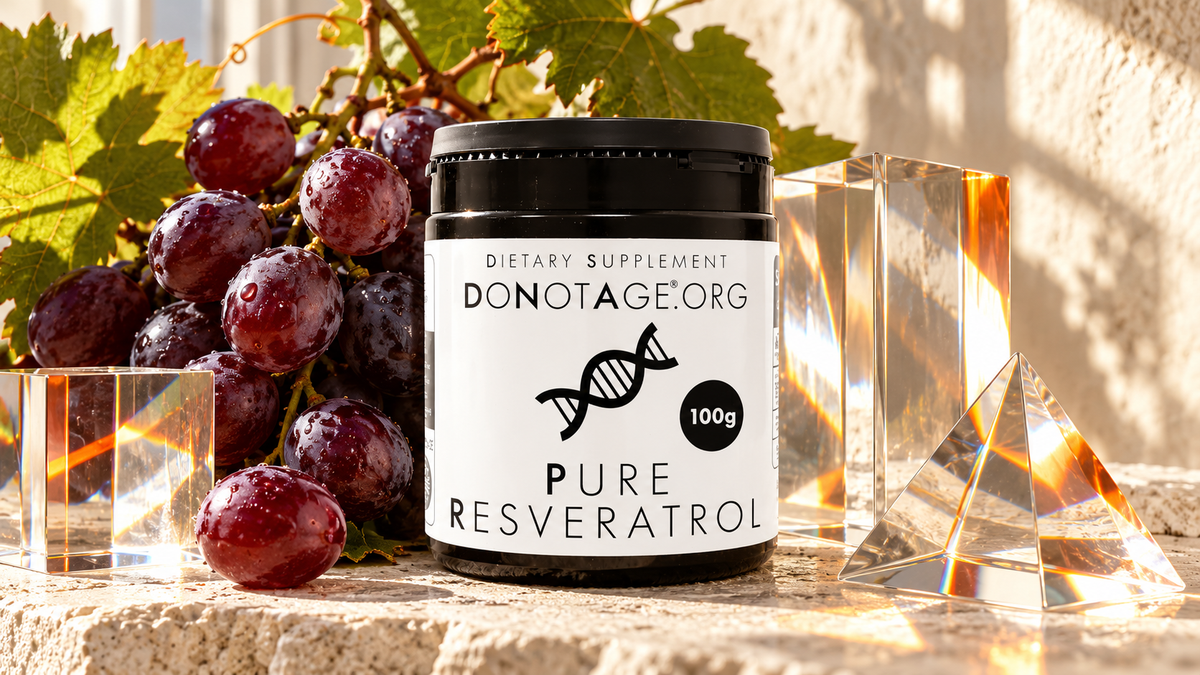
A grape image on the label does not make a product clinically superior, and Japanese knotweed sourcing does not automatically make it inferior.
What is cis-resveratrol?
Cis-resveratrol is the other major geometric isomer. It receives far less attention in supplement trials and has a much smaller direct human evidence base as a defined oral intervention.
Trans-resveratrol can also undergo isomerization under certain conditions, including light exposure. Product stability and storage therefore matter when a manufacturer is making a precise trans-resveratrol claim.
Is cis-resveratrol bad?
No. “Less studied” does not mean “toxic” or “inactive.” It means we should not assume that cis-resveratrol has the same human clinical evidence as the trans form.
Evidence should follow the tested intervention rather than using chemistry as a shortcut.
Does trans-resveratrol work better?
There is no large human head-to-head clinical program proving that purified trans-resveratrol produces superior disease or longevity outcomes versus an otherwise equivalent cis-rich preparation.
The reason to prefer a clearly quantified trans-resveratrol product is therefore mainly evidence matching: most of the oral human research was conducted with trans-resveratrol or products in which trans-resveratrol was the intended active compound.
What purity should a trans-resveratrol supplement have?
A high percentage on the label can be useful, but the number must refer to something verifiable. “98% trans-resveratrol” should ideally be supported by finished-product or batch testing, not only a raw-material specification.
Look for:
- clearly stated trans-resveratrol amount per serving
- batch-specific certificate of analysis when available
- identity and purity testing
- heavy-metal and microbiological testing where relevant
- transparent manufacturer information
Does 99% trans-resveratrol mean 99% bioavailability?
No. Purity and bioavailability are completely different concepts.
A powder can be 99% trans-resveratrol by composition while the parent molecule still undergoes rapid first-pass metabolism after oral ingestion.
Purity answers “what is in the capsule?” Bioavailability answers “what exposure occurs in the body?”
Is micronized or liposomal trans-resveratrol better?
Delivery systems can change pharmacokinetics, but each formulation must demonstrate its own advantage. Generic terms such as “liposomal,” “micronized” or “nano” should not be treated as proof of superior clinical efficacy.
If a company claims several-fold higher absorption, the relevant questions are:
- Was the finished product actually studied in humans?
- Was trans-resveratrol exposure measured?
- Was the comparator appropriate?
- Was only Cmax/AUC improved, or were clinical outcomes also improved?

How much trans-resveratrol is used in studies?
Human studies span a wide dose range, from low tens of milligrams to gram-level exposures. Many modern supplement trials sit in the 150–500 mg/day range, but no universal optimal dose exists.
See Resveratrol Dosage for the trial-by-trial map.
Is trans-resveratrol better for longevity?
Trans-resveratrol is the form behind much of the longevity-related experimental and human research, but that does not mean it has been shown to extend human life.
No dose or formulation of trans-resveratrol has demonstrated human lifespan extension.
See Resveratrol and Longevity.
Is trans-resveratrol better for SIRT1?
Trans-resveratrol is the form usually discussed in SIRT1 research, but human randomized-trial evidence does not show a significant overall increase in SIRT1 gene expression, protein expression or circulating levels.
What should you buy: resveratrol or trans-resveratrol?
For a supplement intended to match the human evidence base, a product that clearly discloses its actual trans-resveratrol amount is easier to evaluate than an unspecified “resveratrol complex.”
That does not mean the highest milligram number or most elaborate delivery system is automatically best. Dose, purity, third-party testing, formulation evidence, medication interactions and cost still matter.
Bottom line
Trans-resveratrol is the form that best matches the modern human evidence base. The critical consumer distinction is not simply the word “trans” on the front of the bottle—it is whether the label tells you how much trans-resveratrol is actually present and whether that amount is independently verified.
For product-level decisions, combine form and purity with dose, bioavailability, safety and medication interactions. The core evidence is mapped in the Resveratrol Data Center.
Frequently asked questions
Is resveratrol the same as trans-resveratrol?
Which form of resveratrol is best studied?
Is 500 mg of Japanese knotweed extract the same as 500 mg trans-resveratrol?
Is trans-resveratrol better absorbed?
Is 98% or 99% trans-resveratrol better?
Sources & article history
Sources (5)
-
High absorption but very low bioavailability of oral resveratrol in humans Drug Metabolism and Disposition. 2004;32(12):1377-1382.
-
Phase I dose escalation pharmacokinetic study in healthy volunteers of resveratrol, a potential cancer chemopreventive agent Cancer Epidemiology, Biomarkers & Prevention. 2007;16(6).
-
Pharmacokinetic and safety profile of trans-resveratrol in a rising multiple-dose study in healthy volunteers Molecular Nutrition & Food Research. 2009;53(S1):S7-S15.
-
Pharmacokinetic evaluation of two oral Resveratrol formulations in a randomized, open-label, crossover study in healthy fasting subjects Scientific Reports. 2025;15(1):24515.
-
Resveratrol for the Management of Human Health: How Far Have We Come? A Systematic Review of Resveratrol Clinical Trials to Highlight Gaps and Opportunities International Journal of Molecular Sciences. 2024;25(2):747.


