Wonderfeel Youngr NMN Review: Too Many Claims, Too Many Ingredients, Not Enough Product-Specific Evidence
Wonderfeel Youngr combines 900 mg NMN with resveratrol, ergothioneine, olive extract and vitamin D3. The formula is expensive and heavily marketed, but the finished combination lacks a randomized clinical trial.
 By
Dr. Khaled Mahmoud, MBBCh
Critical Care Medicine, Longevity Science & Editorial Direction
By
Dr. Khaled Mahmoud, MBBCh
Critical Care Medicine, Longevity Science & Editorial Direction
 Reviewed by
Dr. Amr Yasser, PhD
Cardiometabolic, Musculoskeletal, Gut & Bioavailability
Reviewed by
Dr. Amr Yasser, PhD
Cardiometabolic, Musculoskeletal, Gut & Bioavailability
 Reviewed by
Dr. Abdulla Mostafa, PhD
Cellular Senescence, Neurological, Mitochondrial & Brain-Ageing Biology
Reviewed by
Dr. Abdulla Mostafa, PhD
Cellular Senescence, Neurological, Mitochondrial & Brain-Ageing Biology
- Published
- Last reviewed
- Reading time
- 7 min
- Sources cited
- 4
On this page
This Wonderfeel NMN review focuses on Youngr because the marketing story is much more sophisticated than the clinical evidence. It combines a high NMN dose with resveratrol, ergothioneine, olive-derived hydroxytyrosol and vitamin D3, then positions the formula as a multi-targeted anti-aging system.
The problem is straightforward: the exact finished formula does not have the randomized human trial needed to support the package of claims being made for it.
How we verified this review: We checked Wonderfeel Youngr's current product information, label and serving size, ingredient/source claims, public certificates or testing documentation when available, current one-time pricing, and how the retail dose/formula maps to published human NMN evidence. Biohack Blueprint did not independently laboratory-assay the retail lot unless explicitly stated.
What is actually in Youngr?
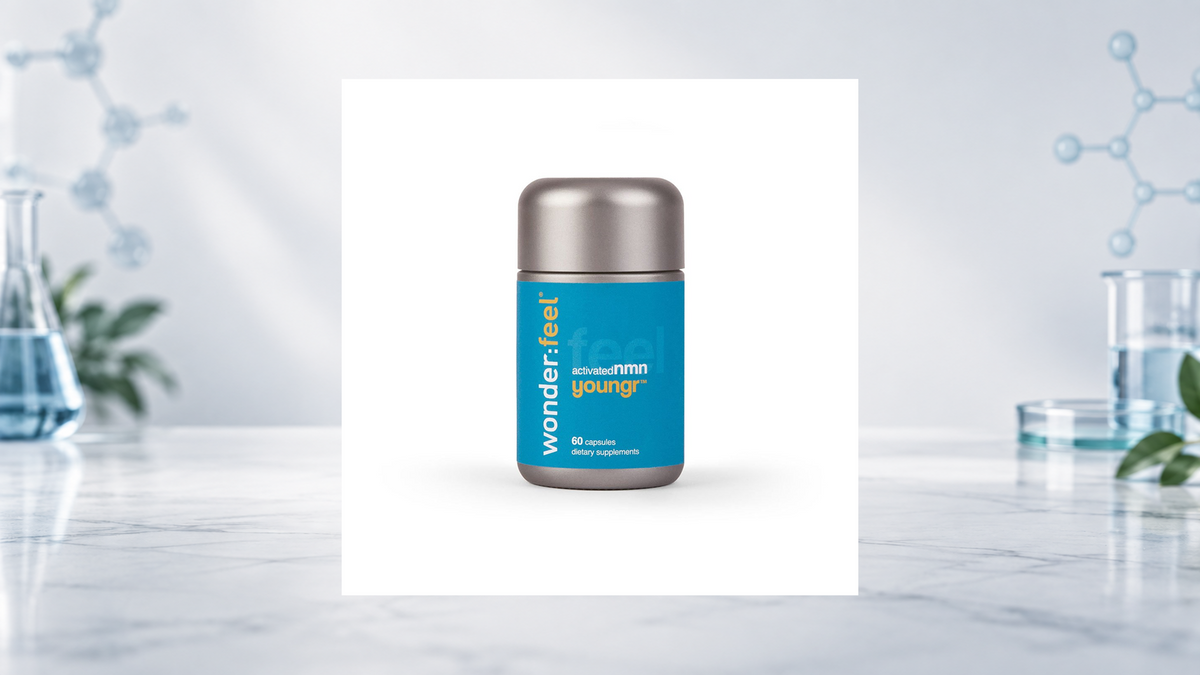
The current product page lists each capsule as 450 mg NMN, 2 mg ergothioneine, 50 mg trans-resveratrol, 25 mg olive fruit extract standardized to 40% hydroxytyrosol, and 10 mcg vitamin D3. Two capsules therefore provide 900 mg NMN plus the combined antioxidant stack.
The one-time price is currently $88 for a 30-day supply, with a $73 subscription option.
Con #1: no randomized trial of the finished formula
Wonderfeel describes the 900 mg NMN dose as clinically backed, but that is not the same as clinically testing Youngr.
A trial of NMN alone cannot establish the effect of NMN + resveratrol + ergothioneine + hydroxytyrosol + vitamin D3. Once several actives are combined, both efficacy and adverse effects become harder to attribute.
Con #2: the claims are too broad for the evidence
The current product page calls Youngr a “patented solution to aging” and says it can increase energy, restore skin elasticity, optimize organ health and cognition, improve recovery and improve sleep quality.
The overall NMN literature is much more mixed. The 2026 meta-analysis found many routine metabolic outcomes were neutral. [1]
There is no finished Youngr RCT establishing this multi-system package of benefits.
Con #3: the menopause positioning gets ahead of human reproductive evidence
Wonderfeel has a dedicated menopause marketing page describing Youngr as a formula designed to help women thrive through menopause and discussing preserving healthier ovarian function and extending fertility.
Those ideas come largely from preclinical reproductive-aging science. Human NMN trials have not demonstrated preserved ovarian reserve, improved IVF success, extended fertility or reversal of menopausal physiology.
Our NMN for Women article separates the mouse fertility evidence from the human data.
Con #4: resveratrol synergy is not clinically proven
The formula presents resveratrol as a sirtuin-activating partner that enhances NMN. The main direct NMN-plus-resveratrol combination paper is a mouse tissue-distribution study. [2]
There is still no randomized human trial showing that adding 100 mg resveratrol to NMN improves health outcomes beyond NMN alone.
Con #5: expensive complexity
At $88 one-time for 30 days, Youngr is materially more expensive than a basic NMN product. The extra cost could be justified if the finished combination had superior clinical outcomes. That study is missing.
Complexity also creates an attribution problem: if a user sleeps better or develops a side effect, NMN is only one of several active ingredients.
Con #6: “patented” is not evidence of clinical effectiveness
A patent protects intellectual property. It does not mean the formula has been shown in randomized trials to slow aging or outperform simpler NMN.
Con #7: customer reviews cannot replace a controlled trial
Wonderfeel has hundreds of user reviews and has even published an observational analysis of voluntary customer feedback. That can describe what customers report, but it is uncontrolled, self-selected and vulnerable to expectation effects.
Testimonials are particularly weak evidence for subjective outcomes such as energy, cognition, sleep and recovery.
Quality documentation is not the problem
Wonderfeel states that it manufactures in U.S. cGMP facilities, third-party tests its products and provides COAs. That is positive quality-control information.
The issue is not whether the capsules contain what the company intends. The issue is whether the combined product does what the marketing says.
Wonderfeel versus DoNotAge
| Wonderfeel Youngr | DoNotAge Pure NMN | |
|---|---|---|
| Formula | 5 active components | Single active NMN |
| NMN dose | 900 mg/day | 500 mg per capsule/scoop; 1,000 mg recommended |
| Named NMN source | Not emphasized as Uthever on current product page | Uthever |
| Finished-formula RCT | No | No |
| Ease of matching to evidence | Low; multi-ingredient | Higher; single ingredient |
| One-time price | $88/30 days | From about $80 depending format/quantity |
| Our preference | No | Recommended |
The formula creates an attribution problem for every claimed benefit
If a Youngr user reports better sleep, several ingredients could plausibly be involved, including vitamin D status, resveratrol-related signaling, expectancy and NMN. If a user develops gastrointestinal symptoms or headache, the same problem applies in reverse. A multi-ingredient product needs its own controlled trial precisely because class-level ingredient studies cannot identify which component caused what.
Con #8: the 900 mg dose is not clearly better than 600 mg
Wonderfeel explicitly says its 900 mg/day recommendation is based on one of the largest NMN clinical trials. The cited Yi dose-ranging trial randomized 80 adults to placebo, 300, 600 or 900 mg/day for 60 days. [3]
The trial did show that 600 and 900 mg produced the highest blood-NAD values and both performed better than placebo on six-minute walking. But 900 mg did not significantly outperform 600 mg on walking distance, and the paper's own conclusion stated that clinical efficacy expressed by NAD concentration and physical performance reached highest at 600 mg/day.
That does not make 900 mg ineffective. It means Wonderfeel's higher dose should not be sold as though the trial proved a clinically meaningful advantage over 600 mg. The additional 300 mg increases ingredient exposure and cost without a demonstrated incremental outcome in that study.
Con #9: “NAD starts declining in your 30s” is now too categorical
Wonderfeel's educational marketing still says NAD naturally begins declining as early as our 30s. That is a familiar longevity narrative, but the human evidence is more tissue-specific.
A 2026 Nature Metabolism study using a rigorously validated assay across seven independent human cohorts found that whole-blood NAD+ remained remarkably stable with age. [4] Other human tissue studies, including skeletal muscle, can show age-associated changes.
The accurate consumer statement is therefore not “everyone starts losing systemic NAD in their 30s.” It is that NAD biology changes with age in tissue- and context-dependent ways, while blood NAD is not a validated universal aging clock.
The hydroxytyrosol story is more complicated than the marketing
The current label lists olive fruit extract standardized to hydroxytyrosol. Hydroxytyrosol has its own nutritional and cardiovascular literature, but Youngr's finished combination has not shown that this small added amount creates a measurable incremental benefit when layered onto NMN.
“Mediterranean-diet molecule” is not equivalent to reproducing the benefits of a Mediterranean dietary pattern.
Vitamin D3 adds another confounder
Vitamin D3 can be beneficial in people who are deficient, but adding it to an NMN product means response can depend on baseline vitamin D status. A person correcting deficiency may feel better for reasons that have little to do with NAD biology.
Menopause marketing deserves the highest burden of proof
Menopause is not a generic energy problem. It involves ovarian aging, declining estrogen/progesterone signaling, vasomotor symptoms, bone health, sleep, urogenital health and cardiometabolic changes. Suggesting that an NMN stack can preserve ovarian function or reshape menopause requires dedicated human reproductive trials.
Those trials do not currently exist.
What would make Youngr more convincing?
- A randomized placebo-controlled trial of the exact finished formula.
- A factorial study showing whether the added antioxidants improve outcomes beyond NMN alone.
- Menopause-specific endpoints if the product is marketed for menopause.
- Clear separation of customer testimonials from clinical evidence.
- Less reliance on “patented” as a proxy for efficacy.
Related NMN guides
Bottom line
Wonderfeel Youngr is well-branded, professionally formulated and quality-tested, but it asks consumers to accept too many unproven connections at once: that 900 mg provides an incremental clinical advantage over 600 mg, that resveratrol enhances NMN in humans, that systemic NAD inevitably falls from the 30s onward, and that the package improves skin, cognition, sleep, recovery and menopause-related biology. We prefer a simpler NMN product whose active ingredient can be evaluated directly.
Frequently asked questions
What is the biggest problem with Wonderfeel Youngr?
How much NMN is in Wonderfeel Youngr?
What else is in Wonderfeel Youngr?
Is Wonderfeel Youngr clinically tested?
Does Youngr help menopause?
Is resveratrol proven to make NMN work better?
Why is Youngr expensive?
Wonderfeel or DoNotAge: which do we prefer?
Does Wonderfeel publish COAs?
Is 900 mg of NMN proven to work better than 600 mg?
Does NAD+ definitely start declining in your 30s?
Sources & article history
Sources (4)
-
Safety and Metabolism-Related Outcomes of Oral Nicotinamide Mononucleotide Supplementation in Adults: A Systematic Review and Meta-Analysis Nutrients. 2026;18, 2251.
-
Improvement of tissue-specific distribution and biotransformation potential of nicotinamide mononucleotide in combination with ginsenosides or resveratrol Pharmacology Research & Perspectives. 2022;10(4):e00986.
-
The efficacy and safety of β-nicotinamide mononucleotide (NMN) supplementation in healthy middle-aged adults: a randomized, multicenter, double-blind, placebo-controlled, parallel-group, dose-dependent clinical trial GeroScience. 2023;45(1):29-43.
-
Human whole-blood NAD+ levels do not vary with age or lifestyle interventions Nature Metabolism. 2026;8(6):1282–1290.