NMN and Resveratrol: Should You Take Them Together?
NMN and resveratrol are a popular longevity stack, but human synergy is unproven. We examine the mouse combination study, tissue NAD+ results, timing, TMG and what personal routines cannot prove.
 By
Dr. Khaled Mahmoud, MBBCh
Critical Care Medicine, Longevity Science & Editorial Direction
By
Dr. Khaled Mahmoud, MBBCh
Critical Care Medicine, Longevity Science & Editorial Direction
 Reviewed by
Dr. Amr Yasser, PhD
Cardiometabolic, Musculoskeletal, Gut & Bioavailability
Reviewed by
Dr. Amr Yasser, PhD
Cardiometabolic, Musculoskeletal, Gut & Bioavailability
 Reviewed by
Dr. Abdulla Mostafa, PhD
Cellular Senescence, Neurological, Mitochondrial & Brain-Ageing Biology
Reviewed by
Dr. Abdulla Mostafa, PhD
Cellular Senescence, Neurological, Mitochondrial & Brain-Ageing Biology
- Published
- Last reviewed
- Reading time
- 8 min
- Sources cited
- 3
On this page
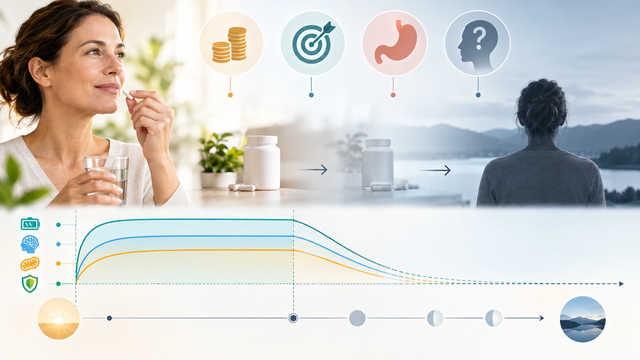
NMN and resveratrol are commonly taken together, but human evidence has not shown that the combination is better than NMN alone. The experimental paper most often used to support synergy is a 2022 mouse study—not a human randomized trial.
Why people combine NMN and resveratrol
The stack became popular because NMN is used to increase NAD+ availability while resveratrol is discussed as a polyphenol that can influence AMPK, sirtuin-related signaling and metabolic stress responses. The conceptual story sounds complementary: provide more NAD+ substrate and add a compound associated with NAD-dependent signaling.
A plausible mechanism, however, is not proof of a better outcome.
What the combination study found
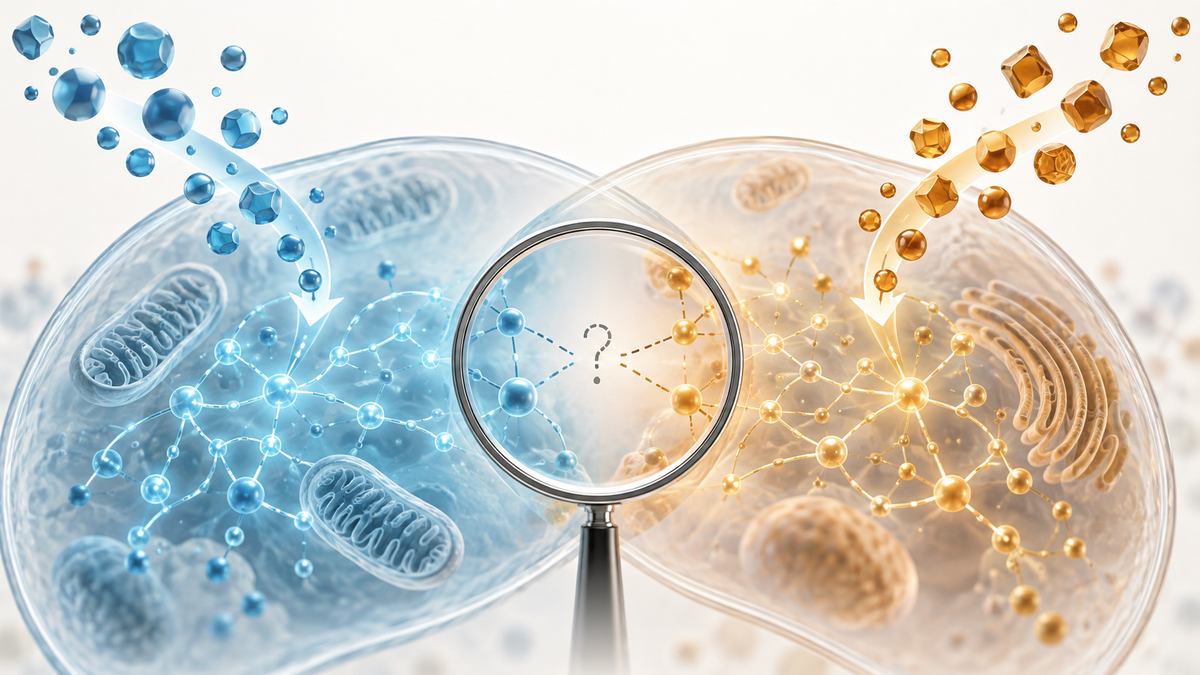
Bai and colleagues gave mice NMN alone or NMN combined with resveratrol or selected ginsenosides and measured tissue distribution and NAD+. The NMN-plus-resveratrol group showed roughly 1.6-times the NAD+ level in heart and 1.7-times the level in skeletal muscle compared with NMN alone under the study conditions. [1]
The effect was tissue-specific. It did not establish a universal increase across every organ, and the experiment did not study human longevity, exercise performance, cognition or disease outcomes.
Why this does not prove human synergy
- The study used mice.
- The NMN dose was 500 mg/kg and resveratrol 50 mg/kg—far removed from typical fixed human supplement labels.
- The endpoint was tissue NAD+ and biotransformation, not a clinical benefit.
- No randomized human NMN-plus-resveratrol trial has shown superior outcomes to NMN alone.
- Resveratrol has its own pharmacokinetic limitations and evidence base.
Does resveratrol activate SIRT1?
Resveratrol became famous partly through sirtuin research, but the phrase “resveratrol activates SIRT1” compresses a long and technically complex literature about direct versus indirect activation, assay substrates, AMPK signaling and cellular context.
Even if a compound influences sirtuin-related signaling, it does not follow that combining it with NMN has clinically additive anti-aging effects.
Should NMN and resveratrol be taken at the same time?
There is no human trial establishing an optimal timing relationship between the two. Taking them together, separating them, morning dosing or pairing resveratrol with fat are practical routines rather than NMN-combination protocols validated by clinical outcomes.
Does resveratrol need fat?
Resveratrol is poorly water soluble and undergoes extensive metabolism. Food composition can affect exposure, but “take it with fat” should not be converted into a universal guarantee of greater clinical efficacy. The appropriate advice depends on the specific product and the evidence behind it.
What about David Sinclair's NMN and resveratrol routine?
Publicly discussed personal routines helped popularize the combination, but a scientist's personal supplement use is not a randomized clinical trial. Personal routines can also change over time and should not be treated as dosing guidelines.
See our dated fact-check: David Sinclair and NMN.
Can resveratrol make NMN safer?
No human evidence establishes that resveratrol prevents NMN adverse effects or makes high-dose NMN safer. Combining supplements adds another active compound, its own interactions and another source of product-quality variability.
Can the stack improve exercise?
NMN exercise evidence is already mixed. One runner trial reported improved aerobic-capacity measures, while a 2026 BFR study found that high-dose NMN dampened acute inflammatory/remodeling responses. [2] [3]
Adding resveratrol has not been shown in a human NMN-combination RCT to resolve that uncertainty.
Do you need TMG too?
TMG is frequently added to the internet “longevity stack” because nicotinamide metabolites can participate in methylation pathways. But routine TMG co-supplementation has not been shown necessary in NMN randomized trials, and the three-way NMN-resveratrol-TMG stack does not have a validation trial establishing superior benefit.
How to think about stacking responsibly
| Question | Better evidence-based approach |
|---|---|
| Is there a human combination RCT? | No—do not call the stack clinically proven. |
| Does the mouse study show synergy? | It shows tissue-specific NAD+ differences in mice, not human benefit. |
| Can both compounds have biological activity? | Yes, independently. |
| Does that guarantee additive benefit? | No. |
| Does stacking raise interaction complexity? | Yes. |
| Best reason to add resveratrol? | A separate evidence-based reason for resveratrol, not because NMN automatically needs it. |
Why tissue NAD+ synergy does not equal longevity synergy
A stack can increase a biomarker without improving a health outcome. The key missing human experiment would randomize people to NMN, resveratrol, the combination and placebo, then compare prespecified clinical endpoints. That study has not been done.
Without it, we cannot know whether the combination is additive, redundant, neutral or less effective for a given endpoint.
Does resveratrol improve NMN absorption?
The mouse study suggests altered tissue distribution and biotransformation, not a universal human absorption multiplier. There is no validated claim such as “resveratrol makes NMN 60% more bioavailable” for consumers.
Human NMN on its own already raises blood NAD-related markers across multiple trials, so resveratrol is not required simply to make oral NMN biologically active.
What about homocysteine?
Homocysteine is the clinically relevant biomarker often invoked in the TMG discussion. A recommendation to add TMG would be stronger if NMN consistently raised homocysteine in humans and TMG prevented that effect in a controlled trial. That evidence is not established for routine NMN use.
Adding quercetin, fisetin or spermidine
Longevity stacks often grow by mechanism rather than by combination evidence: NMN for NAD+, resveratrol for sirtuins, fisetin for senescence, quercetin for flavonoid signaling, spermidine for autophagy. Each additional compound increases uncertainty and interaction complexity.
A stack of individually interesting molecules is not automatically an evidence-based protocol. Combination trials are rare, and the contribution of each ingredient becomes impossible to identify if everything is started at once.
NMN with NAC, glutathione or CoQ10: different biology, no proven human stack
Your keyword data shows meaningful interest in NMN + NAC, NMN + glutathione and NMN + CoQ10. These combinations are biologically plausible because they touch different parts of redox or mitochondrial metabolism. Plausibility is not the same as a validated stack.
- NAC: supports cysteine availability for glutathione synthesis. We did not identify a human randomized trial showing that adding NAC to NMN improves outcomes beyond NMN alone.
- Glutathione: is a major intracellular redox buffer. NMN can influence redox biology in preclinical models, but there is no established human NMN-plus-glutathione protocol.
- CoQ10: participates in mitochondrial electron transport. Human trials exist for CoQ10 plus NADH in chronic fatigue syndrome, but that is not an NMN+CoQ10 trial and should not be used as evidence for an NMN stack.
There are cell and animal studies in which NMN and antioxidant pathways intersect, and a 2026 cell-culture paper tested a multi-ingredient NMN formulation containing CoQ10, PQQ, resveratrol and glutathione. That kind of mechanistic work cannot establish that a multi-supplement stack improves longevity or clinical outcomes in people.
Why stacking more antioxidants can make interpretation worse
Every extra ingredient creates another explanation for benefit, side effects or laboratory changes. If your goal is to learn whether NMN itself helps you, starting five new ingredients simultaneously makes the experiment less interpretable.
This is especially relevant for exercise, where some oxidative and inflammatory signaling is part of training adaptation. “More antioxidant activity” is not automatically better in every context.
How to decide whether resveratrol belongs in your stack
- Ask whether you have an independent evidence-based reason to use resveratrol.
- Do not add it solely because a pathway diagram says NMN needs a sirtuin activator.
- Review medication interactions and bleeding risk for the complete stack.
- Start fewer interventions at once if you want to interpret tolerability or biomarkers.
- Judge product quality separately for both NMN and resveratrol.
- Do not assume animal dose ratios should be copied into human self-experimentation.
What would convince us the combination is better?
A factorial human RCT could answer this efficiently: placebo, NMN alone, resveratrol alone and the combination. It would need a prespecified outcome meaningful enough to matter—physical function, metabolic health or another validated endpoint—not just a change in blood NAD+. Until that exists, the combination remains plausible rather than proven.
Related NMN guides
Bottom line
NMN plus resveratrol is a biologically plausible and popular stack with an interesting mouse tissue-distribution study behind it. That is not the same as human evidence of synergy. If both are used, each should earn its place independently rather than being bundled into a supposedly proven longevity protocol.
Frequently asked questions
Should NMN be taken with resveratrol?
Does resveratrol make NMN work better?
What is the best NMN-to-resveratrol ratio?
Do I need TMG with NMN?
Can I take NMN, resveratrol and TMG together?
Can NMN be taken with quercetin?
When should I take NMN and resveratrol?
Sources & article history
Sources (3)
-
Improvement of tissue-specific distribution and biotransformation potential of nicotinamide mononucleotide in combination with ginsenosides or resveratrol Pharmacology Research & Perspectives. 2022;10(4):e00986.
-
Nicotinamide mononucleotide supplementation enhances aerobic capacity in amateur runners: a randomized, double-blind study Journal of the International Society of Sports Nutrition. 2021;18, 54.
-
Anti-inflammatory effects of nicotinamide mononucleotide (NMN) in human skeletal muscle after BFR-exercise Journal of the International Society of Sports Nutrition. 2026;Volume 23, issue 1, article 2632284.