How to Verify NMN Purity: COAs, Lab Tests, β-NMN & Label Accuracy
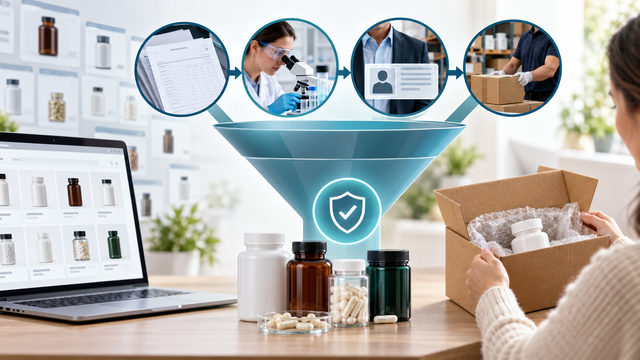
Independent studies have found major label failures and isomer inconsistencies in commercial NMN. This guide shows how to read a COA, verify batch potency and distinguish meaningful testing from marketing.
 By
Dr. Khaled Mahmoud, MBBCh
Critical Care Medicine, Longevity Science & Editorial Direction
By
Dr. Khaled Mahmoud, MBBCh
Critical Care Medicine, Longevity Science & Editorial Direction
 Reviewed by
Dr. Amr Yasser, PhD
Cardiometabolic, Musculoskeletal, Gut & Bioavailability
Reviewed by
Dr. Amr Yasser, PhD
Cardiometabolic, Musculoskeletal, Gut & Bioavailability
 Reviewed by
Dr. Abdulla Mostafa, PhD
Cellular Senescence, Neurological, Mitochondrial & Brain-Ageing Biology
Reviewed by
Dr. Abdulla Mostafa, PhD
Cellular Senescence, Neurological, Mitochondrial & Brain-Ageing Biology
- Published
- Last reviewed
- Reading time
- 12 min
- Sources cited
- 3
On this page
“99% pure NMN” is not enough information to judge an NMN supplement. The finished product should contain the labeled amount of the correct NMN isomer, in the tested batch, with credible contaminant and identity data. Independent research has shown why: some marketed NMN products have contained far less active ingredient than claimed, including products with essentially no detectable labeled NMN.
Why NMN quality deserves its own article
Many supplements can suffer from under-dosing or contamination, but NMN has unusually direct published evidence documenting label problems. An independent GeroScience analysis tested 18 commercial NMN supplements and found measured content ranging from essentially absent to near the declared amount, with some deviations reaching −100%. [1]
A 2026 analytical paper went one step further by separating α-NMN and β-NMN and applying the validated method to eight commercial products. The authors found substantial variation in isomer composition and undeclared or inaccurately labeled ingredients. [2]
What a strong NMN certificate of analysis should show
| COA element | Why it matters |
|---|---|
| Batch or lot number | Links the report to the bottle you actually bought |
| Sample/product name | Prevents a generic raw-material report being passed off as finished-product testing |
| Test date | Shows the result is current enough to be relevant |
| Identity method | Confirms the compound is NMN, ideally distinguishing β-NMN where claimed |
| Quantitative assay | Measures how much NMN is actually present |
| Acceptance specification | Shows the pass/fail range rather than only a result |
| Heavy metals | Screens lead, arsenic, cadmium and mercury where appropriate |
| Microbiology | Relevant for finished-product safety |
| Residual solvents / contaminants | Important when manufacturing processes warrant testing |
| Laboratory identity | Allows readers to assess whether the report is internal or independent |
Purity percentage vs label-claim accuracy
A raw material can be 99.9% pure and the finished capsule can still be underdosed. “Purity” asks what fraction of the tested material is the target substance. “Potency” or assay asks how much target substance is actually in the finished product.
A good product therefore needs both identity and quantitative confirmation. A marketing badge saying “99.8% purity” without lot-matched finished-product data does not tell you whether a 500 mg capsule contains 500 mg.
β-NMN vs α-NMN
Most clinical supplementation research is framed around β-NMN. Isomer identity therefore matters when a brand claims that its product matches the clinical literature.
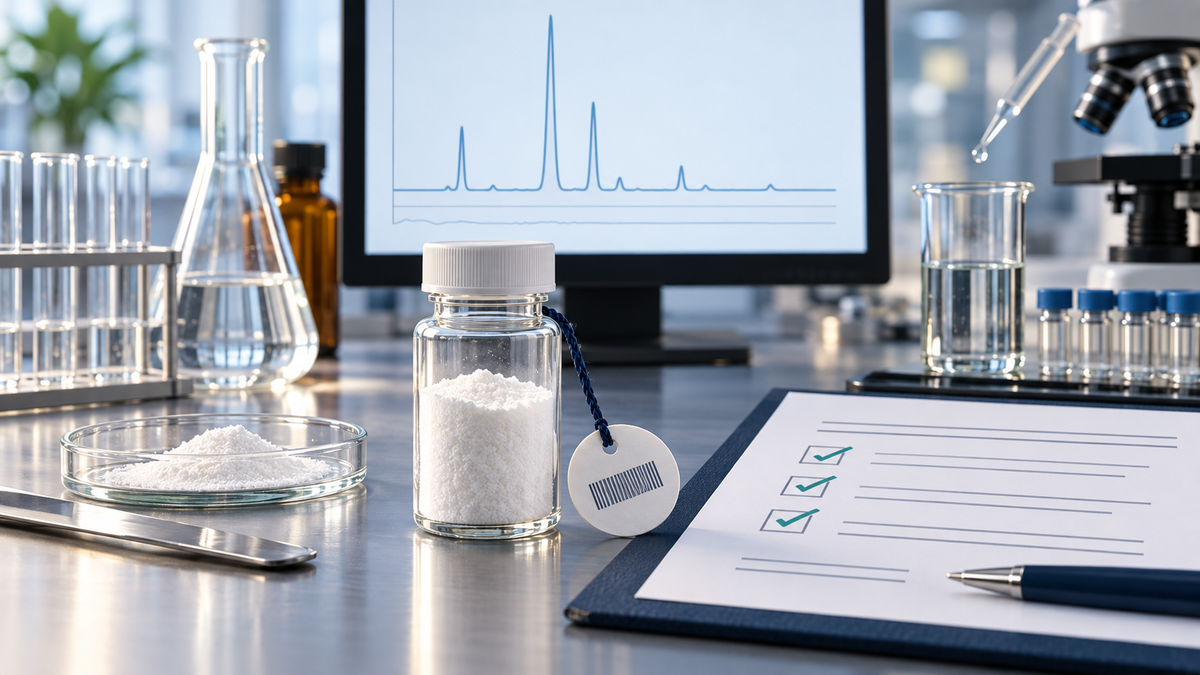
The 2026 Chng paper is important because its pentabromophenyl LC-MS/MS method could resolve α- and β-NMN under aqueous conditions rather than reporting an undifferentiated total. [3]
Consumers do not need to become analytical chemists. They do need to recognize that “NMN detected” and “correct β-NMN identity and amount verified” are different levels of evidence.
What does third-party tested mean?
It should mean an outside laboratory performed specified analyses. It does not automatically mean:
- every batch was tested;
- the finished product rather than only the raw powder was tested;
- the lab tested the actual labeled dose;
- the report distinguishes NMN isomers;
- the product was tested for every relevant contaminant;
- the brand has published the report.
Ask what was tested, on which lot, by which method, and whether you can see the report.
The Biohack Blueprint NMN testing-evidence ladder
To keep product reviews consistent, Biohack Blueprint uses a hierarchy rather than treating every “lab tested” badge as equivalent.
| Level | Evidence | What it actually tells you |
|---|---|---|
| Level 4 — strongest | Current, lot-matched finished-product report with numeric identity/potency and relevant contaminants | The exact batch being sold was analytically checked after manufacturing |
| Level 3 | Finished-product report with numeric potency, but current-lot matching is unclear | That formula has been measured, but not necessarily your bottle |
| Level 2 | Raw-material supplier COA or branded-ingredient specification | The incoming ingredient met a specification before final manufacturing |
| Level 1 | “Third-party tested,” GMP or ISO-lab claim without a public product-specific result | A quality process is claimed, but the buyer cannot independently verify the measured serving |
| Level 0 | No meaningful analytical documentation | The label is doing almost all the evidentiary work |
This hierarchy is deliberately strict. A Level 2 branded raw-material certificate can coexist with an excellent finished product; it simply answers a different question from a Level 4 finished-batch assay.
Four COA mismatches that should stop a buyer from overinterpreting a report
- Wrong stage: the report tests bulk raw NMN, while the label claim is for finished capsules or powder after manufacturing.
- Wrong SKU: a brand links testing for a 500 mg product while you are buying the 1,000 mg or liposomal formula.
- Wrong lot: the document is real but belongs to a historical batch rather than the one being shipped.
- Wrong analyte: the report proves heavy-metal compliance but never measures NMN identity or potency.
A fifth problem is subtler: a report may measure “total NMN” without resolving whether the material matches the β-NMN form emphasized in the clinical literature.
What a numerical potency result lets you calculate
If a laboratory reports a finished capsule at 513.2 mg against a 500 mg label, you can calculate label accuracy directly: measured amount ÷ label amount × 100. A vague “PASS” does not give the reader that information.
For powders, check whether the assay is reported as percentage by weight, mg/g or mg per defined scoop. Those units are convertible only if the sample mass and serving definition are clear.
Clinical evidence and analytical quality are two separate axes
A pristine COA does not prove a health benefit. It proves that the tested sample better matches what the label says. Conversely, a human RCT on a branded β-NMN ingredient does not prove that an unrelated retail bottle contains the same dose or even the correct amount of NMN.
Our product reviews therefore ask two independent questions:
- Did the exact bottle pass a strong analytical verification standard?
- How directly can human research be transferred to this ingredient, dose and formulation?
The strongest product would perform well on both axes. This is the framework used in our 2026 NMN comparison.
How to verify NMN quality
Red flags in NMN COAs
- A report with no lot number or a lot number that does not match the bottle.
- A report years older than the purchased batch.
- A raw-material supplier certificate presented as finished-product testing.
- Only heavy-metal testing with no NMN identity or potency assay.
- Only a purity percentage with no mg-per-serving confirmation.
- A cropped screenshot with laboratory and method information removed.
- A brand that says 'third-party tested' but refuses to show documentation.
- A report for one flagship product used to imply every SKU is tested identically.
Does FDA or EFSA testing guarantee product quality?
No. Dietary-supplement regulation does not mean FDA laboratory-tests each bottle before sale. An NDI notification is not batch certification. Likewise, EFSA's 2026 scientific opinion evaluated a specific β-NMN material and proposed use under a defined dossier; it does not authenticate every commercial product using the letters “NMN.” [4]
Does branded NMN guarantee quality?
A branded raw material can improve traceability and may have its own specifications or regulatory dossier, but the finished supplement still needs appropriate manufacturing and testing. The capsule can differ from the bulk ingredient through dose error, excipients, storage, degradation or supply-chain substitution.
How much potency deviation is acceptable?
There is no single universal percentage we can apply to every NMN product without reference to the product specification and applicable regulatory framework. The relevant point is that enormous deviations—especially products containing little or none of the declared active ingredient—are not small manufacturing noise.
How to verify an NMN product before buying
- Find the exact product and serving size.
- Look for a batch-specific COA, not a generic quality page.
- Match the lot number.
- Confirm NMN identity and quantitative assay.
- Prefer β-NMN identity data when the label claims β-NMN.
- Check contaminants appropriate to the dosage form.
- Check the manufacturing and laboratory dates.
- See whether the manufacturer names the testing laboratory and method.
- Compare the COA dose with the Supplement Facts panel.
The three quality questions most NMN labels blur together
Identity asks whether the material is actually the claimed molecule. Purity asks what proportion of the tested material is the target compound rather than impurities. Potency asks how much target compound is present in the finished serving. A product can perform well on one and poorly on another.
For example, raw powder could be 99.8% pure β-NMN while a manufacturing error leaves the finished capsules with only 350 mg instead of a labeled 500 mg. A raw-material purity certificate would not detect the underfill.
What independent testing has found
What the independent label-accuracy study found
Sandalova and colleagues analytically tested marketed NMN products rather than relying on brand documentation. The measured amount of active ingredient varied widely relative to the label claim, with some products showing essentially no detectable labeled NMN. [5]
The practical implication is significant: if a trial used 300 mg/day of verified NMN, a retail product labeled “300 mg” cannot be assumed to reproduce that exposure without credible assay data.
Why β-NMN versus α-NMN matters
NMN exists as stereochemical/isomeric forms. The mainstream supplement and clinical literature centers on β-NMN. A generic assay that detects total NMN but does not resolve isomers can miss whether the material matches the form described on the label.
The 2026 Chng paper developed a fully aqueous LC-MS/MS method capable of separating α-NMN and β-NMN within minutes, then applied it to eight commercial supplements. The products showed substantial variation in isomer composition, including undeclared or inaccurate ingredients. [6]
How to read an NMN COA
Raw-material COA versus finished-product COA
| Document | What it can show | What it cannot prove by itself |
|---|---|---|
| Raw-material supplier COA | Identity/purity of incoming NMN powder | Correct amount in the final capsule or scoop |
| In-house finished-product test | Batch potency if method is valid | Independent verification |
| Third-party finished-product COA | Independent batch identity/potency and selected contaminants | Every future batch unless each lot is tested |
| Marketing '99% pure' badge | A claim | Method, lot, actual serving potency or contaminant profile |
How to read the assay line
A useful potency report should state the measured result and the acceptable specification. If a 500 mg serving is expected to contain within a defined manufacturing range, the report should make that relationship visible rather than merely reporting “pass.”
Also check whether the assay is performed on the finished dosage form. Testing one gram of supplier powder is not the same as testing a capsule after blending, encapsulation and storage.
Heavy metals, microbes and solvents
NMN identity is only one dimension of quality. Depending on the manufacturing process and dosage form, a finished-product panel may also include lead, arsenic, cadmium, mercury, microbial counts, pathogens and residual solvents.
A product can contain the correct amount of NMN and still fail on a contaminant specification. Conversely, a clean heavy-metal report tells you nothing about whether NMN is present at the labeled dose.
What does “GMP manufactured” tell you?
Good manufacturing practice addresses systems, documentation and process control. It is valuable, but it does not substitute for seeing the batch's analytical result. GMP status and product assay answer different questions.
What ISO/IEC 17025 laboratory accreditation means
ISO/IEC 17025 accreditation can indicate that a laboratory has demonstrated competence for specified testing scopes. It does not automatically validate every analysis the lab performs. Ideally, the relevant NMN identity or assay method should fall within an appropriate validated or accredited testing capability.
How a buyer can audit a COA in five minutes
- Match the lot number on the bottle to the report.
- Check the sample description: raw material or finished product?
- Find the identity test and the quantitative NMN assay.
- Check whether β-NMN is specifically verified where claimed.
- Look at the measured result, units and acceptance range.
- Confirm the report date and laboratory identity.
- Check relevant contaminant tests rather than assuming one panel covers everything.
- Be suspicious of a cropped image that hides sample, lot, method or lab details.
How Biohack Blueprint evaluates NMN purity
Why Amazon reviews cannot establish purity
A consumer cannot reliably detect a 20%, 50% or 100% potency shortfall by taste or perceived energy. Subjective response varies too much, and NMN itself does not have a unique sensory signature that validates identity.
Stability is part of purity over time
The COA may represent the product on the day it was tested. Shelf-life quality requires packaging, moisture control and stability data showing that potency remains within specification through expiration. This is especially important for powders or liquids exposed repeatedly to air and humidity.
How we will use purity in Biohack Blueprint reviews
Our product pages separate ingredient evidence from finished-product verification. A brand receives credit for transparent lot-specific testing, but a clinical trial on a branded raw material does not automatically validate every formula that uses it. That same standard will be applied in the best NMN supplement guide.
Related NMN guides
- best NMN supplements
- Uthever NMN
- NMN regulatory status
- dose verification
- NMN supplement guide
- where to buy NMN safely
Bottom line
For NMN, the first buying question should not be “liposomal or capsule?” It should be “does this bottle contain the correct amount of the correct ingredient?” Published independent testing makes that a scientific concern, not consumer paranoia.
We apply this framework in our best NMN supplement guide and every brand review.
Frequently asked questions
What purity should NMN be?
How can I tell if an NMN supplement is real?
What should an NMN COA include?
Does third-party tested mean every batch is tested?
Is beta-NMN the form used in human studies?
Can I test NMN at home?
Does a branded ingredient like Uthever guarantee the final product?
Can NMN degrade during storage?
What does lot-matched NMN testing mean?
Is a raw-material NMN COA enough?
Sources & article history
Sources (3)
-
Testing the amount of nicotinamide mononucleotide and urolithin A as compared to the label claim GeroScience. 2024;Volume 46, pages 5075–5083.
-
Aqueous LC-MS/MS quantification of α-/β-nicotinamide mononucleotide in dietary supplements using a pentabromophenyl column Analytica Chimica Acta. 2026;1386:345027.
-
Safety of beta-nicotinamide mononucleotide (β-NMN) pursuant the regulation (EU) 2015/2283 and the bioavailability of nicotinamide from this source in the context of Directive 2002/46/EC EFSA Journal. 2026;24(5):e10007.