Nutricost NMN Review: Cheap, Simple—and Missing the Evidence Chain We Want
Nutricost NMN is inexpensive and third-party tested, but its current product page does not identify a branded clinically studied NMN source or provide the same public lot-level evidence trail as stronger competitors.
 By
Dr. Khaled Mahmoud, MBBCh
Critical Care Medicine, Longevity Science & Editorial Direction
By
Dr. Khaled Mahmoud, MBBCh
Critical Care Medicine, Longevity Science & Editorial Direction
 Reviewed by
Dr. Amr Yasser, PhD
Cardiometabolic, Musculoskeletal, Gut & Bioavailability
Reviewed by
Dr. Amr Yasser, PhD
Cardiometabolic, Musculoskeletal, Gut & Bioavailability
 Reviewed by
Dr. Abdulla Mostafa, PhD
Cellular Senescence, Neurological, Mitochondrial & Brain-Ageing Biology
Reviewed by
Dr. Abdulla Mostafa, PhD
Cellular Senescence, Neurological, Mitochondrial & Brain-Ageing Biology
- Published
- Last reviewed
- Reading time
- 6 min
- Sources cited
- 3
On this page
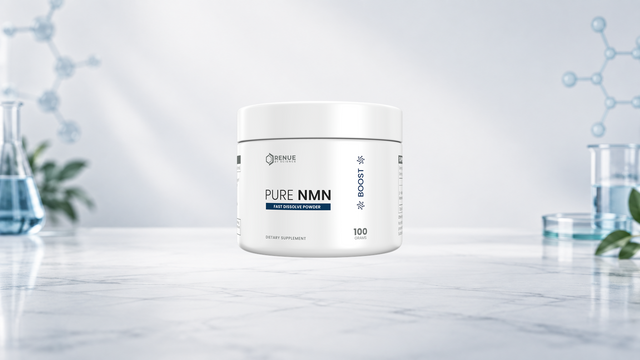
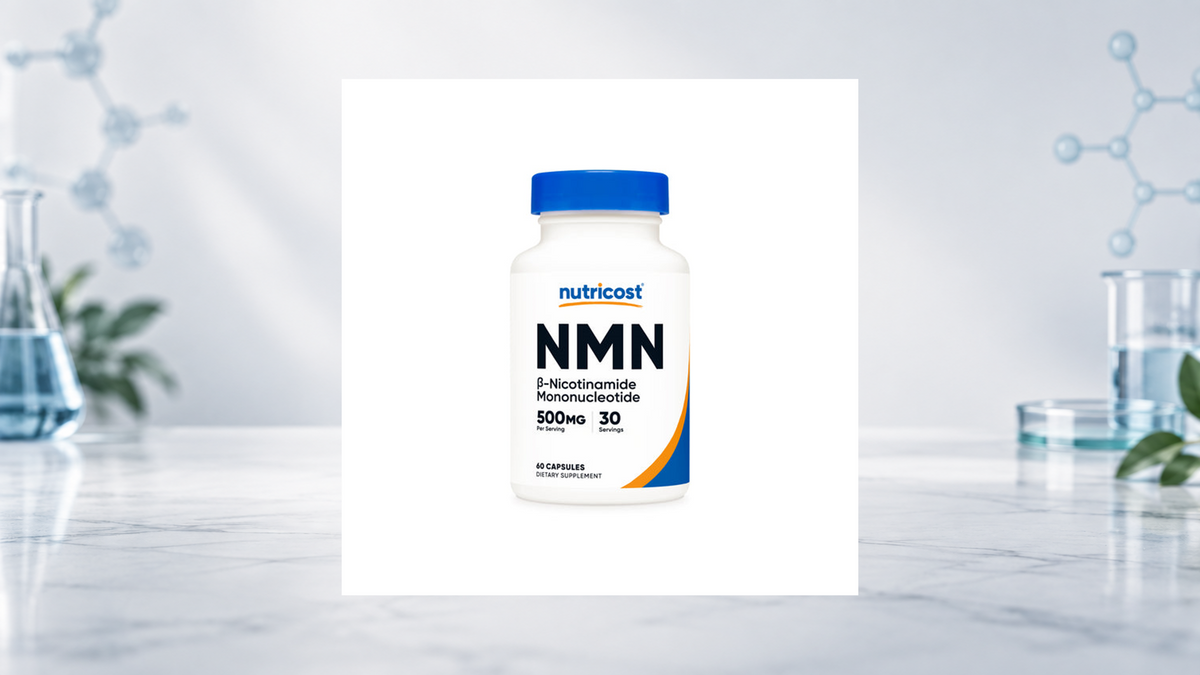
This Nutricost NMN review starts with its clearest advantage: price. The current listing is around $21.97 for 60 capsules, with a 500 mg serving delivered by two capsules. It is vegetarian-friendly and the brand states that it is third-party tested by ISO-accredited laboratories.
None of that makes Nutricost a bad product. It does mean that the reason to choose it is mostly price, not a superior evidence chain.
How we verified this review: We checked Nutricost's current product information, label and serving size, ingredient/source claims, public certificates or testing documentation when available, current one-time pricing, and how the retail dose/formula maps to published human NMN evidence. Biohack Blueprint did not independently laboratory-assay the retail lot unless explicitly stated.
Why we do not rank Nutricost near the top
- The current product page does not identify a named Uthever-style clinically studied NMN source.
- We did not find a product-page-linked lot-specific finished-product COA comparable with Renue's public system.
- The exact finished product has no published randomized clinical outcome trial.
- Third-party tested is useful but does not tell the buyer what was tested, on which lot, unless the report is available.
- Low cost cannot substitute for identity, potency and evidence traceability.
Con #1: generic NMN source
The current Nutricost page lists NMN but does not identify a branded β-NMN source tied to a published human trial. That makes it harder to connect the bottle to ingredient-level evidence.
This is not proof that the material is poor. It is simply a weaker evidence chain than a product explicitly using Uthever.
Con #2: testing claim without easy lot-level audit
Nutricost states that the product is third-party tested by ISO-accredited laboratories. That's good as a baseline claim. We did not find a public lot-matched NMN COA directly linked from the product page during this review.
Independent NMN testing shows why this matters. Some commercial products have contained far less NMN than their labels claimed. [1]
Con #3: no visible isomer-specific evidence
Most human NMN evidence concerns β-NMN. A 2026 analytical study showed that commercial supplements can vary in α-/β-NMN composition. [2]
We would prefer a product to show that the actual finished batch contains the claimed amount of β-NMN, not merely “NMN.”
Con #4: no product-specific clinical trial
The 500 mg dose sits inside the general human NMN research range, but Nutricost's specific capsules have not been shown in a randomized trial to reproduce a clinical endpoint.
The broader 2026 meta-analysis also reminds us that NMN class evidence is mixed beyond NAD+ biomarkers. [3]
What the low price does mean
At about $21.97, Nutricost dramatically lowers the financial barrier to trying a 500 mg/day NMN routine. If the exact finished batch is independently verified, low price is not inherently a flaw.
Our ranking simply gives more weight to traceable ingredient evidence and transparent batch documentation than to price alone.
Nutricost versus DoNotAge
| Nutricost NMN | DoNotAge Pure NMN | |
|---|---|---|
| Serving | 500 mg / 2 capsules | 500 mg per capsule/scoop |
| Price positioning | Budget | Premium-mid |
| Named Uthever ingredient | Not identified on current page | Yes |
| Third-party testing claim | Yes; ISO-accredited labs | Yes |
| Public ingredient evidence chain | Limited | Clearer |
| Our recommendation | Budget fallback | #1 overall |
What does ISO-accredited testing actually tell us?
Using an ISO-accredited laboratory can be a positive quality signal, but accreditation is scope-specific. The phrase does not tell a buyer whether every finished NMN lot was tested for identity, potency, isomer composition, heavy metals and microbiology—or whether only selected tests were performed.
That is why we prefer to see the actual report rather than a testing badge.
Could Nutricost still be chemically excellent?
Absolutely. A generic source can be authentic, high-purity β-NMN and accurately dosed. Our criticism is not that the product is fake; it is that the public evidence trail is thinner. An evidence-first ranking has to distinguish “could be excellent” from “we can independently verify more of the chain.”
500 mg is a sensible commercial dose—but not a product-specific proof point
Five hundred milligrams sits comfortably inside the studied human range. It is neither obviously too low nor unusually high. But the exact Nutricost capsules have not been shown to raise NAD+ by a defined percentage or improve a clinical endpoint in their own trial.
What does the price comparison really show?
At roughly $21.97 per 30-serving bottle, Nutricost is dramatically cheaper than most specialty longevity brands. That can make it attractive for cost-sensitive buyers and highlights how much of the premium in this category may come from branded ingredients, testing systems, packaging and marketing.
We do not penalize low price. We penalize missing evidence transparency.
Capsule simplicity is a quiet advantage
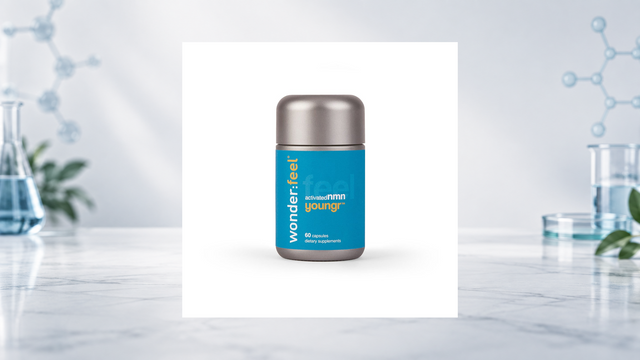
Unlike Wonderfeel, Nutricost does not complicate attribution with multiple active longevity ingredients. If the ingredient source and lot documentation were more transparent, that simplicity would make the product easier to evaluate.
What would move Nutricost up our ranking?
- Publish the current lot's finished-product COA.
- Confirm β-NMN identity explicitly.
- Identify the raw-material supplier or branded source.
- Show quantitative potency per serving, not only generic third-party testing.
- Keep the simple single-ingredient formula.
What Nutricost would need to prove parity with premium NMN
A branded ingredient is not scientifically mandatory. Nutricost could close most of the evidence gap without changing the formula at all by publishing three things: the raw-material identity, a lot-matched finished-product assay confirming β-NMN and the relevant contaminant results. If those documents were strong, a low-cost generic NMN could be every bit as chemically credible as a premium product.
This is why our review does not equate “generic” with “inferior.” It equates less publicly verifiable information with lower confidence.
Does the simple capsule format help?
Yes. Two capsules for 500 mg is easy to understand and close to conventional oral formats used throughout the human NMN literature. There is no liposomal, delayed-release or sublingual claim that requires a separate evidence bridge.
That simplicity is preferable to paying for a delivery system that has not demonstrated superior clinical outcomes.
Who is the Nutricost product most suitable for?
The strongest case is a price-sensitive buyer who wants a simple 500 mg capsule product and is comfortable requesting or independently verifying documentation before purchase. The weakest case is an evidence-first buyer who wants the clearest possible chain from named ingredient supplier to human trial to finished-batch report.
What we would ask Nutricost before buying
- Which NMN raw-material supplier is used for the current lot?
- Is the material specifically verified as β-NMN?
- Can you provide the finished-product potency report for the bottle lot?
- Does that report include heavy metals and microbiological testing?
- Are the 500 mg label claim and capsule content confirmed after encapsulation rather than only on incoming raw powder?
Related NMN guides
Bottom line
Nutricost NMN is cheap, simple and backed by a generic third-party-testing claim. What it lacks is the evidence traceability we want from a longevity supplement: a named clinically studied source and easily auditable lot-level finished-product documentation. For a price-first buyer it is reasonable; for an evidence-first buyer we prefer DoNotAge.
Frequently asked questions
How much NMN is in Nutricost NMN?
Is Nutricost NMN third-party tested?
Does Nutricost use Uthever?
Is Nutricost NMN clinically tested?
Why is Nutricost NMN so much cheaper?
Nutricost or DoNotAge: which do we recommend?
Sources & article history
Sources (3)
-
Testing the amount of nicotinamide mononucleotide and urolithin A as compared to the label claim GeroScience. 2024;Volume 46, pages 5075–5083.
-
Aqueous LC-MS/MS quantification of α-/β-nicotinamide mononucleotide in dietary supplements using a pentabromophenyl column Analytica Chimica Acta. 2026;1386:345027.
-
Safety and Metabolism-Related Outcomes of Oral Nicotinamide Mononucleotide Supplementation in Adults: A Systematic Review and Meta-Analysis Nutrients. 2026;18, 2251.