iHealth NMN Review: Strong Quality Testing, Weak Marketing Discipline
iHealth has credible independent NMN quality certification, but its marketing claims go much further than the clinical evidence. We audit Gene Balance, testing, FDA language and the biggest drawbacks.
 By
Dr. Khaled Mahmoud, MBBCh
Critical Care Medicine, Longevity Science & Editorial Direction
By
Dr. Khaled Mahmoud, MBBCh
Critical Care Medicine, Longevity Science & Editorial Direction
 Reviewed by
Dr. Amr Yasser, PhD
Cardiometabolic, Musculoskeletal, Gut & Bioavailability
Reviewed by
Dr. Amr Yasser, PhD
Cardiometabolic, Musculoskeletal, Gut & Bioavailability
 Reviewed by
Dr. Abdulla Mostafa, PhD
Cellular Senescence, Neurological, Mitochondrial & Brain-Ageing Biology
Reviewed by
Dr. Abdulla Mostafa, PhD
Cellular Senescence, Neurological, Mitochondrial & Brain-Ageing Biology
- Published
- Last reviewed
- Reading time
- 8 min
- Sources cited
- 3
On this page
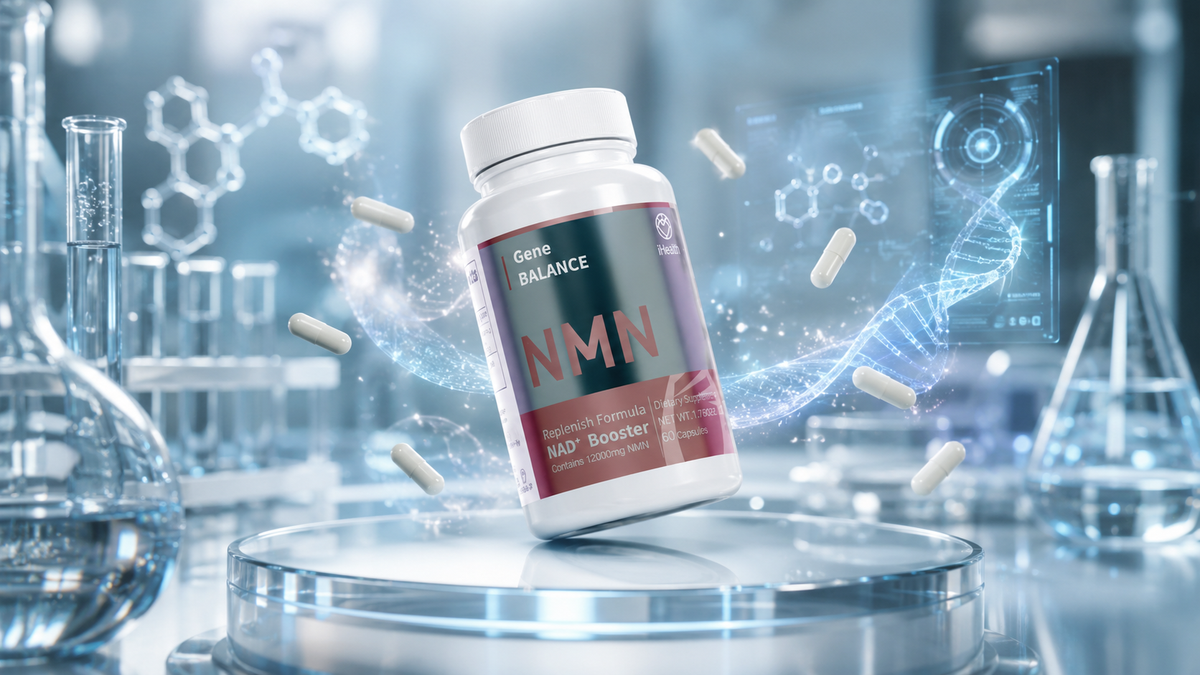
iHealth NMN has better independent quality evidence than many NMN brands—but its marketing is much stronger than its clinical evidence. ConsumerLab currently lists three iHealth NMN products as approved through its quality-certification program, which deserves real credit. The problem is what happens after that quality point: iHealth pages use unusually expansive language around anti-aging, cellular rejuvenation, cognition, immunity and disease-related outcomes that finished-product clinical trials have not established.
This review focuses on the downside and evidence gaps because quality testing and efficacy are different questions. A bottle can contain authentic NMN and still be marketed far beyond what NMN trials show.
How we verified this review: We checked iHealth's current product information, label and serving size, ingredient/source claims, public certificates or testing documentation when available, current one-time pricing, and how the retail dose/formula maps to published human NMN evidence. Biohack Blueprint did not independently laboratory-assay the retail lot unless explicitly stated.
iHealth NMN at a glance
| Question | Our finding |
|---|---|
| Independent quality certification? | Yes. ConsumerLab lists Gene Balance, NMN Coffee and NMN Refresh as approved through its quality-certification program. |
| Public testing information? | Yes. iHealth publishes analytical-content information for several current NMN products. |
| Finished-product randomized efficacy trial? | We did not identify one for the current Gene Balance product. |
| Simple single-ingredient formula? | Not consistently; current portfolio includes NMN plus resveratrol and other formats. |
| Marketing restraint? | Weak. Several official or brand-linked pages make claims materially broader than the human NMN evidence. |
| Our position | Credible quality signals, but not a top-five recommendation because the evidence-to-marketing gap is too large. |
Con #1: iHealth's marketing often outruns human NMN evidence
The biggest issue is not whether iHealth can supply real NMN. It is how the product is framed. Current iHealth-branded pages describe NMN in terms of restoring youth, improving cellular aging, cognition, immunity, metabolism and other broad outcomes. Some regional pages go further with disease-adjacent testimonials and language around chronic conditions.
The 2026 NMN meta-analysis is much more restrained. Across 15 randomized trials, NMN showed broadly reassuring short-term tolerability, but no significant pooled effect on body weight, BMI, fasting glucose, HbA1c, lipid profiles or systolic blood pressure. [1]
Authentic NMN can raise NAD-related biomarkers. That does not validate every downstream claim attached to a retail product.
Con #2: “10,000” and “12,000” are poor numbers for clinical comparison
iHealth uses names such as Gene Balance 10000 Plus and NMN 12000. The company's own testing page presents those figures as total NMN content across the product. That may be accurate as a bottle-content specification, but it is not how clinical trials are normally interpreted.
A reader comparing research needs to know milligrams of β-NMN per daily serving, not the largest number printed in the product name. Human trials are discussed as 250 mg/day, 300 mg/day, 600 mg/day, 900 mg/day, 1,000 mg/day and so on.
This naming architecture creates avoidable confusion, especially because your keyword data shows consumers actively searching terms such as “NMN 10000,” “NMN 18000” and other large-number formulations.
Con #3: certification language can be mistaken for efficacy approval
iHealth has displayed an FDA Certificate of Free Sale, PDR inclusion, manufacturing certifications and other documentation. Those can answer specific regulatory or manufacturing questions. They do not mean “FDA approved anti-aging supplement.”
A historical iHealth Certificate of Free Sale shown in company materials was issued for trade/regulatory documentation; it should not be converted into evidence that FDA clinically evaluated NMN for reversing aging or treating disease.
The distinction matters even more because NMN's U.S. regulatory history changed in 2025. See our current NMN FDA, EU and UK status guide.
Where iHealth deserves credit: ConsumerLab quality certification
Unlike many brands that rely entirely on their own “third-party tested” badge, iHealth has an independent signal worth taking seriously. ConsumerLab currently lists three iHealth NMN products as approved through its Quality Certification Program, but the certification entries shown by ConsumerLab are dated 2022. That is independent quality history—not a fresh 2026 lot assay. The listed products are:
- iHealth NMN Gene Balance;
- iHealth NMN Coffee; and
- iHealth NMN Refresh Electrolyte Drink
as products approved through its quality-certification program.
That improves confidence that the products tested for the certification program met ConsumerLab's applicable quality criteria at that time. It does not establish clinical effectiveness, and a 2022 certification record should not be presented as if it independently verified every 2026 production lot or every product in the iHealth catalogue.
iHealth's own analytical testing is useful—but read what was actually measured
iHealth publishes a table reporting measured NMN concentration and calculated total NMN content for several products. For example, the page reports total contents above the stated 12,000 mg and 10,000 mg thresholds for two Gene Balance products.
That is more useful than a vague “lab tested” logo because there is a numeric result. The next level of transparency would be a consistently accessible, current, lot-matched finished-product report showing sample identity, batch number, method, potency, contaminants, laboratory and date.
This matters because independent research has found large label-claim deviations among commercial NMN products. [2] A 2026 analytical study also showed why β-NMN identity and isomer-specific testing matter. [3]
Con #4: quality evidence is not finished-product efficacy evidence
We did not identify a randomized clinical trial testing the current iHealth Gene Balance finished formula against placebo for clinically meaningful outcomes.
This is an important distinction:
- Quality testing asks whether the tested product contains what it says.
- Ingredient clinical research asks what NMN can do under controlled conditions.
- Finished-product efficacy research asks whether this exact formula, dose and schedule produces the advertised outcome.
iHealth has meaningful evidence at the first level. The broader NMN literature contributes to the second. That does not automatically create the third.
Con #5: combination products make attribution harder
The current English iHealth shop features an NMN product combined with trans-resveratrol. That may be attractive to people who already want both ingredients, but it makes the finished product harder to interpret because no human randomized trial has established that NMN plus resveratrol produces better outcomes than NMN alone.
See our NMN and resveratrol evidence review for the combination problem.
Con #6: the product portfolio is difficult to compare apples-to-apples
iHealth sells or promotes capsules, coffee, electrolyte products and other NMN formats. Different products can have different NMN amounts, other ingredients and intended use. A quality result for one SKU should not be transferred automatically to another.
For an evidence-first buyer, a simpler product makes the chain easier to audit: exact β-NMN source → exact daily dose → exact finished-batch testing → relevant human evidence.
How iHealth compares with our #1 NMN pick
| Factor | iHealth NMN | DoNotAge Pure NMN |
|---|---|---|
| Independent quality signal | ConsumerLab quality certification for multiple iHealth NMN products | Public NMN CoA plus stated every-batch testing |
| Named clinically studied ingredient | Not the central current evidence story | Uthever® β-NMN |
| Formula simplicity | Varies; several combination formats | Single active NMN |
| Evidence transfer | General NMN literature; no finished-product RCT identified | Still no finished-product RCT, but explicit Uthever ingredient-to-trial link |
| Marketing restraint | Major weakness | Still broader than clinical outcomes in places, but easier to separate from the product evidence |
That is why iHealth does not displace DoNotAge Pure NMN as our recommended product.
Who might still consider iHealth?
The strongest reason is not an anti-aging promise. It is the existence of credible independent quality testing for multiple iHealth products. A buyer who values ConsumerLab certification and specifically wants one of the iHealth formats may view that as meaningful reassurance.
The buyer still needs to identify the exact SKU, daily β-NMN dose and current testing applicable to the bottle being purchased.
What we would need to rank iHealth higher
- Clear per-serving β-NMN amounts presented more prominently than cumulative “10000/12000” branding.
- Current lot-matched reports that are easy to connect to the exact retail product.
- Less disease-adjacent and “reverse aging” marketing.
- A randomized trial of a current finished formula.
- Clearer separation between regulatory documents, quality certification and efficacy evidence.
Related NMN guides
Bottom line
iHealth is more credible on product quality than its marketing language suggests—but that is exactly why the distinction matters. ConsumerLab quality certification is a real positive. The weakness is the leap from “tested product containing NMN” to broad anti-aging, vitality and disease-adjacent narratives. We would like to see the quality discipline matched by equally disciplined claims.
Frequently asked questions
Is iHealth NMN third-party tested?
Is iHealth NMN FDA approved?
What does iHealth NMN 10000 or 12000 mean?
Does iHealth NMN have a human clinical trial?
Is 99.8% purity enough to choose an NMN product?
Is iHealth NMN better than DoNotAge?
Who should be cautious with iHealth NMN?
Sources & article history
Sources (3)
-
Safety and Metabolism-Related Outcomes of Oral Nicotinamide Mononucleotide Supplementation in Adults: A Systematic Review and Meta-Analysis Nutrients. 2026;18, 2251.
-
Testing the amount of nicotinamide mononucleotide and urolithin A as compared to the label claim GeroScience. 2024;Volume 46, pages 5075–5083.
-
Aqueous LC-MS/MS quantification of α-/β-nicotinamide mononucleotide in dietary supplements using a pentabromophenyl column Analytica Chimica Acta. 2026;1386:345027.