ProHealth NMN Review: Uthever Is Credible, but the Marketing Claims Go Too Far
ProHealth uses Uthever NMN, but its product pages make claims about biological-age reversal, unique clinical proof and broad health benefits that exceed the peer-reviewed evidence.
 By
Dr. Khaled Mahmoud, MBBCh
Critical Care Medicine, Longevity Science & Editorial Direction
By
Dr. Khaled Mahmoud, MBBCh
Critical Care Medicine, Longevity Science & Editorial Direction
 Reviewed by
Dr. Amr Yasser, PhD
Cardiometabolic, Musculoskeletal, Gut & Bioavailability
Reviewed by
Dr. Amr Yasser, PhD
Cardiometabolic, Musculoskeletal, Gut & Bioavailability
 Reviewed by
Dr. Abdulla Mostafa, PhD
Cellular Senescence, Neurological, Mitochondrial & Brain-Ageing Biology
Reviewed by
Dr. Abdulla Mostafa, PhD
Cellular Senescence, Neurological, Mitochondrial & Brain-Ageing Biology
- Published
- Last reviewed
- Reading time
- 6 min
- Sources cited
- 3
On this page
This ProHealth NMN review has an unusual starting point: the product has one of the strongest ingredient pedigrees in the NMN market and some of the most aggressive marketing. That combination is exactly why it needs a skeptical review.
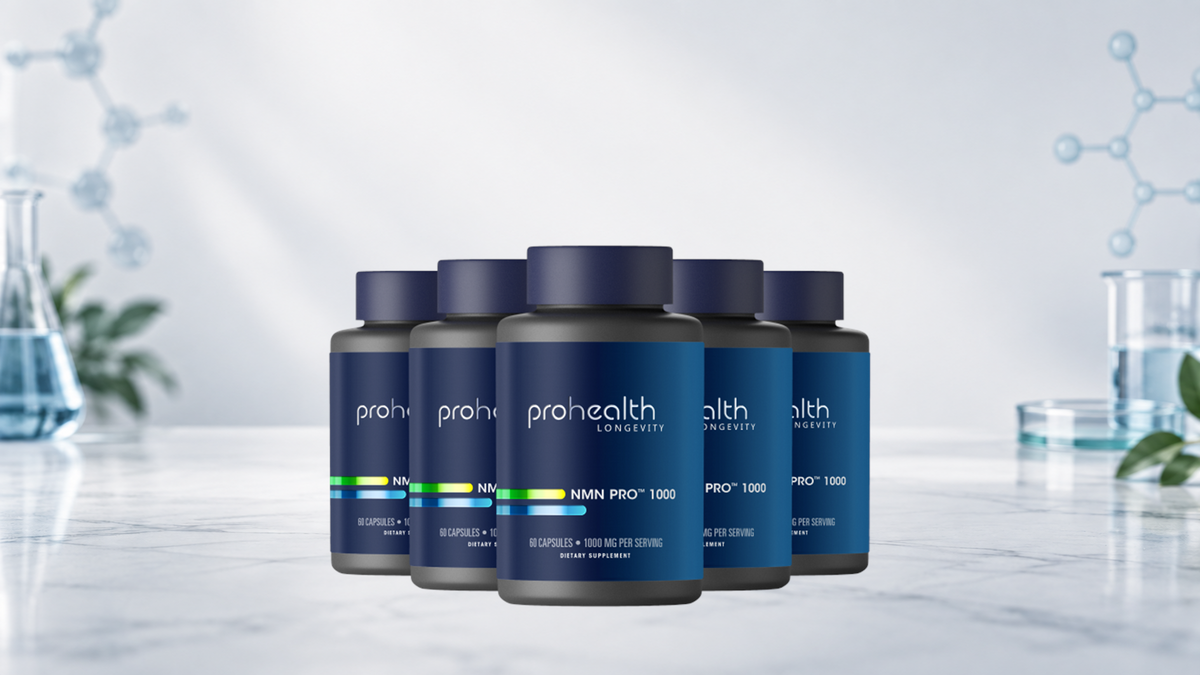
NMN Pro 1000 currently provides 1,000 mg Uthever β-NMN per serving in 60 capsules and is listed around $64.95 as a one-time purchase. Uthever has a legitimate published human randomized trial. The problem is that ProHealth repeatedly stretches that ingredient-level evidence into claims about “rewinding biological age,” broad anti-aging benefits and being the “only clinically-proven NMN.”
How we verified this review: We checked ProHealth's current product information, label and serving size, ingredient/source claims, public certificates or testing documentation when available, current one-time pricing, and how the retail dose/formula maps to published human NMN evidence. Biohack Blueprint did not independently laboratory-assay the retail lot unless explicitly stated.
Why ProHealth is not our #1 recommendation
- The marketing is substantially stronger than the human evidence.
- The 1,000 mg serving is not the dose used in the published 300 mg/day Uthever RCT.
- The exact finished product does not have its own randomized clinical outcome trial.
- The price is materially higher than budget and powder competitors.
- Several product pages blur ingredient research, animal evidence and finished-product claims.
Con #1: “only clinically-proven NMN” is too broad
ProHealth's current powder page calls its NMN the “Only Clinically-Proven NMN.” That phrasing is difficult to defend in 2026 because many NMN formulations have now been studied in human randomized trials.
Uthever does have a published 60-day RCT at 300 mg/day. [1] But Pencina's MIB-626 studies, Yoshino's 250 mg trial, Yi's dose-ranging work, the 2026 precursor comparison and many others are also clinical NMN research.
Con #2: the “12-year biological age reversal” framing is not a proven anti-aging endpoint
ProHealth product marketing states that a clinical study showed a “12-year reversal in biological age.” That wording sounds much stronger than the peer-reviewed evidence warrants.
Biological-age algorithms are surrogate models, not direct measures of regained lifespan or organ rejuvenation. The Uthever RCT did not establish that participants became clinically twelve years younger or that their mortality risk was reset by twelve years.
Con #3: 1,000 mg sounds more powerful than the trial that supports the ingredient
The Uthever paper used 300 mg/day. NMN Pro 1000 supplies 1,000 mg per serving. One gram is within modern research exposure—the 2026 direct precursor trial also used 1,000 mg/day—but that does not prove ProHealth's higher dose provides greater benefits. [2]
Higher dose increases cost and exposure. It needs an outcome advantage to justify being presented as inherently better.
Con #4: health claims on the collection pages are too expansive
Current ProHealth pages describe NMN as improving heart health, muscle strength, neurological function, body weight and gene expression, and use language about epigenetic reprogramming and rewinding biological age.
The 2026 meta-analysis is far more restrained: pooled weight, BMI, fasting glucose, HbA1c and lipid outcomes were largely null. [3]
That evidence gap matters more to us than whether the site uses an FDA disclaimer.
Con #5: the absorption story is not product-specific clinical proof
ProHealth markets certain powder formats as sublingual, claiming increased bioavailability and faster delivery. A 2026 sublingual NMN study does show route-dependent metabolite kinetics, but it does not validate every sublingual powder or prove superior clinical outcomes.
Standard oral NMN already raises human NAD+; “absorbs faster” is not equivalent to “works better.”
Testing and Uthever are still real positives
ProHealth states that every batch is third-party tested in U.S. laboratories and that COAs are available. Uthever is a named β-NMN ingredient with a clinical history. Those are meaningful strengths.
Our issue is not that ProHealth lacks quality signals. It is that those quality signals are used alongside benefit language that runs ahead of what the randomized literature can support.
Price context
NMN Pro 1000 is currently listed around $64.95 for a one-time purchase. That is not the most expensive option in this comparison, but it is substantially above Nutricost and above Renue's current 100 g powder price on a raw-mass basis.
At premium pricing, we want premium evidence discipline—not just a premium dose.
ProHealth versus DoNotAge
| ProHealth NMN Pro 1000 | DoNotAge Pure NMN | |
|---|---|---|
| NMN source | Uthever | Uthever |
| Labeled dose | 1,000 mg/serving | 500 mg capsule/scoop; 1,000 mg recommended |
| Ingredient RCT | Uthever 300 mg/day | Same Uthever evidence base |
| Testing claim | Every batch; COAs available | Every batch; purity/potency testing claimed |
| Marketing restraint | Low | Still broad, but less dependent on 'only clinically proven' framing |
| Our recommendation | Strong competitor | #1 overall |
How much of ProHealth's evidence belongs to Uthever rather than ProHealth?
This is the central review question. The published randomized trial studied Uthever at 300 mg/day. A retailer using Uthever can legitimately say its ingredient source has human research behind it. It cannot automatically claim that a different 1,000 mg finished capsule product reproduced every trial outcome.
This distinction is especially important because ProHealth sells several NMN formats—capsules, powders, blends and liposomal products. The evidence cannot be transferred identically across all of them simply because the same trademark appears somewhere in the formula.
What about the customer-review volume?
ProHealth has thousands of product reviews. That is useful for understanding taste, capsule tolerance and customer experience, but review volume cannot validate claims such as biological-age reversal. People self-select into buying, know what they are taking and often change multiple health behaviors at once.
Does the 1,000 mg serving have a safety advantage or disadvantage?
Short human studies at gram-level NMN exposure are broadly reassuring, but the higher dose creates more exposure without proven proportional clinical benefit. For a supplement intended for years of use, dose efficiency matters: if 250–300 mg already changes NAD biology, the justification for 1,000 mg should be outcome-based rather than simply “more precursor.”
Why the 'rewind biological age' language matters
Biological-age calculators can be useful research tools, but there are many different clocks and algorithms. A large change in one calculated score does not necessarily predict lower mortality, fewer diseases or slower functional decline. Marketing a modeled age score as if the body literally became twelve years younger risks confusing a surrogate with a clinical endpoint.
What would improve this product's evidence positioning?
- Retire the “only clinically proven NMN” language.
- Describe the Uthever study at its actual 300 mg dose.
- Separate NAD biomarker findings from biological-age claims.
- Make lot-matched finished-product COAs easy to access for each current batch.
- Use route-specific evidence before claiming enhanced absorption for nonstandard formats.
Related NMN guides
Bottom line
ProHealth is not a bad NMN product. It is a credible Uthever product wrapped in marketing that asks the evidence to carry more weight than it can. We prefer DoNotAge because it gives us the same branded ingredient pedigree without making “only clinically proven” and dramatic biological-age language central to the sales case.
Frequently asked questions
Is ProHealth NMN clinically proven?
Does ProHealth NMN reverse biological age by 12 years?
Is ProHealth the only clinically proven NMN?
Is 1,000 mg of ProHealth NMN necessary?
Does ProHealth third-party test its NMN?
ProHealth or DoNotAge: which do we prefer?
Is ProHealth's enhanced-absorption language proven?
Sources & article history
Sources (3)
-
A Multicentre, Randomised, Double Blind, Parallel Design, Placebo Controlled Study to Evaluate the Efficacy and Safety of Uthever (NMN Supplement), an Orally Administered Supplementation in Middle Aged and Older Adults Frontiers in Aging. 2022;3:851698.
-
The differential impact of three different NAD+ boosters on circulatory NAD and microbial metabolism in humans Nature Metabolism. 2026;Volume 8, issue 1, pages 62–73.
-
Safety and Metabolism-Related Outcomes of Oral Nicotinamide Mononucleotide Supplementation in Adults: A Systematic Review and Meta-Analysis Nutrients. 2026;18, 2251.