
What is Ca-AKG supplement? A plain-English guide
What is Ca-AKG? A plain-English guide to calcium alpha-ketoglutarate, what AKG does in the body, why it is sold for longevity, and what it is not.
 By
Dr. Khaled Mahmoud, MBBCh
Critical Care Medicine, Longevity Science & Editorial Direction
By
Dr. Khaled Mahmoud, MBBCh
Critical Care Medicine, Longevity Science & Editorial Direction
 Reviewed by
Dr. Amr Yasser, PhD
Cardiometabolic, Musculoskeletal, Gut & Bioavailability
Reviewed by
Dr. Amr Yasser, PhD
Cardiometabolic, Musculoskeletal, Gut & Bioavailability
 Reviewed by
Dr. Abdulla Mostafa, PhD
Cellular Senescence, Neurological, Mitochondrial & Brain-Ageing Biology
Reviewed by
Dr. Abdulla Mostafa, PhD
Cellular Senescence, Neurological, Mitochondrial & Brain-Ageing Biology
- Published
- Last reviewed
- Reading time
- 9 min
- Sources cited
- 10
On this page
Ca-AKG stands for calcium alpha-ketoglutarate. It is a supplement form of alpha-ketoglutarate (AKG), a molecule your body already makes and uses in normal metabolism.
If you searched “what is Ca-AKG supplement?” the most useful answer is simple: it is AKG bound to calcium as a salt. The interesting part is not the name on the bottle. It is the biology of AKG — and the much harder question of whether taking extra AKG as a supplement changes human aging in a meaningful way.
This page is the plain-English introduction. For the full benefits, safety, dose and longevity evidence, see our calcium alpha-ketoglutarate evidence guide. Every research citation below also maps to our Ca-AKG Data Center.
What is Ca-AKG in one sentence?
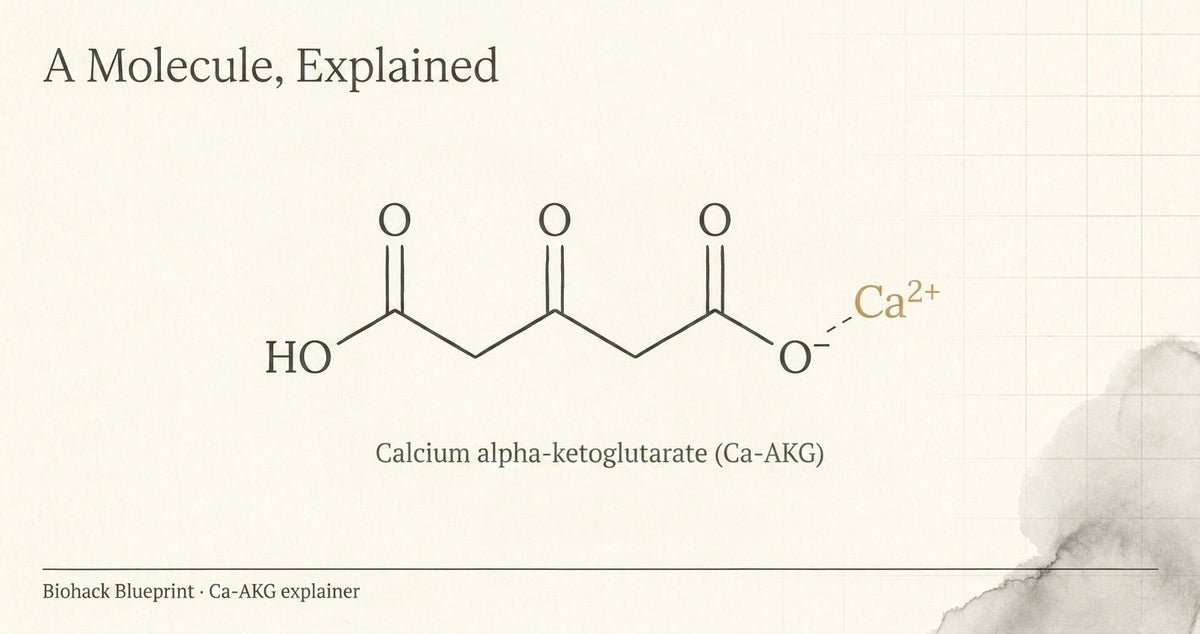
Ca-AKG is the calcium salt of alpha-ketoglutarate, an endogenous metabolite involved in the Krebs cycle and several enzyme systems that regulate cellular metabolism and gene activity.
What does “calcium alpha-ketoglutarate” mean?
The name has two parts.
Alpha-ketoglutarate (AKG) is a small molecule found naturally inside cells. It is also called 2-oxoglutarate in scientific literature.
Calcium is the mineral bound to AKG to form the calcium salt. Supplement manufacturers use salts because free alpha-ketoglutaric acid and its mineral-bound forms have different handling, acidity and formulation properties.
You may see the same supplement written as Ca-AKG, CaAKG, calcium AKG or calcium α-ketoglutarate.
What does AKG do in the body?
AKG has several established biochemical roles. These roles are real even if a Ca-AKG supplement never produces a measurable longevity benefit.
It is part of the Krebs cycle. The Krebs cycle — also called the tricarboxylic acid or TCA cycle — is one of the central pathways cells use to process fuel and generate energy.
It connects energy metabolism with amino-acid metabolism. AKG can accept and donate nitrogen through reactions involving glutamate and related amino acids.
It is a cofactor for alpha-ketoglutarate-dependent enzymes. This includes TET enzymes involved in DNA demethylation and JmjC enzymes involved in histone demethylation. That connection between metabolism and gene regulation is one reason AKG has attracted aging researchers.
It has experimental links to nutrient-sensing pathways. A 2014 study found that AKG could inhibit ATP synthase and TOR signaling in experimental models [1]. Those mechanistic results help explain the scientific interest in AKG, but they do not show that swallowing Ca-AKG reproduces the same effect in humans.
For the deeper pathway discussion, see how Ca-AKG works.
Where does your body get AKG?
Your body makes it continuously.
AKG is an intermediate in normal cellular metabolism rather than a vitamin you must obtain from food. Its concentration and metabolic role can vary by tissue, age, physiological state and energy demand.
That distinction matters because an endogenous molecule is not automatically beneficial when supplemented. Your body making AKG naturally tells us that AKG is biologically important; it does not tell us that more oral AKG will extend lifespan or improve health.
Why is Ca-AKG sold as a longevity supplement?
The modern longevity interest comes from several layers of evidence rather than one proven human outcome.
First came mechanistic work in worms, flies and cells showing that AKG interacts with pathways involved in nutrient sensing, epigenetics and cellular stress.
Then a 2020 study in C57BL/6J mice reported that Ca-AKG supplementation beginning in middle age improved frailty measures and extended lifespan in female mice [2]. That study became the foundation for many commercial longevity claims.
But later lifespan testing made the picture more complicated. The US National Institute on Aging Interventions Testing Program tested AKG in genetically heterogeneous UM-HET3 mice across multiple sites. A late-start experiment did not increase lifespan [3], and a second experiment starting supplementation earlier also found no lifespan extension [4].
So the beginner-friendly version is: Ca-AKG has interesting animal longevity evidence, but the mouse lifespan findings are mixed.
What human evidence is there?
Human evidence exists, but it does not yet show that Ca-AKG extends lifespan or prevents age-related disease.
A small 2021 retrospective study of 42 people taking Rejuvant — a delayed-release Ca-AKG product that also contains added vitamins — reported a large reduction in a proprietary DNA methylation age measure [5]. Because there was no placebo group, the study cannot establish that Ca-AKG caused the change.
A larger 2026 observational study of 4,260 health-conscious adults found that delayed-release AKG users had a lower DNA methylation Age Residual in cross-sectional analysis. Plain non-delayed AKG showed a smaller, non-significant association. In the longitudinal analysis, the delayed-release signal did not remain significant after fuller adjustment for baseline values and regression to the mean [6].
The ABLE trial is designed to provide stronger evidence. Its published protocol tests 1 g/day of sustained-release Ca-AKG against placebo in middle-aged adults [7]. Recruitment has been reported, but efficacy outcomes have not been published as of September 20, 2026.
A 2022 review of AKG supplementation in humans summarizes the broader clinical and mechanistic literature and reaches the same basic conclusion: the biology is interesting, but direct human healthy-aging evidence remains limited [8].
Is Ca-AKG a peptide?
No.
A peptide is a short chain of amino acids. Ca-AKG is a mineral salt made from calcium and alpha-ketoglutarate. Calling it a peptide is chemically incorrect.
Is Ca-AKG a vitamin?
No.
Vitamins are essential micronutrients that the body generally cannot make in sufficient amounts. AKG is an endogenous metabolite your cells produce themselves. Ca-AKG is sold as a dietary supplement, but that does not make it a vitamin.
Is Ca-AKG the same as calcium?
No. Calcium is only one component of the salt.
The amount of elemental calcium depends on the exact chemical form and hydration state, but roughly one-fifth of Ca-AKG mass can be calcium. That contribution matters if you already take calcium supplements.
Ca-AKG should not be chosen as a general calcium supplement. The longevity interest is centered on the AKG component.
Is Ca-AKG the same as AAKG?
No.
Ca-AKG is calcium alpha-ketoglutarate. AAKG is arginine alpha-ketoglutarate. Both contain an AKG component, but they are different salts with different partner molecules and different research histories.
AAKG is studied mainly in sports-nutrition and nitric-oxide contexts. Modern longevity research centers on Ca-AKG or delayed-release Ca-AKG. Evidence from one form should not automatically be transferred to another.
See Ca-AKG vs AAKG, Ca-AKG vs AKG, and AKG forms explained for the detailed distinctions.
What does an AKG supplement actually do?
This is where biochemical function and clinical outcome need to stay separate.
Taking Ca-AKG delivers an oral source of alpha-ketoglutarate along with calcium. Human metabolic studies show that orally administered AKG salts can affect circulating metabolites [9]. What remains uncertain is whether typical longevity-supplement doses change the relevant tissues and pathways enough to improve meaningful health outcomes.
So “AKG participates in energy metabolism” is established biochemistry. “An AKG supplement increases your energy,” “reverses aging,” or “extends your life” are different claims and are not established by that biochemistry alone.
Is Ca-AKG safe?
Ca-AKG and related AKG salts have a longer history of human use than the modern longevity marketing suggests, including clinical use in renal and nutritional settings [10]. That history is reasonably reassuring, but it does not replace long-term safety data in healthy people taking Ca-AKG specifically for longevity.
The practical issues include the added calcium, unstudied drug interactions, kidney disease or kidney-stone history, pregnancy and breastfeeding, and use during active cancer treatment.
For the full evidence review, see Ca-AKG side effects and safety.
How much Ca-AKG do people take?
There is no proven optimal longevity dose.
One gram per day is a commonly studied modern dose because it is used in Rejuvant-related research and in the ABLE protocol. That makes 1 g/day a studied dose, not a proven effective dose for extending life or slowing aging.
See Ca-AKG dosage for the study-by-study dose breakdown and when to take Ca-AKG for timing questions.
Bottom line
Ca-AKG is calcium alpha-ketoglutarate: a supplement salt of a normal metabolite your body already uses in energy metabolism and enzyme systems involved in gene regulation.
It is not a peptide, not a vitamin, not the same as AAKG, and not a proven anti-aging treatment. The science is interesting enough to justify serious research, but the current human evidence does not show that Ca-AKG extends lifespan or prevents age-related disease.
If you want the evidence rather than the definition, continue to our complete Ca-AKG benefits and evidence guide.
Frequently asked questions
What is Ca-AKG supplement?
What does AKG supplement do?
Is calcium AKG the same as calcium?
Is AKG good for kidneys?
Does AKG reverse aging?
Is Ca-AKG a peptide?
Sources & article history
Sources (10)
-
The metabolite alpha-ketoglutarate extends lifespan by inhibiting the ATP synthase and TOR Nature. 2014;Volume 510, issue 7505, pages 397–401.
-
Alpha-Ketoglutarate, an Endogenous Metabolite, Extends Lifespan and Compresses Morbidity in Aging Mice Cell Metabolism. 2020;Volume 32, issue 3, pages 447–456.e6.
-
Lifespan effects in male UM-HET3 mice treated with sodium thiosulfate, 16-hydroxyestradiol, and late-start canagliflozin GeroScience. 2024;46(5):4657-4670.
-
Astaxanthin, meclizine, mitoglitazone, pioglitazone, alpha-ketoglutarate, mifepristone, methotrexate, and atorvastatin-telmisartan do not increase lifespan in UM-HET3 mice GeroScience. 2026;48(3):3821-3830.
-
Rejuvant®, a potential life-extending compound formulation with alpha-ketoglutarate and vitamins, conferred an average 8 year reduction in biological aging, after an average of 7 months of use, in the TruAge DNA methylation test Aging (Albany NY). 2021;Volume 13, issue 22, pages 24485–24499.
-
Supplements and Drugs Are Associated With Biological Age in a Cohort of Exceptionally Healthy Individuals Aging Cell. 2026;Volume 25, issue 6, article e70517.
-
Alpha-ketoglutarate supplementation and BiologicaL agE in middle-aged adults (ABLE)—intervention study protocol GeroScience. 2023;Volume 45, issue 5, pages 2897–2907.
-
Alpha-Ketoglutarate dietary supplementation to improve health in humans Trends in Endocrinology and Metabolism. 2022;Volume 33, issue 2, pages 136–146.
-
Action of ornithine alpha-ketoglutarate, ornithine hydrochloride, and calcium alpha-ketoglutarate on plasma amino acid and hormonal patterns in healthy subjects Journal of the American College of Nutrition. 1990;9(1):2-12.
-
Alpha-Ketoglutarate as a Molecule with Pleiotropic Activity: Well-Known and Novel Possibilities of Therapeutic Use Archivum Immunologiae et Therapiae Experimentalis. 2017;Volume 65, issue 1, pages 21–36.


