
Calcium alpha-ketoglutarate: benefits, dose and evidence
Calcium alpha-ketoglutarate (Ca-AKG) reviewed against 63 audited papers: benefits, dose, safety, biological age, mixed mouse lifespan results and what remains unproven.
 By
Dr. Khaled Mahmoud, MBBCh
Critical Care Medicine, Longevity Science & Editorial Direction
By
Dr. Khaled Mahmoud, MBBCh
Critical Care Medicine, Longevity Science & Editorial Direction
 Reviewed by
Dr. Amr Yasser, PhD
Cardiometabolic, Musculoskeletal, Gut & Bioavailability
Reviewed by
Dr. Amr Yasser, PhD
Cardiometabolic, Musculoskeletal, Gut & Bioavailability
 Reviewed by
Dr. Abdulla Mostafa, PhD
Cellular Senescence, Neurological, Mitochondrial & Brain-Ageing Biology
Reviewed by
Dr. Abdulla Mostafa, PhD
Cellular Senescence, Neurological, Mitochondrial & Brain-Ageing Biology
- Published
- Last reviewed
- Reading time
- 14 min
- Sources cited
- 19
On this page
Calcium alpha-ketoglutarate (Ca-AKG) is the calcium salt of alpha-ketoglutarate, a molecule your cells already use in the Krebs cycle and in enzymes involved in epigenetic regulation. It is now widely sold as a longevity supplement, but the evidence is much less settled than the marketing suggests.
The most accurate 2026 summary is this: Ca-AKG has plausible biology, decades of human exposure in non-longevity settings, one small randomized human bone trial, early observational biological-age data, and a mixed mouse lifespan record. It has not been shown to extend human lifespan, prevent age-related disease, or reverse aging in a clinical sense.
This guide is the broad evidence hub for Ca-AKG. Narrow questions — dosage, timing, side effects, biological age, formulations and product choice — link to dedicated articles so the same search intent is not repeated across the cluster. Every research citation also maps back to our Ca-AKG Data Center, which currently contains 63 audited records.
Ca-AKG evidence at a glance
| Question | Best available evidence | What it means |
|---|---|---|
| Does Ca-AKG extend lifespan? | One positive C57BL/6J mouse program; two null NIA ITP UM-HET3 lifespan experiments | Mouse lifespan evidence is mixed, not settled. |
| Does it reduce biological age in humans? | Small retrospective Rejuvant study plus a 4,260-person observational cohort | There is an association for the delayed-release product, but causality is unproven. |
| Is there a randomized human longevity trial? | ABLE is randomized, double-blind and placebo-controlled; protocol and recruitment papers are published | Efficacy results have not yet been published. |
| Does Ca-AKG have any randomized human efficacy data? | A 2007 six-month trial in postmenopausal women with osteopenia | It changed a bone-resorption biomarker; it did not test lifespan or clinical aging outcomes. |
| Is it safe? | Older human Ca-AKG studies, related-form clinical literature and animal toxicology | Short- and medium-term tolerability is reasonably reassuring, but long-term healthy-adult longevity safety remains incompletely characterized. |
| What dose works for longevity? | 1,000 mg/day is used in the Rejuvant observational work and ABLE protocol | This is a studied dose, not a proven optimal or effective longevity dose. |
What is calcium alpha-ketoglutarate?
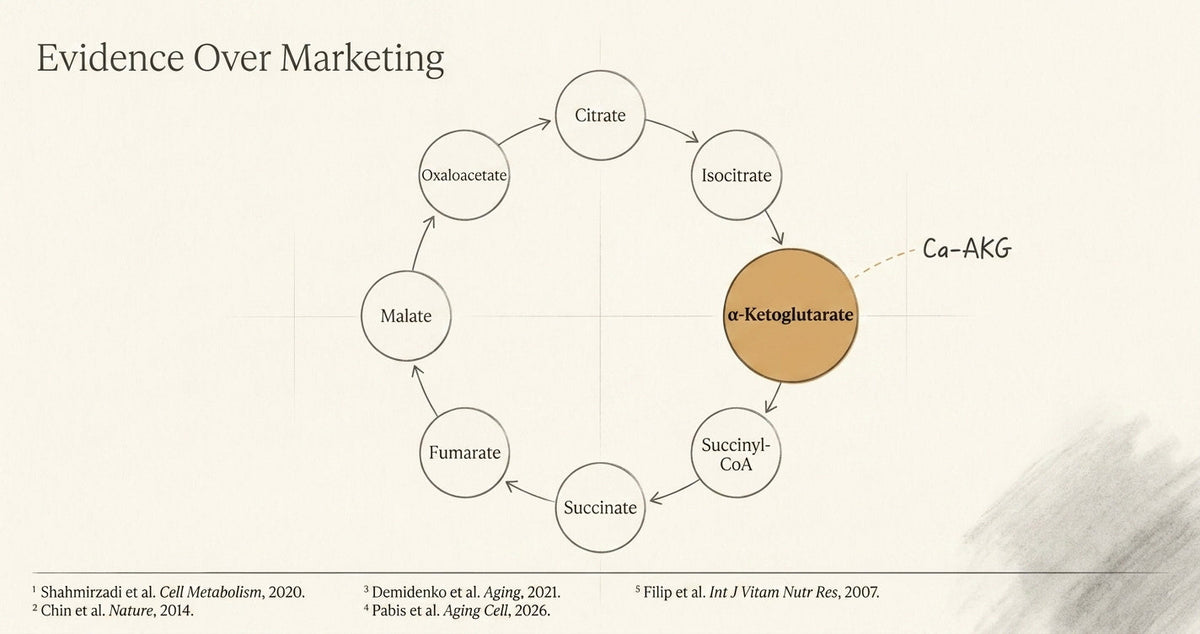
Alpha-ketoglutarate — usually shortened to AKG — is a five-carbon molecule produced continuously inside the body. It sits in the tricarboxylic acid cycle, also called the Krebs cycle, where nutrients are converted into usable cellular energy.
AKG also connects energy metabolism with amino-acid metabolism and serves as a required cofactor for alpha-ketoglutarate-dependent dioxygenases. Those enzymes include TET DNA-demethylation enzymes and JmjC histone demethylases, which is one reason AKG appears so often in modern aging research.
Ca-AKG is simply AKG bound to calcium. The salt is easier to formulate than free alpha-ketoglutaric acid and is the form used in much of the modern longevity literature. For a simpler introduction, see What is Ca-AKG supplement?
Is Ca-AKG the same as AKG or AAKG?
No. AKG refers to alpha-ketoglutarate itself. Ca-AKG is its calcium salt. AAKG is arginine alpha-ketoglutarate, a different salt that is marketed mainly in sports nutrition. OAKG binds AKG to ornithine and has a separate history in clinical nutrition.
These forms share an AKG component, but their partner molecule, dosing, pharmacology and evidence base are different. The longevity evidence should not be transferred automatically from Ca-AKG to AAKG or OAKG. See Ca-AKG vs AKG, Ca-AKG vs AAKG, and AKG forms explained.
How does Ca-AKG work?
At the biochemical level, AKG is well established. At the supplement level, the important question is whether oral Ca-AKG changes these pathways enough to produce meaningful human outcomes.
Krebs-cycle metabolism. AKG is an endogenous intermediate in cellular energy metabolism.
Epigenetic enzymes. AKG is a cofactor for TET and JmjC enzymes involved in DNA and histone demethylation. Cell studies support a mechanistic link between AKG availability, TET activity and senescence biology, but those experiments do not prove that an oral Ca-AKG capsule reverses senescence in people.
ATP synthase, TOR and AMPK. A 2014 study found that AKG can inhibit ATP synthase and TOR signaling in C. elegans and mammalian experimental systems [1]. A 2019 fruit-fly study reported lifespan extension involving mTOR inhibition and AMPK activation [2].
Inflammation and senescence signaling. The 2020 Ca-AKG mouse study reported lower inflammatory signaling and a senomorphic pattern — reducing parts of the senescence-associated secretory phenotype rather than simply killing senescent cells [4].
Autophagy is not a settled one-way mechanism. Some AKG models connect TOR/AMPK signaling with autophagy, while other mechanistic work has found AKG can inhibit autophagy under specific conditions. That context dependence is why we treat Ca-AKG and autophagy as a separate evidence question rather than a proven benefit.
A 2022 human-focused review summarizes the broad metabolic, epigenetic and organ-system rationale, while also emphasizing how limited direct human supplementation evidence remains [3]. For the full mechanistic walkthrough, see How does Ca-AKG work?
Does AKG actually decline with age?
This is more complicated than many supplement pages claim.
A frequently repeated statement says circulating AKG falls dramatically with age. The historical review from which that claim spread attributes the observation to unpublished data. A published metabolomics study of adults aged 20 to 97 instead found higher serum AKG in older adults than in young adults, and AKG correlated positively with IL-6 after age adjustment [12].
A 2026 multi-organ metabolic atlas in mice also found that aging trajectories vary substantially by organ and sex, with AKG contributing differently to different tissue-specific metabolic aging clocks [13].
So the defensible conclusion is not “AKG inevitably falls with age.” It is that AKG metabolism changes with aging in a tissue- and context-dependent way. Circulating blood concentration is not the same thing as intracellular availability or metabolic flux.
Ca-AKG benefits: what does the evidence actually support?
1. Lifespan and healthspan: the mouse evidence is mixed
The study that made Ca-AKG a mainstream longevity supplement was published in Cell Metabolism in 2020. Middle-aged C57BL/6 mice received 2% Ca-AKG in chow from 18 months of age. Female lifespan increased in the replicated cohorts, while male lifespan did not increase significantly. Frailty scores improved substantially in both sexes, and the study reported changes in inflammatory markers and several age-related phenotypes [4].
That result is important. It is no longer the entire lifespan story.
The National Institute on Aging Interventions Testing Program subsequently tested AKG in genetically heterogeneous UM-HET3 mice across three independent sites. A late-start experiment beginning at 18 months did not increase lifespan in either sex [5]. A second ITP experiment started AKG much earlier, at seven months, and again found no lifespan extension in either sex [6].
These experiments differ in mouse strain, study design and formulation context, so the null ITP results do not erase the Shahmirzadi healthspan findings. They do mean that “Ca-AKG extends lifespan in mice” is too broad. The accurate statement is: one mouse program reported a lifespan benefit, while two rigorous multi-site ITP tests did not reproduce it.
For the original positive paper in detail, see the Shahmirzadi 2020 study explained.
2. Biological age: interesting human signal, still observational
In 2021, researchers analyzed 42 self-selected users of Rejuvant, a delayed-release Ca-AKG formulation combined with vitamin A or vitamin D. After roughly seven months, the mean TruAge DNA methylation age reportedly fell by 7.96 years [8].
The result was attention-grabbing, but the study had no placebo group, only 42 participants, used a proprietary first-generation methylation clock, and involved researchers with connections to the product and clock companies. Rejuvant also contains added vitamins, so the isolated Ca-AKG contribution cannot be determined.
A much larger 2026 observational cohort included 4,260 unusually healthy adults. Delayed-release AKG users had an average Age Residual about 1.8 years lower than non-users in cross-sectional analysis, and the association remained significant after multiple covariate adjustments. Plain non-delayed AKG showed a smaller, statistically non-significant association [9].
But the closer-to-causal longitudinal analysis was much less convincing. The delayed-release AKG signal became non-significant after adjustment for baseline Age Residual and regression to the mean. The cohort was highly selected, supplement use was largely self-reported, and the delayed-release product again included vitamins. This is evidence of an association, not proof that Ca-AKG reverses biological aging.
Our dedicated Ca-AKG and biological age article breaks down the Rejuvant claims, the 4,260-person cohort and the ongoing randomized evidence.
3. Randomized human longevity evidence: ABLE has not reported efficacy yet
The ABLE study is the most important randomized human Ca-AKG trial for the longevity question. Its published protocol describes a double-blind, placebo-controlled trial of 1 g/day sustained-release Ca-AKG for six months in middle-aged adults whose DNA methylation age exceeds chronological age [10].
A 2025 peer-reviewed recruitment analysis confirmed that 120 participants were enrolled, but it reported recruitment feasibility rather than biological-age, vascular, metabolic, muscle, bone or safety outcomes [11].
As of September 20, 2026, our evidence database does not contain a published ABLE efficacy result. Until that changes, statements that ABLE “proved” Ca-AKG slows aging are premature.
4. Bone health: one randomized human trial moved a biomarker
In 2007, 76 postmenopausal women with osteopenia were randomized in a six-month double-blind trial. Ca-AKG reduced serum CTX, a marker of bone resorption [7].
This is genuine randomized human evidence, but it does not establish fracture prevention, meaningful bone-density improvement, or a general anti-aging effect. The population, dose and outcome were specific. See Ca-AKG for bone health for the full trial analysis.
5. Muscle, metabolism, brain and cardiovascular biology: mostly preclinical
AKG has accumulated substantial animal and mechanistic evidence across muscle, adipose tissue, brain, cardiovascular biology and stem-cell aging. Examples include improved arterial elasticity in aged mice [17], rescue of synaptic plasticity deficits in an Alzheimer's mouse model [18], and a large literature on skeletal-muscle metabolism summarized in a 2024 review [19].
Middle-aged mouse studies also suggest effects on adiposity and metabolic signaling, but this does not amount to evidence that Ca-AKG causes weight loss in humans. We separate those questions into muscle and frailty, weight loss and fatty liver, and inflammation and inflammaging.
Does Ca-AKG reverse aging?
No human study has shown that Ca-AKG reverses aging in the clinical sense.
The phrase usually bundles together three different observations: a positive mouse healthspan/lifespan study, an uncontrolled 42-person Rejuvant methylation study, and a larger cross-sectional cohort showing a smaller association with lower DNA methylation age.
Those findings are scientifically interesting. None demonstrates that Ca-AKG reduces cardiovascular events, prevents dementia, lowers cancer risk, extends human lifespan or restores aged tissues to a younger clinical state. Even the mouse lifespan evidence is now mixed after two null NIA ITP experiments.
Biological-age clocks are biomarkers. They can be useful research tools, but a lower clock value is not automatically equivalent to better health or longer life.
What dose of Ca-AKG is supported by research?
There is no established effective longevity dose of Ca-AKG.
One gram per day is the most visible modern research dose because the Rejuvant observational study and the ABLE randomized protocol both use approximately 1,000 mg/day of sustained- or delayed-release Ca-AKG [8] [10]. That makes 1 g/day a studied dose. It does not make it a proven optimal dose.
The 2007 osteopenia trial used a much higher total daily Ca-AKG dose for a different clinical question [7]. Older human studies also used Ca-AKG in renal and metabolic settings at gram-level doses.
We do not convert the 2% mouse-chow dose from the Shahmirzadi study into a recommended human dose. The audited paper record explicitly notes that human dose translation is not established from that study alone.
For the full dose-by-study table, see Ca-AKG dosage. For morning versus evening, split dosing and food timing, see when to take Ca-AKG.
Does delayed-release Ca-AKG work better?
The strongest human biological-age signal is associated with the proprietary delayed-release Rejuvant formulation. In the 2026 observational cohort, standard non-delayed AKG had a smaller, non-significant association while delayed-release users had a larger association with lower Age Residual [9].
That does not prove delayed release itself caused the difference. Rejuvant includes added vitamins, users were not randomized, recruitment differed between groups, and the longitudinal signal did not remain significant after fuller adjustment. A formulation effect is plausible; it is not established.
This distinction matters when comparing commercial products. A generic immediate-release Ca-AKG capsule should not borrow the biological-age headline from Rejuvant as if the products were interchangeable.
Is Ca-AKG safe?
The safety picture is more reassuring than the longevity-efficacy picture, but it still has gaps.
Ca-AKG has been given to humans for decades in renal, mineral-metabolism and nutritional studies. Acute work in healthy adults directly compared oral Ca-AKG with other AKG salts [14], and longer clinical interventions provide additional exposure data. A 2017 review summarizes much of that historical literature [15]. A repeated-dose animal toxicology study also adds preclinical safety information [16].
What we do not have is a large, long-duration placebo-controlled safety trial of Ca-AKG used specifically as a longevity supplement in healthy adults.
Calcium load matters. Depending on the exact salt and hydration state, roughly one-fifth of Ca-AKG mass is calcium. A 1 g serving therefore adds roughly 200 mg of elemental calcium. If you already supplement calcium, include Ca-AKG in your total intake.
Drug interactions have not been systematically studied. Because Ca-AKG supplies calcium, standard calcium-separation precautions can matter for medicines such as levothyroxine, tetracycline or quinolone antibiotics, bisphosphonates and iron.
Pregnancy and breastfeeding are unstudied. Significant kidney disease, a kidney-stone history, active cancer treatment or narrow-therapeutic-index medications are reasonable reasons to discuss supplementation with a clinician first.
See Ca-AKG side effects and safety for the detailed evidence review.
What foods contain Ca-AKG?
Ca-AKG itself is not a meaningful dietary nutrient. Your cells make AKG through normal metabolism.
Foods rich in glutamate and glutamine provide substrates connected to AKG metabolism, but eating more of those amino acids has not been shown to reproduce the exposure created by a Ca-AKG supplement. Exercise also changes circulating and tissue AKG biology, but the relationship is dynamic rather than a simple “more is always better” story.
See Ca-AKG dietary sources for the food and endogenous-production question.
How does Ca-AKG compare with other longevity supplements?
Ca-AKG is not interchangeable with NAD+ precursors, senolytics or mitophagy-targeted compounds. The mechanism and evidence maturity differ.
For direct comparisons, see Ca-AKG vs NMN, Ca-AKG vs Urolithin A, and Ca-AKG and fisetin. If you combine multiple longevity supplements, Ca-AKG stacking separates mechanistic logic from combinations that have actually been tested.
How to choose a Ca-AKG supplement
Product selection should begin with evidence matching rather than marketing claims.
Check the exact salt form, the amount per serving, whether the label is quoting Ca-AKG salt mass or AKG base mass, the release formulation, and whether the company publishes a batch-specific certificate of analysis. Do not assume a “liposomal,” “slow-release” or “third-party tested” label proves superior absorption or quality without documentation.
Also keep the evidence boundary clear: the positive human biological-age association belongs to a specific delayed-release combination product. Generic standard-release capsules have not demonstrated the same effect in a randomized trial.
Our current product-level comparison is in Best Ca-AKG supplement: a clinician's buying guide.
What we still do not know
Whether Ca-AKG extends human lifespan or healthspan. No human trial has answered this.
Whether the biological-age association is causal. The strongest human aging datasets are observational, and the longitudinal signal in the 2026 cohort did not remain significant after fuller adjustment.
Whether delayed release is genuinely superior. The observational signal suggests a difference, but formulation, vitamins, recruitment and user characteristics are confounded.
Whether the positive mouse lifespan result is strain-specific. The C57BL/6J study was positive; two multi-site UM-HET3 ITP experiments were null.
Whether Ca-AKG activates or inhibits autophagy in the contexts that matter for human aging. Mechanistic literature is context-dependent rather than uniformly pro-autophagy.
Whether blood AKG is a useful marker of tissue aging. Human serum and multi-organ animal data argue against a simple universal age-related decline.
What the optimal dose, duration and stopping strategy are. One gram per day is common in modern studies, but no randomized dose-ranging longevity trial has established an optimum.
Bottom line
Calcium alpha-ketoglutarate is a biologically important metabolite salt with a serious research literature. That makes it more interesting than many trend-driven longevity ingredients, but it does not make the clinical case complete.
The strongest pro-Ca-AKG points are its established biochemistry, decades of human exposure, a randomized bone-biomarker trial, substantial preclinical work and an observational biological-age signal for delayed-release Rejuvant. The strongest reasons for caution are equally important: human longevity outcomes are unproven, the biological-age data are non-randomized, the delayed-release product is confounded by added vitamins and industry relationships, and two independent NIA ITP lifespan experiments failed to reproduce the original mouse lifespan benefit.
If you are considering Ca-AKG in 2026, the evidence supports describing it as promising but unproven for human longevity. That is a stronger and more useful position than either “anti-aging breakthrough” or “no evidence at all.”
Frequently asked questions
What does calcium alpha-ketoglutarate do?
Is calcium alpha-ketoglutarate the same as calcium?
Does AKG reverse ageing?
Does Ca-AKG actually work?
What is the correct dose of calcium alpha-ketoglutarate?
Are there side effects to calcium alpha-ketoglutarate?
What foods contain alpha-ketoglutarate?
How is Ca-AKG different from AAKG?
Sources & article history
Sources (19)
-
The metabolite alpha-ketoglutarate extends lifespan by inhibiting the ATP synthase and TOR Nature. 2014;Volume 510, issue 7505, pages 397–401.
-
Alpha-ketoglutarate extends Drosophila lifespan by inhibiting mTOR and activating AMPK Aging (Albany NY). 2019;Volume 11, issue 12, pages 4183–4197.
-
Alpha-Ketoglutarate dietary supplementation to improve health in humans Trends in Endocrinology and Metabolism. 2022;Volume 33, issue 2, pages 136–146.
-
Alpha-Ketoglutarate, an Endogenous Metabolite, Extends Lifespan and Compresses Morbidity in Aging Mice Cell Metabolism. 2020;Volume 32, issue 3, pages 447–456.e6.
-
Lifespan effects in male UM-HET3 mice treated with sodium thiosulfate, 16-hydroxyestradiol, and late-start canagliflozin GeroScience. 2024;46(5):4657-4670.
-
Astaxanthin, meclizine, mitoglitazone, pioglitazone, alpha-ketoglutarate, mifepristone, methotrexate, and atorvastatin-telmisartan do not increase lifespan in UM-HET3 mice GeroScience. 2026;48(3):3821-3830.
-
Alpha-Ketoglutarate Decreases Serum Levels of C-terminal Cross-Linking Telopeptide of Type I Collagen (CTX) in Postmenopausal Women with Osteopenia: Six-Month Study International Journal for Vitamin and Nutrition Research. 2007;Volume 77, issue 2, pages 89–97.
-
Rejuvant®, a potential life-extending compound formulation with alpha-ketoglutarate and vitamins, conferred an average 8 year reduction in biological aging, after an average of 7 months of use, in the TruAge DNA methylation test Aging (Albany NY). 2021;Volume 13, issue 22, pages 24485–24499.
-
Supplements and Drugs Are Associated With Biological Age in a Cohort of Exceptionally Healthy Individuals Aging Cell. 2026;Volume 25, issue 6, article e70517.
-
Alpha-ketoglutarate supplementation and BiologicaL agE in middle-aged adults (ABLE)—intervention study protocol GeroScience. 2023;Volume 45, issue 5, pages 2897–2907.
-
Recruitment evaluation of a gerotherapeutic randomized controlled trial testing alpha-ketoglutarate in biologically older, middle-aged adults (ABLE) Experimental Gerontology. 2025;209:112867.
-
Metabolomics-Based Identification of Metabolic Dysfunction in Frailty The Journals of Gerontology: Series A. 2022;77(12):2367-2372.
-
A metabolic atlas of mouse aging Cell Metabolism. 2026;38(2):399-418.e7.
-
Action of ornithine alpha-ketoglutarate, ornithine hydrochloride, and calcium alpha-ketoglutarate on plasma amino acid and hormonal patterns in healthy subjects Journal of the American College of Nutrition. 1990;9(1):2-12.
-
Alpha-Ketoglutarate as a Molecule with Pleiotropic Activity: Well-Known and Novel Possibilities of Therapeutic Use Archivum Immunologiae et Therapiae Experimentalis. 2017;Volume 65, issue 1, pages 21–36.
-
Toxicity of alpha-ketoglutarate following 14-days repeated oral administration in Wistar rats Cellular and Molecular Biology. 2011;57 Suppl:OL1543-OL1549.
-
Alpha-ketoglutarate stabilizes redox homeostasis and improves arterial elasticity in aged mice Journal of Physiology and Pharmacology. 2011;Volume 62, issue 1, pages 37–43.
-
Alpha-Ketoglutarate Ameliorates Synaptic Plasticity Deficits in APP/PS1 Mice Model of Alzheimer's Disease Aging Cell. 2025;Volume 24, issue 11, article e70235.
-
Impact of Alpha-Ketoglutarate on Skeletal Muscle Health and Exercise Performance: A Narrative Review Nutrients. 2024;Volume 16, issue 22, article 3968.


