
When to take Ca-AKG: what actually matters (and what doesn't)
When to take Ca-AKG: no study proves a best time of day. What human protocols actually used, what food timing does not establish, and when calcium–medication spacing matters.
 By
Dr. Khaled Mahmoud, MBBCh
Critical Care Medicine, Longevity Science & Editorial Direction
By
Dr. Khaled Mahmoud, MBBCh
Critical Care Medicine, Longevity Science & Editorial Direction
 Reviewed by
Dr. Abdulla Mostafa, PhD
Cellular Senescence, Neurological, Mitochondrial & Brain-Ageing Biology
Reviewed by
Dr. Abdulla Mostafa, PhD
Cellular Senescence, Neurological, Mitochondrial & Brain-Ageing Biology
 Reviewed by
Dr. Amr Yasser, PhD
Cardiometabolic, Musculoskeletal, Gut & Bioavailability
Reviewed by
Dr. Amr Yasser, PhD
Cardiometabolic, Musculoskeletal, Gut & Bioavailability
- Published
- Last reviewed
- Reading time
- 7 min
- Sources cited
- 5
On this page
There is no proven “best time” to take Ca-AKG. No published trial has directly compared morning versus evening, with food versus fasting, or once-daily versus split dosing for a longevity outcome.
The practical answer is therefore simpler than most supplement pages make it: use the schedule specified by your product, take it consistently enough to match the kind of daily exposure used in studies, and pay more attention to medication interactions than to the clock.
For dose rather than timing, see Ca-AKG dosage. For the overall evidence, see the Ca-AKG evidence guide.
When is the best time to take Ca-AKG?
No study has established a superior time of day.
Modern Ca-AKG studies generally use daily supplementation over weeks or months, but they do not show that 8 AM is better than 8 PM. The 2021 Rejuvant observational study involved sustained-release Ca-AKG taken daily over several months [1]. The ABLE protocol likewise uses 1 g/day of sustained-release Ca-AKG for six months [2].
That supports daily use as a study design. It does not prove that precise clock timing changes efficacy.
Morning or evening?
There is no direct evidence that morning dosing is better than evening dosing.
Claims such as “take AKG in the morning for energy” or “avoid it at night because it is stimulating” are not supported by Ca-AKG trials. Human studies have not established a reproducible effect on alertness, sleep onset or circadian rhythm.
If a particular timing feels better for you, that can be a practical reason to choose it. It should not be presented as a research-backed biological advantage.
Should you take Ca-AKG with food?
This has not been directly tested against fasting administration.
The clearest published example of meal-linked dosing comes from the 2007 randomized osteopenia trial, which used 6 g/day of Ca-AKG divided into three doses taken with meals [3]. That study was designed for bone metabolism, not to determine whether food improves Ca-AKG absorption.
The Rejuvant and ABLE publications do not establish that taking Ca-AKG with or without food changes the biological effect [1] [2].
So “with food” should be treated as a tolerance or label-instruction question unless future pharmacokinetic studies show otherwise.
Should you take Ca-AKG on an empty stomach?
There is no evidence that fasting administration improves longevity-related outcomes.
It is tempting to assume that an empty stomach increases absorption, but that has not been demonstrated for Ca-AKG in a way that establishes a better clinical effect. A small acute human metabolic study shows that oral Ca-AKG is biologically active after ingestion, but it was not a fasting-versus-fed comparison [4].
If the manufacturer instructs you to take a specific formulation with or without food, follow that formulation-specific label rather than assuming all Ca-AKG products behave identically.
Once daily or split across the day?
No longevity trial has directly compared these schedules.
Different studies used different regimens because their doses and purposes differed:
| Study | Exposure | Schedule | What it proves |
|---|---|---|---|
| Rejuvant 2021 | ~1 g/day sustained-release Ca-AKG | Daily use | Observational biological-age data, not a timing comparison |
| ABLE protocol | 1 g/day sustained-release Ca-AKG | Daily use | Randomized trial design; no published efficacy result yet |
| Filip 2007 | 6 g/day | Three meal-time doses | Bone-marker trial, not proof that splitting is superior |
It is therefore reasonable to follow the studied schedule for the formulation you are using, but we should not claim that splitting an immediate-release product recreates sustained-release pharmacokinetics or improves outcomes. That has not been demonstrated.
Does delayed release change when you should take it?
Delayed- or sustained-release formulations are designed to alter release over time, but the human Ca-AKG literature does not establish a special morning or evening window for them.
The 2026 observational cohort found a stronger cross-sectional biological-age association among delayed-release AKG users than among users of plain non-delayed AKG [5]. This was not a randomized formulation or timing trial, and the delayed-release product also contained added vitamins.
So the result should not be converted into a rule such as “delayed release works better because it is taken once in the morning.” Formulation and timing are separate questions.
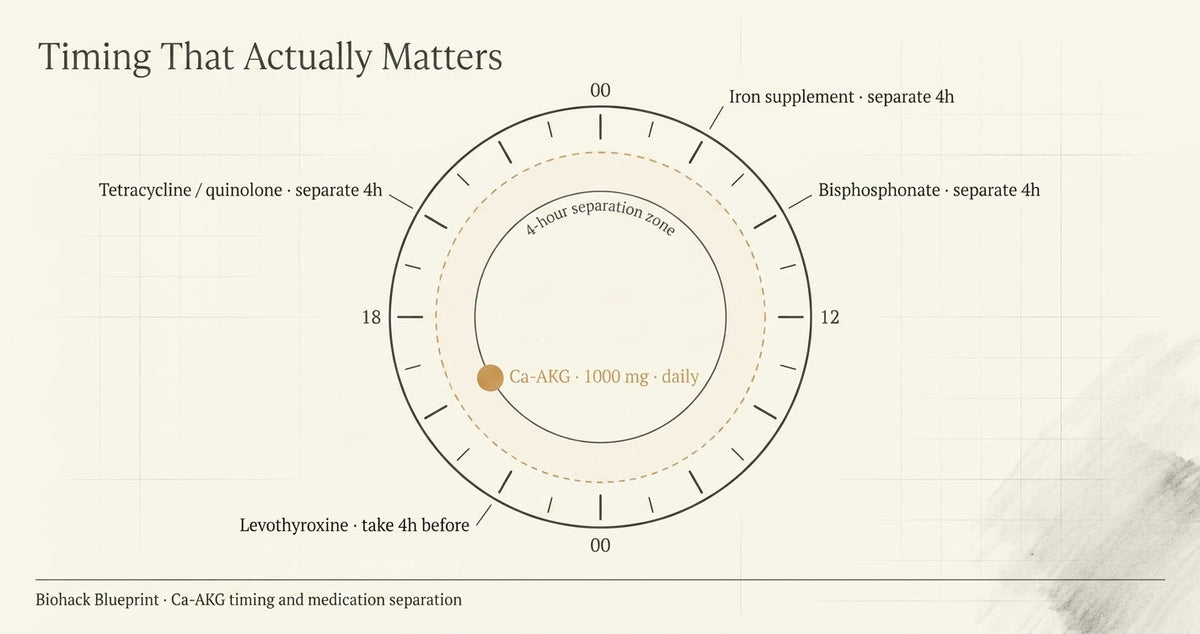
The timing issue that actually matters: calcium and medications
Ca-AKG contains calcium, and calcium can interfere with the absorption of some medicines. This is much better established than any morning-versus-evening Ca-AKG claim.
The US National Institutes of Health lists medication interactions for calcium supplements, including levothyroxine and quinolone antibiotics. Levothyroxine should not be taken within four hours of calcium carbonate, while quinolone spacing can differ by drug; NIH gives two hours before or after calcium as an example for several quinolones. NIH calcium interaction guidance.
Tetracycline absorption can also be impaired by calcium-containing products; the exact instruction depends on the specific antibiotic label. Iron, bisphosphonates and other medicines can have their own mineral-spacing requirements.
Do not apply one universal four-hour rule to every medicine. Follow the drug label or pharmacist's instructions for the specific medication you take.
What about levothyroxine?
This is the clearest practical example. NIH notes that calcium carbonate can reduce levothyroxine absorption and cites the FDA-approved instruction to avoid taking levothyroxine within four hours of a calcium supplement.
Ca-AKG is not calcium carbonate, and there is no direct Ca-AKG–levothyroxine trial. The cautious approach is to treat the calcium component as potentially relevant and follow your thyroid-medication label or pharmacist's advice.
What about antibiotics?
Calcium can reduce absorption of some quinolone and tetracycline antibiotics. NIH lists this interaction for quinolones, while current doxycycline labeling states that tetracycline absorption is impaired by calcium-containing antacids and iron preparations.
The exact separation interval depends on the drug. If you are prescribed an antibiotic with mineral-chelation instructions, the medication label takes priority over your supplement routine.
If you miss a dose
Ca-AKG does not have an evidence-based missed-dose protocol.
Do not invent one from prescription-drug rules. Follow the product label. If the label gives no instruction, there is no evidence that doubling the next dose provides a benefit, and a larger one-off dose also increases the calcium exposure.
What the research does and does not tell us
Supported: human studies have used daily Ca-AKG exposure; sustained-release and divided-dose regimens both exist in the literature.
Not established: morning superiority, evening superiority, fasting superiority, with-food superiority, a benefit from splitting standard-release Ca-AKG, or a universal medication-separation interval.
Clinically relevant: the calcium component can matter when Ca-AKG is taken near medicines whose absorption is affected by calcium.
Bottom line
There is no research-backed best hour for Ca-AKG.
Use the schedule specified for your product and prioritize consistency over unsupported timing optimization. With food versus empty stomach and morning versus evening have not been shown to change longevity outcomes.
The timing issue worth taking seriously is medication separation. Because Ca-AKG contains calcium, check the label or ask a pharmacist about medicines such as levothyroxine, quinolone or tetracycline antibiotics, bisphosphonates and iron rather than relying on a blanket supplement rule.
Frequently asked questions
When is the best time to take Ca-AKG?
Should Ca-AKG be taken with food or on an empty stomach?
Is it better to take Ca-AKG in the morning or evening?
Should I split my Ca-AKG dose across the day?
Does Ca-AKG interact with medications based on when you take it?
What happens if I miss a dose of Ca-AKG?
Sources & article history
Sources (5)
-
Rejuvant®, a potential life-extending compound formulation with alpha-ketoglutarate and vitamins, conferred an average 8 year reduction in biological aging, after an average of 7 months of use, in the TruAge DNA methylation test Aging (Albany NY). 2021;Volume 13, issue 22, pages 24485–24499.
-
Alpha-ketoglutarate supplementation and BiologicaL agE in middle-aged adults (ABLE)—intervention study protocol GeroScience. 2023;Volume 45, issue 5, pages 2897–2907.
-
Alpha-Ketoglutarate Decreases Serum Levels of C-terminal Cross-Linking Telopeptide of Type I Collagen (CTX) in Postmenopausal Women with Osteopenia: Six-Month Study International Journal for Vitamin and Nutrition Research. 2007;Volume 77, issue 2, pages 89–97.
-
Action of ornithine alpha-ketoglutarate, ornithine hydrochloride, and calcium alpha-ketoglutarate on plasma amino acid and hormonal patterns in healthy subjects Journal of the American College of Nutrition. 1990;9(1):2-12.
-
Supplements and Drugs Are Associated With Biological Age in a Cohort of Exceptionally Healthy Individuals Aging Cell. 2026;Volume 25, issue 6, article e70517.


