
Ca-AKG vs AKG: does the calcium binding really matter?
Ca-AKG vs free AKG: both have human oral data, but no clean head-to-head trial proves a dramatic Ca-AKG bioavailability advantage. What differs is salt chemistry, calcium exposure and evidence history.
 By
Dr. Khaled Mahmoud, MBBCh
Critical Care Medicine, Longevity Science & Editorial Direction
By
Dr. Khaled Mahmoud, MBBCh
Critical Care Medicine, Longevity Science & Editorial Direction
 Reviewed by
Dr. Amr Yasser, PhD
Cardiometabolic, Musculoskeletal, Gut & Bioavailability
Reviewed by
Dr. Amr Yasser, PhD
Cardiometabolic, Musculoskeletal, Gut & Bioavailability
 Reviewed by
Dr. Abdulla Mostafa, PhD
Cellular Senescence, Neurological, Mitochondrial & Brain-Ageing Biology
Reviewed by
Dr. Abdulla Mostafa, PhD
Cellular Senescence, Neurological, Mitochondrial & Brain-Ageing Biology
- Published
- Last reviewed
- Reading time
- 9 min
- Sources cited
- 9
On this page
Ca-AKG and free AKG are related, but the evidence does not support the usual internet claim that calcium binding has been proven to make AKG dramatically more bioavailable.
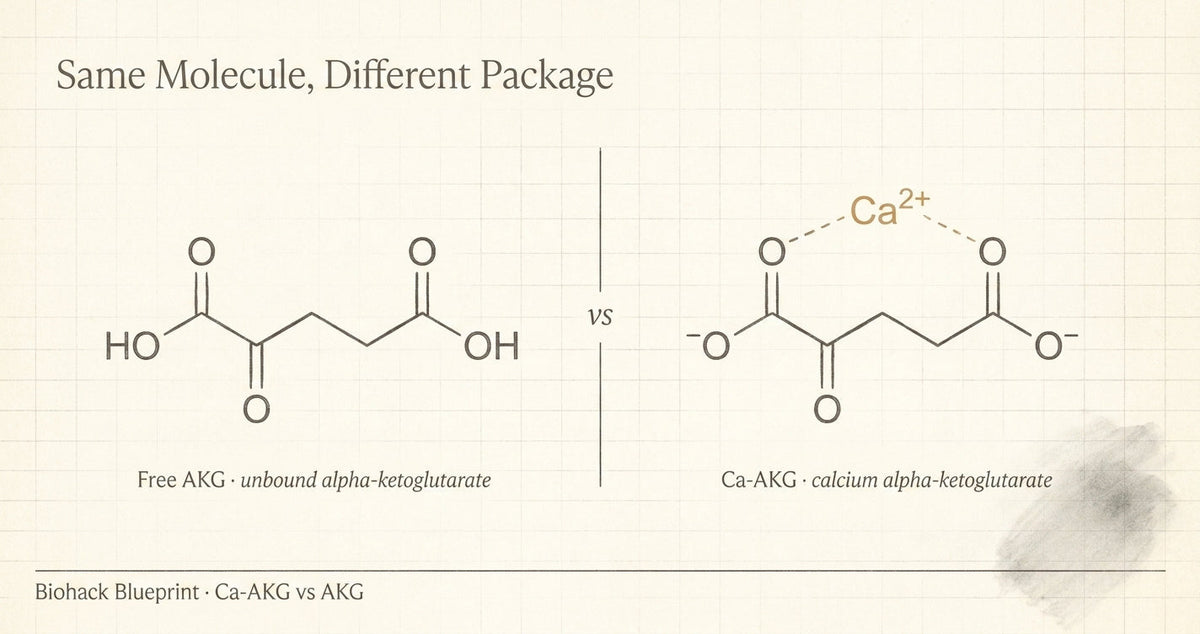
Ca-AKG is the calcium salt of alpha-ketoglutarate. “Free AKG” usually means alpha-ketoglutaric acid without a mineral or amino-acid counter-ion. Both can ultimately provide alpha-ketoglutarate, but they differ in dose labeling, acidity, accompanying calcium and research history.
Ca-AKG vs AKG: the short version
| Question | Ca-AKG | Free AKG |
|---|---|---|
| What is it? | Calcium salt of AKG | Alpha-ketoglutaric acid / unbound AKG |
| Human oral data? | Yes | Yes |
| Direct Ca-AKG vs free-AKG human PK trial? | No clear head-to-head trial in the audited corpus | |
| Human longevity efficacy? | Observational delayed-release data; randomized ABLE outcomes pending | No human longevity efficacy trial |
| Added mineral? | Calcium | None |
What exactly is Ca-AKG?
Ca-AKG is calcium alpha-ketoglutarate: alpha-ketoglutarate paired with calcium as a salt.
A 1990 study gave healthy volunteers 3.6 g of Ca-AKG and documented measurable metabolic effects after oral administration [1].
Ca-AKG is also the form used in the 2007 randomized osteopenia trial [2] and the 2020 C57BL/6 mouse aging study [3].
What is free AKG?
Free AKG refers to alpha-ketoglutaric acid without calcium, arginine, ornithine or another counter-ion.
It has actually been administered orally to humans.
A 2010 healthy-volunteer study tested 5–20 g doses of oral free AKG in an antidote-development program [4].
Estimated absorption depended on dose, water intake and whether a large dose was split. A 20 g total dose had better estimated bioavailability when divided into two 10 g administrations than when taken all at once.
That does not tell us what happens at a 1 g longevity-supplement dose, but it directly contradicts the idea that free AKG simply “cannot be absorbed.”
Has Ca-AKG been proven more bioavailable than free AKG?
Not by a direct human head-to-head study in our audited corpus.
We have human oral data for Ca-AKG and separate human oral data for free AKG. We do not have a clean randomized pharmacokinetic trial giving matched AKG-equivalent doses of both forms under the same conditions and measuring systemic exposure.
That means statements such as “Ca-AKG survives the stomach while free AKG breaks down” or “Ca-AKG is X times more bioavailable” should not be stated as proven clinical facts without a direct source.
Does the calcium salt still matter?
Yes, but in ways we can state confidently.
It changes the chemical form. Salts differ from their free acids in physical properties and formulation behavior.
It changes the dose basis. The mass of a Ca-AKG salt includes calcium, so 1,000 mg of Ca-AKG is not necessarily equivalent to 1,000 mg of free alpha-ketoglutaric acid.
It adds calcium. That matters for total mineral intake and for people taking calcium-sensitive medications or managing kidney/mineral disorders.
It changes the evidence match. The key modern aging studies used Ca-AKG or a delayed-release Ca-AKG formulation, not free AKG.
What does delayed-release Ca-AKG add to the comparison?
Delayed-release Ca-AKG is not a different chemical salt. It is a delivery formulation.
In the 2026 Pabis observational cohort, delayed-release AKG users had a significant cross-sectional association with lower DNA-methylation Age Residual, whereas plain non-delayed AKG users had a smaller, non-significant association [5].
But this was not a randomized comparison of release technologies. The delayed-release product contained vitamins, exposure was self-reported, and the adjusted longitudinal signal was not significant.
So Pabis 2026 should not be used to claim that delayed-release Ca-AKG is a precise multiple “better” than standard Ca-AKG, much less that Ca-AKG is a precise multiple better than free AKG.
Which form has more human longevity evidence?
Ca-AKG does.
The Rejuvant retrospective used sustained-release Ca-AKG with added vitamins [6]. ABLE uses 1 g/day sustained-release Ca-AKG in a randomized placebo-controlled design [7].
That tells us where the aging research has concentrated. It does not prove that the calcium counter-ion itself is responsible for any benefit.
Free AKG has human oral pharmacokinetic evidence, but not a human aging-efficacy trial.
What about the mouse lifespan evidence?
The original 2020 positive mouse study used Ca-AKG [3].
Two later NIA Interventions Testing Program experiments using dietary AKG in genetically heterogeneous UM-HET3 mice did not reproduce lifespan extension [8] [9].
So even the form with the strongest aging research does not have uniformly positive preclinical lifespan evidence.
How should you compare product labels?
Look for three separate facts:
- the exact ingredient name;
- whether the milligram figure refers to the full salt or AKG equivalent;
- and how much calcium is separately declared.
A 1 g “Ca-AKG” serving cannot be assumed to contain the same AKG-base amount as 1 g free AKG.
Is free AKG a reasonable way to avoid calcium?
It removes the calcium counter-ion, but that does not automatically make it a better product.
Free AKG has high-dose human oral PK data but little direct healthy-aging evidence. Anyone choosing it should understand that they are moving away from the formulation used in most modern longevity studies.
Sodium AKG is another non-calcium form, but it likewise lacks direct human longevity efficacy data.
Bottom line
Ca-AKG and free AKG both connect to the same underlying metabolite, but their evidence bases are not interchangeable.
The strongest defensible difference is research history and formulation, not a proven dramatic bioavailability advantage. Ca-AKG has direct human clinical exposure and dominates the modern aging literature. Free AKG has human oral absorption data, but no human longevity efficacy trial.
There is no clean human head-to-head study in our audited corpus proving that Ca-AKG is more bioavailable or clinically more effective than free AKG at matched doses.
For all other salts, see AKG forms explained.
Frequently asked questions
Is calcium AKG the same as AKG?
Is Ca-AKG more effective than free AKG?
What is the difference between delayed-release Ca-AKG and standard Ca-AKG?
Can you take free AKG instead of Ca-AKG?
Does Ca-AKG have better bioavailability than free AKG?
Which is best: free AKG, standard Ca-AKG, or delayed-release Ca-AKG?
Sources & article history
Sources (9)
-
Action of ornithine alpha-ketoglutarate, ornithine hydrochloride, and calcium alpha-ketoglutarate on plasma amino acid and hormonal patterns in healthy subjects Journal of the American College of Nutrition. 1990;9(1):2-12.
-
Alpha-Ketoglutarate Decreases Serum Levels of C-terminal Cross-Linking Telopeptide of Type I Collagen (CTX) in Postmenopausal Women with Osteopenia: Six-Month Study International Journal for Vitamin and Nutrition Research. 2007;Volume 77, issue 2, pages 89–97.
-
Alpha-Ketoglutarate, an Endogenous Metabolite, Extends Lifespan and Compresses Morbidity in Aging Mice Cell Metabolism. 2020;Volume 32, issue 3, pages 447–456.e6.
-
Radiolabeling and dose fixation study of oral alpha-ketoglutarate as a cyanide antidote in healthy human volunteers Clinical Toxicology. 2010;48(6):509-515.
-
Supplements and Drugs Are Associated With Biological Age in a Cohort of Exceptionally Healthy Individuals Aging Cell. 2026;Volume 25, issue 6, article e70517.
-
Rejuvant®, a potential life-extending compound formulation with alpha-ketoglutarate and vitamins, conferred an average 8 year reduction in biological aging, after an average of 7 months of use, in the TruAge DNA methylation test Aging (Albany NY). 2021;Volume 13, issue 22, pages 24485–24499.
-
Alpha-ketoglutarate supplementation and BiologicaL agE in middle-aged adults (ABLE)—intervention study protocol GeroScience. 2023;Volume 45, issue 5, pages 2897–2907.
-
Lifespan effects in male UM-HET3 mice treated with sodium thiosulfate, 16-hydroxyestradiol, and late-start canagliflozin GeroScience. 2024;46(5):4657-4670.
-
Astaxanthin, meclizine, mitoglitazone, pioglitazone, alpha-ketoglutarate, mifepristone, methotrexate, and atorvastatin-telmisartan do not increase lifespan in UM-HET3 mice GeroScience. 2026;48(3):3821-3830.


