Betaine Anhydrous vs Betaine HCl: Which Form Is TMG?
Compare betaine anhydrous and betaine HCl: TMG identity, stomach-acid research, label differences and why equal milligrams are not equivalent.
 By
Dr. Khaled Mahmoud, MBBCh
Critical Care Medicine, Longevity Science & Editorial Direction
 Reviewed by
Dr. Amr Yasser, PhD
Cardiometabolic, Musculoskeletal, Gut & Bioavailability
 Reviewed by
Dr. Abdulla Mostafa, PhD
Cellular Senescence, Neurological, Mitochondrial & Brain-Ageing Biology
- Published
- Last reviewed
- Reading time
- 9 min
- Sources cited
- 9
On this page
Affiliate disclosure: Biohack Blueprint may earn a commission from qualifying DoNotAge purchases through our links.
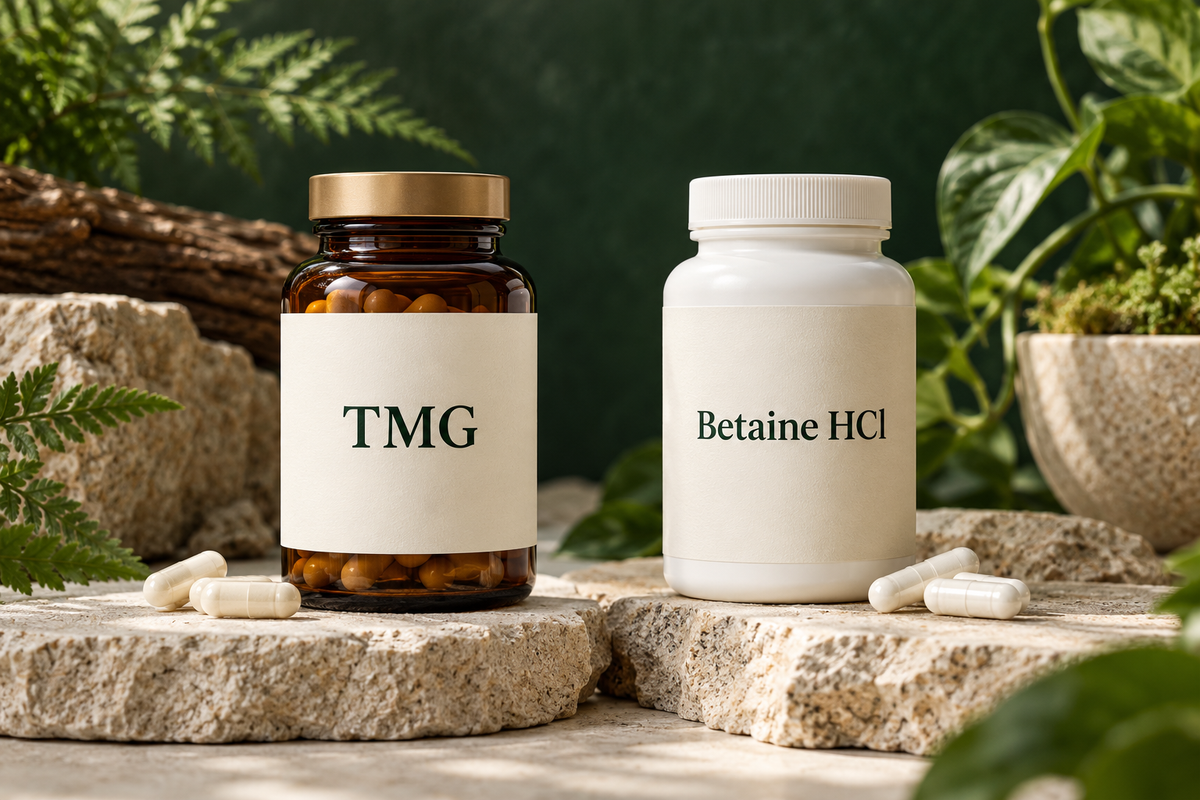
Betaine anhydrous versus betaine HCl is a formulation question, not simply two names for an identical capsule. Betaine anhydrous is commonly called TMG or trimethylglycine. Betaine HCl is betaine hydrochloride, an acid-associated form usually discussed in relation to digestion and stomach acidity.
The overlap in names makes them easy to confuse. The studies, intended uses and milligram amounts should still be checked separately.
A side-by-side comparison
| Feature | Betaine anhydrous / TMG | Betaine HCl |
|---|---|---|
| Label names | Trimethylglycine, glycine betaine, TMG | Betaine hydrochloride |
| Common research questions | Homocysteine, metabolism, exercise performance | Gastric pH and pH-dependent drug absorption |
| Typical product context | Single-ingredient capsules, tablets or powder | Digestive products, sometimes combined with other ingredients |
| Does one inherit the other’s trial results? | No. Match the formulation, amount and endpoint to the actual study | |
| Direct substitution | Not automatic, including for a prescribed use | |

Three label examples that prevent the common mix-up
| Example wording | What it identifies | What to check next |
|---|---|---|
| “Trimethylglycine (betaine anhydrous), 500 mg per capsule” | A declared amount of plain TMG | Number of capsules in the label serving and any other active ingredients |
| “Betaine hydrochloride, 650 mg, with pepsin” | An acid-form digestive supplement plus an additional ingredient | The HCl-related cautions and the fact that pepsin makes this a combination formula |
| “Methylation complex,” with betaine in a blend | A mixture that may include TMG | Whether the exact betaine form and individual amount are disclosed |
The examples illustrate wording, not recommended products or doses. A capsule’s size, white powder appearance, vegan shell or beetroot branding cannot reliably identify the formulation. The ingredient panel is the useful starting point.
Both compounds contain a betaine component, but HCl is the hydrochloride salt. Treating them as entirely unrelated chemistry can be as confusing as calling them interchangeable. The practical differences are the acid component, amount expressed on the label, intended use and evidence for the exact formulation.
What “anhydrous” tells you
Anhydrous identifies the compound without water of crystallization. In supplement discussions, betaine anhydrous refers to the TMG used in many methyl-donor and sports studies. Its biological role includes methyl transfer through BHMT and cellular osmotic functions. [1]
This is the formulation category to check when reading a betaine homocysteine trial or comparing plain TMG supplements. The word “betaine” alone on a page is insufficient if the study actually used a salt, a combination formula or a local-use product.
What has betaine HCl research measured?
One small experiment gave six healthy volunteers betaine HCl after a proton-pump inhibitor had induced low gastric acidity. A 1.5-gram amount temporarily lowered gastric pH. This was a controlled physiology experiment, rather than evidence that routine digestive symptoms diagnose a need for acid supplementation. [2]
Other studies examined the absorption of specific drugs under experimentally altered acidity. Results depended on the medicine and the meal conditions. An HCl experiment with dasatinib, for example, cannot become a general recommendation for someone taking a different drug. [3] [4]
A further randomized study in nine adults tested different HCl amounts after food. It reinforces the importance of meal context when interpreting gastric pH experiments. [5] A review of mealtime HCl use describes the limits of this evidence base. [6]
Why equal milligrams are not the same comparison
A stated mass of a hydrochloride formulation is not automatically the same exposure as that mass of betaine anhydrous. Products may also include pepsin or other ingredients. Comparing “500 mg” on two front labels without reading the Supplement Facts panel can therefore create a false equivalence.
Do not convert between them casually or copy a trial amount into the wrong product. The TMG dosage guide assumes betaine anhydrous when discussing ordinary TMG capsule arithmetic.

What the small stomach-acid studies do not establish
One gastric-acid study gave 1.5 g betaine HCl to six healthy volunteers after acid suppression with rabeprazole. It measured gastric pH, a useful pharmacological question in that artificial setting. It did not diagnose the cause of everyday bloating or demonstrate long-term symptom relief in a large patient trial. [2]
Other experiments assessed absorption of acid-sensitive medicines or studied meal conditions. Those are important because changing stomach pH can change drug exposure; they are not a reason to self-adjust acid-suppressing treatment. Food and formulation details affect the question being tested. [3] [4] [5]
Symptoms such as fullness, reflux or indigestion do not by themselves prove low acid. An online “increase HCl until you feel burning” routine is not a substitute for diagnosis and is not supported by the plain-TMG homocysteine trials. People with stomach conditions or medicines affected by acidity need individual advice before using an acid-form product.
Can you take both forms together?
The fact that one product is marketed for methylation and another for digestion does not establish a need to combine them. There is no general evidence-based rule saying that taking TMG requires HCl, or that HCl use should be accompanied by a gram-matched amount of TMG. Review the reason for each product and the full regimen.
Which form should you look for in exercise or homocysteine research?
The relevant trials discussed in this cluster generally specify betaine or betaine anhydrous. Match the study’s formulation and purpose when evaluating a claim. If your product says HCl, a positive result from an betaine anhydrous sports study does not demonstrate the same outcome for that product.
Our dosage guide and exercise guide explain the actual protocols. For a plain capsule option, the DoNotAge Pure TMG review identifies the declared form and amount without treating HCl as an alternative serving.
Does TMG treat low stomach acid or bloating?
Plain TMG is not the same intervention used to acidify the stomach in HCl studies. Nor do bloating, reflux or feeling full after meals establish low gastric acid on their own. Several conditions can produce similar symptoms, and using an acid product may complicate treatment.
If a digestive product is being considered alongside acid-suppressing medicine or a drug whose absorption depends on pH, involve a pharmacist or clinician. The interaction cannot be reduced to a universal instruction to separate products by a certain number of hours.
Topical betaine is another separate category
Our research collection includes betaine-containing toothpastes and mouth products. Some examine dry-mouth symptoms or local irritation, and several contain olive oil, xylitol or other ingredients. These are topical or local-use formulations, not evidence that swallowing TMG capsules treats dry mouth or gum disease. [7] [8]
Keeping these papers in the Data Center is useful precisely because it allows the formulation to be identified. Counting every betaine paper as support for an oral TMG capsule would erase that distinction.
A gastric-acid experiment is not a TMG outcome trial
The small betaine-HCl pharmacology study examined temporary reacidification after a medicine had suppressed gastric acid. It showed a route- and formulation-specific gastric effect, not improved homocysteine, exercise performance or longevity from an ordinary TMG capsule. [2]
By contrast, the homocysteine dose-response trial used betaine as a methyl-donor intervention over six weeks. The difference is the research question as well as the name on the label. The hydrochloride formulation should not be substituted gram-for-gram simply because both names contain “betaine.” [9]
When shopping, identify the full ingredient name, the declared amount and any accompanying digestive enzymes or active ingredients. A product sold for digestive acidity has a different purpose from a standalone betaine-anhydrous capsule. If the reason for considering HCl is persistent digestive symptoms, establish the cause rather than using a TMG comparison as a self-diagnosis of low stomach acid.
How to choose the form for your question
- Homocysteine or methyl-donor research: check for betaine anhydrous and read the population and amount.
- Sports research: verify the actual TMG grams and whether the product contains other actives.
- Stomach-acid or medicine-absorption questions: use the HCl evidence with professional guidance.
- Prescription treatment: use the prescribed formulation and specialist instructions.
Our preferred plain capsule option is covered in the DoNotAge Pure TMG review. For a broader comparison of equivalent anhydrous products, use the TMG buying guide. HCl products are excluded from that like-for-like comparison.
Sources and next steps
Browse the complete 415-publication TMG Data Center for the original studies, methods, disclosures and limitations. The numbered references below identify the sources used for this article; the full library also retains supporting and null evidence.
Continue by question: TMG Supplement: Benefits, Dosage, Safety and Research · TMG Dosage Guide: Study Doses and Capsule Calculations · TMG vs Glycine: Benefits, Sleep, Methylation and DMG · Best TMG Supplements: Capsules, Tablets and Powder Compared.
Our recommended TMG product

DoNotAge Pure TMG — 5/5 editorial rating
Our first choice for a straightforward single-active capsule: 500 mg TMG per capsule, a vegan capsule and 60 or 366 capsules. The score assesses the formula, label clarity and practical product choice; clinical evidence is judged separately.
Read the full evidence-led review · View at DoNotAge. Use BB10 for 10% off eligible standalone products; confirm current checkout terms.
Affiliate disclosure: Biohack Blueprint may earn a commission from qualifying purchases. This is a desk-based editorial recommendation, not an independent batch assay or a promise of a health outcome.
Frequently asked questions
Is betaine HCl the same as TMG?
Does plain TMG increase stomach acid?
Can betaine HCl replace TMG capsules?
Does the HCl research prove it treats bloating?
What wording should I look for on a TMG label?
Sources & article history
Sources (9)
-
Betaine in human nutrition The American journal of clinical nutrition. 2004;80(3):539-549.
-
Gastric reacidification with betaine HCl in healthy volunteers with rabeprazole-induced hypochlorhydria Molecular pharmaceutics. 2013;10(11):4032-4037.
-
The use of betaine HCl to enhance dasatinib absorption in healthy volunteers with rabeprazole-induced hypochlorhydria The AAPS journal. 2014;16(6):1358-1365.
-
Meal Effects Confound Attempts to Counteract Rabeprazole-Induced Hypochlorhydria Decreases in Atazanavir Absorption Pharmaceutical research. 2017;34(3):619-628.
-
Food, Acid Supplementation and Drug Absorption - a Complicated Gastric Mix: a Randomized Control Trial Pharmaceutical research. 2019;36(11):155.
-
Meal-Time Supplementation with Betaine HCl for Functional Hypochlorhydria: What is the Evidence? Integrative medicine (Encinitas, Calif.). 2020;19(1):32-36.
-
Effects of a betaine-containing toothpaste on subjective symptoms of dry mouth: a randomized clinical trial The journal of contemporary dental practice. 2003;4(2):11-23.
-
Rapid Reduction of Pro-Inflammatory Cytokines with an Oral Topical Composition Comprising Olive Oil, Trimethylglycine and Xylitol: A Randomized Double-Blind Controlled Trial International journal of molecular sciences. 2025;26(10):4920.
-
Low dose betaine supplementation leads to immediate and long term lowering of plasma homocysteine in healthy men and women The Journal of nutrition. 2003;133(12):4135-4138.