
Fucoidan SIRT6 Activator: The Evidence, In Mice and Humans
Fucoidan is the leading natural SIRT6 activator candidate. Mouse and mechanistic evidence has now progressed into human testing, including NUS PROMETHEUS and the randomized Project SIRT6 Activator trial.
 By
Dr. Khaled Mahmoud, MBBCh
Critical Care Medicine, Longevity Science & Editorial Direction
By
Dr. Khaled Mahmoud, MBBCh
Critical Care Medicine, Longevity Science & Editorial Direction
 Reviewed by
Dr. Amr Yasser, PhD
Cardiometabolic, Musculoskeletal, Gut & Bioavailability
Reviewed by
Dr. Amr Yasser, PhD
Cardiometabolic, Musculoskeletal, Gut & Bioavailability
 Reviewed by
Dr. Abdulla Mostafa, PhD
Cellular Senescence, Neurological, Mitochondrial & Brain-Ageing Biology
Reviewed by
Dr. Abdulla Mostafa, PhD
Cellular Senescence, Neurological, Mitochondrial & Brain-Ageing Biology
- Published
- Last reviewed
- Reading time
- 12 min
- Sources cited
- 11
On this page
Specific fucoidan preparations can activate SIRT6 in biochemical experiments, and a 2025 mouse lifespan preprint used DoNotAge.org-supplied Fucus vesiculosus fucoidan. That is the strongest product-linked evidence in the current SIRT6 supplement literature. It is also easy to overstate.
The 2025 lifespan paper remains a preprint, the female lifespan result was not statistically significant, human SIRT6 target engagement has not been demonstrated, and a separate 2025 senotherapeutic preprint used Sigma-Aldrich F8190 as its main Fucoidan-FV preparation—not DoNotAge product material. This page keeps those evidence chains separate.
| Evidence | Fucoidan source | Main finding | Product-specific to DoNotAge? |
|---|---|---|---|
| Rahnasto-Rilla 2017 | Brown-algae extracts / purified fucoidan | Direct SIRT6 activation in biochemical assay | No |
| Biashad 2025 preprint | F. vesiculosus; DoNotAge-supplied material used in vivo | Male median lifespan +13%; frailty/epigenetic-age effects; SIRT6-dependent evidence | Yes for the in-vivo cohort |
| Robbins 2025 preprint | Sigma-Aldrich F8190 Fucoidan-FV; other screened fucoidans | Senomorphic activity, SIRT6-dependent DNA repair, aged/progeroid mouse effects | No |
| Human fucoidan studies | Multiple species/extracts | Absorption, immune, metabolic and safety signals | Generally no |
| NCT07500649 | Fucoidan/SIRT6 activator 2.4 g/day | Randomized biological-aging trial | DoNotAge collaborator; results pending |
What is fucoidan?
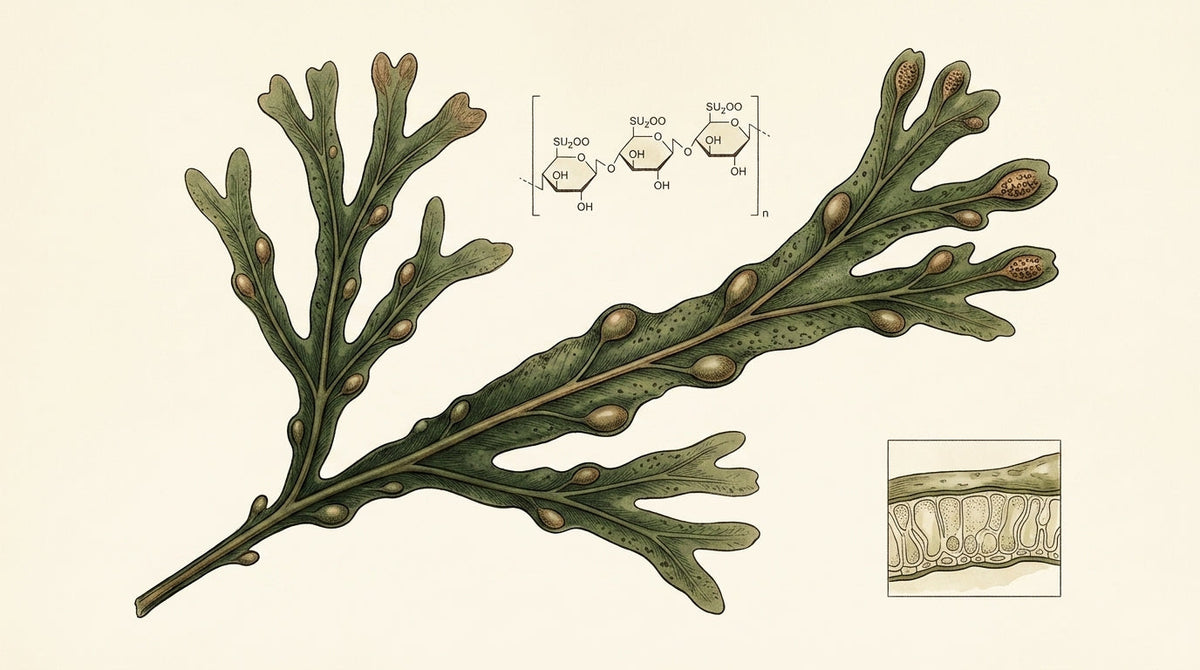
Fucoidan is a family of sulfated, fucose-rich polysaccharides found mainly in brown seaweeds. “Fucoidan” does not describe one molecule. Molecular weight, fucose/galactose composition, sulfation pattern, branching, seaweed species, harvest conditions and extraction methods all change the final material.
That chemical heterogeneity is central to the SIRT6 question. A positive result with one Fucus vesiculosus preparation cannot automatically be transferred to mozuku, wakame, a generic “brown seaweed complex” or another commercial fucoidan.
Where did the fucoidan–SIRT6 story start?
In 2017, Rahnasto-Rilla and colleagues screened extracts from brown algae for SIRT6 activity. Several extracts increased H3K9 deacetylation, with the strongest effect from Fucus distichus. The active material was identified as fucoidan [1].
In the purified-enzyme system, fucoidan produced a very large activation signal—roughly 355-fold at 100 μg/mL under the reported assay conditions. That number describes a test-tube enzyme assay. It is not evidence that oral supplementation increases human SIRT6 activity hundreds of times.
A literature-conflict worth explaining
Some later secondary reviews have listed fucoidan inconsistently, including as an inhibitor. The primary experimental record is clearer: the 2017 paper directly measured increased SIRT6 deacetylation, and the 2025 Biashad and Robbins preprints report increased SIRT6 deacetylation and/or mono-ADP-ribosylation with selected fucoidans.
When a secondary summary conflicts with direct primary data, this cluster will follow the primary experiment. The scientifically careful wording is: specific fucoidan preparations activate SIRT6 in the assays tested.
Biashad 2025: the mouse lifespan preprint
The Biashad group asked whether fucoidan could activate both major SIRT6 catalytic functions and whether long-term administration from middle age could alter mouse aging [2].
Exact source attribution
The methods state that multiple fucoidan sources were used for biochemical screening, including Sigma-Aldrich materials and a DoNotAge.org preparation. Crucially, the F. vesiculosus fucoidan used for the in-vivo aging study was obtained from DoNotAge.org.
This makes the lifespan experiment genuinely product-linked in a way that generic fucoidan research is not.
What the study found
- Fucoidan stimulated both SIRT6 deacetylation and mono-ADP-ribosylation in the reported biochemical experiments.
- Forty-four mice received fucoidan beginning at 15 months of age and 36 served as controls.
- Male median lifespan increased by about 13% (reported p=0.009).
- The female median-lifespan increase was about 3% and was not statistically significant.
- Frailty progression improved in both sexes.
- Blood epigenetic-age measures were lower in treated animals.
- LINE1 repression, chromatin and inflammatory signatures shifted in directions consistent with parts of SIRT6 biology.
- Fucoidan did not rescue lifespan in SIRT6-knockout mice, supporting—but not proving exclusivity of—a SIRT6-dependent mechanism.
The dose problem
The mice received an average of roughly 278 mg/day through drinking water and chow. For a ~30 g mouse, that is an enormous mg/kg exposure compared with consumer human dosing. Straight body-weight translation is inappropriate, but the gap is still large enough that the mouse result should not be treated as validation of a 1.6–2.4 g/day human dose.
The conflict-of-interest context
The preprint discloses that senior author Vera Gorbunova is a scientific advisory-board member of DoNotAge and several other longevity companies. That relationship does not invalidate the experiment, but it increases the importance of independent replication and peer review.
Robbins 2025: senotherapeutic and DNA-repair evidence
The separate Robbins preprint screened 12 fucoidan variants for senotherapeutic effects and found that different preparations behaved very differently [3].
The main Fucus vesiculosus preparation, called Fucoidan-FV, was Sigma-Aldrich F8190. It showed senomorphic effects, improved DNA-repair readouts and increased SIRT6 catalytic activity. SIRT6 knockdown/knockout weakened important effects, supporting partial SIRT6 dependence.
Another preparation from Macrocystis pyrifera behaved more like a senolytic. That is powerful evidence against treating “fucoidan” as one uniform ingredient.
This paper should strengthen the biological case for F. vesiculosus fucoidan and SIRT6. It should not be presented as an exact-product DoNotAge replication.
Are the two 2025 papers peer reviewed?
No. As of September 21, 2026, Biashad remains a bioRxiv preprint and Robbins remains a Research Square preprint indexed by PubMed/PMC as a preprint. They are substantial datasets from established aging laboratories, but their results should remain labeled preliminary until peer-reviewed publication.
The bioavailability problem
Fucoidan is a large sulfated polysaccharide, so oral translation is not straightforward. Human work shows that fucoidan-derived material can be detected after oral intake, but absorption is low and highly variable [4].
Even measurable systemic absorption does not answer the key SIRT6 question: what chemical species reaches a target cell, enters or signals to the nucleus, and increases SIRT6 activity in vivo?
The Robbins preprint explicitly notes this mechanistic uncertainty and suggests that metabolites, breakdown products or indirect signaling may contribute. The active in-vivo species has not been definitively identified.
What human fucoidan studies can tell us
Human fucoidan research predates the SIRT6 story. Trials have studied osteoarthritis symptoms, immune responses, metabolic markers, exercise/resistance-training contexts and coagulation. Those studies are useful for human exposure and safety context but use different species and preparations.
Examples include a randomized osteoarthritis study of a F. vesiculosus extract [5], immune studies with Cladosiphon-derived fucoidan [6], and a 2025 prediabetes RCT reporting metabolic/inflammatory changes [7].
None of those older studies demonstrated human SIRT6 target engagement.
What human SIRT6Activator trials are underway?
Project SIRT6 Activator — NCT07500649
This is the cleanest current supplement-specific test. Sixty prefrail men aged 50–80 are being randomized to 2.4 g/day fucoidan/SIRT6 activator or placebo for six months. The primary endpoint is change in DNA-methylation biological age. The study remains recruiting, with primary completion planned for March 2027.
PROMETHEUS — NCT07451496
The peer-reviewed PROMETHEUS protocol includes DoNotAge.org SIRT6Activator® at 2.4 g/day [8]. But the intervention is a personalized multimodal program involving exercise, diet, sleep, whey, creatine and potentially other nutraceuticals. It cannot isolate SIRT6Activator's contribution.
NCT06295588: adjacent fucoidan evidence
The University of Rochester is recruiting cancer survivors with fatigue into a randomized study using 4 g/day F. vesiculosus fucoidan for eight weeks, with fatigue, inflammatory and frailty endpoints. This is relevant human fucoidan evidence but is not registered as a SIRT6 target-engagement study.
Safety and anticoagulation
Short human studies of multiple fucoidan preparations are broadly reassuring, but long-term product-specific SIRT6Activator safety is not established. Fucoidans can have anticoagulant activity in vitro; a small human study did not show a strong predictable systemic anticoagulant effect, but interaction data remain limited [9].
See fucoidan safety for the ingredient-wide risk discussion and SIRT6Activator dosage for trial vs manufacturer doses.
What the evidence supports—and what it does not
Supported:
- Specific purified fucoidan preparations can directly activate SIRT6 in biochemical assays.
- The Biashad lifespan preprint used DoNotAge-supplied F. vesiculosus fucoidan for its in-vivo aging cohort.
- That preprint reported a statistically significant 13% male median-lifespan increase, frailty benefits in both sexes and SIRT6-dependent evidence.
- A separate Sigma-Fucoidan-FV preprint supports senomorphic and SIRT6-dependent DNA-repair biology.
- Human randomized healthy-aging testing is underway.
Not supported yet:
- that every fucoidan product activates SIRT6;
- that the 13% mouse lifespan result applies to women, humans or consumer doses;
- that oral SIRT6Activator has demonstrated SIRT6 target engagement in human tissue;
- that the product slows human biological aging or extends healthspan/lifespan;
- that two independent 2025 studies tested the exact DoNotAge product.
Bottom line
Fucoidan has one of the more interesting natural SIRT6 evidence chains, but precision matters. The direct biochemical mechanism is real for selected preparations; the most commercially relevant mouse lifespan study used DoNotAge-supplied material; the separate Robbins senotherapeutic study used research-grade Sigma F8190 and is not exact-product replication.
Both major 2025 mouse papers remain preprints. Human aging trials are underway, but no completed study has yet shown that oral fucoidan activates SIRT6 in human tissues or slows human aging.
For the full human program, see SIRT6 clinical trials. For our product-specific evaluation, see the DoNotAge SIRT6Activator review.
Frequently asked questions
Does fucoidan actually activate SIRT6?
Which fucoidan is the "right" one — is any commercial product OK?
How much fucoidan did the mice actually receive?
Are the Biashad 2025 and Robbins 2025 papers peer-reviewed?
What about human clinical trials?
Is fucoidan bioavailable when taken orally?
Is fucoidan safe to take daily?
Sources & article history
Sources (11)
-
The Identification of a SIRT6 Activator from Brown Algae Fucus distichus Marine Drugs. 2017;Volume 15, issue 6, article 190.
-
SIRT6 activator fucoidan extends healthspan and lifespan in aged wild-type mice bioRxiv (preprint). 2025;Preprint identifier 2025.03.24.645072 (posted 26 March 2025).
-
Fucoidans are senotherapeutics that enhance SIRT6-dependent DNA repair Research Square (preprint, not peer-reviewed). 2025;Preprint, rs.3.rs-6613032/v1.
-
Absorption Study of Mozuku Fucoidan in Japanese Volunteers Marine Drugs. 2018;16(8):254.
-
Effects of fucoidan from Fucus vesiculosus in reducing symptoms of osteoarthritis: a randomized placebo-controlled trial Biologics. 2016;10:81-88.
-
Effects of Ingesting Fucoidan Derived from Cladosiphon okamuranus Tokida on Human NK Cells: A Randomized, Double-Blind, Parallel-Group, Placebo-Controlled Pilot Study Marine Drugs. 2021;19(6):340.
-
Supplementation of elderly Japanese men and women with fucoidan from seaweed increases immune responses to seasonal influenza vaccination The Journal of Nutrition. 2013;143(11):1794-1798.
-
Effect of fucoidan supplementation on glycolipid metabolism, systemic inflammation and gut microbiota in prediabetes: A randomized controlled trial International Journal of Biological Macromolecules. 2025;287:138415.
-
Investigating fucoidan blend supplementation and resistance training in humans: a parallel randomized controlled trial design Scientific Reports. 2025;15(1):40249.
-
Pilot clinical study to evaluate the anticoagulant activity of fucoidan Blood Coagulation & Fibrinolysis. 2009;20(7):607-610.
-
PROMETHEUS clinical trial protocol: tailoring healthy ageing with lifestyle and nutraceuticals GeroScience. 2026;Online ahead of print, published July 3, 2026.