Liposomal NMN vs Capsules, Powder and Sublingual NMN
Liposomal NMN is marketed as more bioavailable, but direct human superiority data are missing. We compare standard oral, sublingual, powder, microcrystalline and liposomal forms using current pharmacokinetic evidence.
 By
Dr. Khaled Mahmoud, MBBCh
Critical Care Medicine, Longevity Science & Editorial Direction
By
Dr. Khaled Mahmoud, MBBCh
Critical Care Medicine, Longevity Science & Editorial Direction
 Reviewed by
Dr. Amr Yasser, PhD
Cardiometabolic, Musculoskeletal, Gut & Bioavailability
Reviewed by
Dr. Amr Yasser, PhD
Cardiometabolic, Musculoskeletal, Gut & Bioavailability
 Reviewed by
Dr. Abdulla Mostafa, PhD
Cellular Senescence, Neurological, Mitochondrial & Brain-Ageing Biology
Reviewed by
Dr. Abdulla Mostafa, PhD
Cellular Senescence, Neurological, Mitochondrial & Brain-Ageing Biology
- Published
- Last reviewed
- Reading time
- 7 min
- Sources cited
- 5
On this page
Liposomal NMN is marketed as a higher-bioavailability form, but there is still no human clinical trial showing that liposomal NMN produces better health outcomes than standard oral NMN. The most relevant new human route data are actually for sublingual NMN, not liposomes.
NMN forms compared
| Form | Human evidence | What we can say |
|---|---|---|
| Standard oral capsule/tablet | Most NMN randomized trials | Best-supported delivery format for clinical evidence |
| Powder | Ingredient-equivalent when authentic; fewer format-specific comparisons | Convenient dosing, not proven superior |
| Sublingual | 2026 randomized crossover PK study | Changes early metabolite exposure; clinical superiority unproven |
| Liposomal | No strong direct human NMN outcome comparison | Plausible delivery technology; superiority remains a marketing claim |
| Pharmaceutical microcrystalline MIB-626 | Human PK and physiologic trials | Specific formulation with its own data; cannot validate ordinary retail NMN |
What does “liposomal” mean?
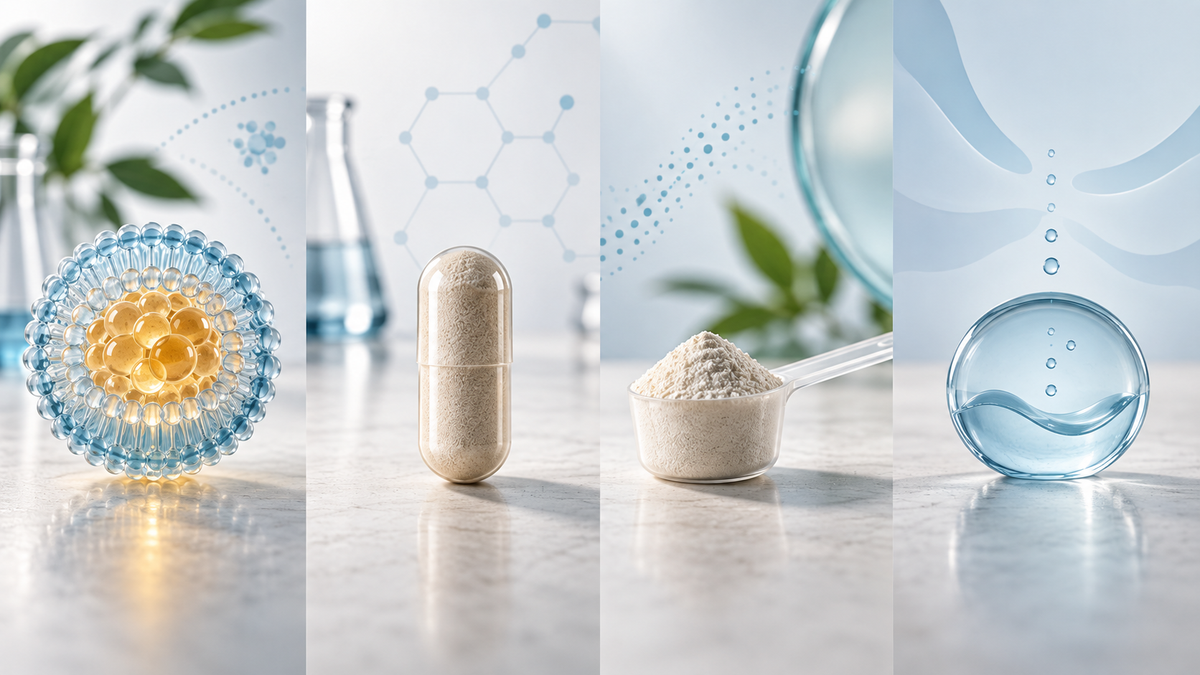
Liposomes are lipid vesicles designed to encapsulate compounds and alter their delivery. In principle, they can protect some molecules from degradation or change absorption. Whether that theoretical advantage matters depends on the specific molecule, particle characteristics, manufacturing, dose and human pharmacokinetics.
Evidence for liposomal delivery in one ingredient cannot automatically be transferred to NMN.
What is missing for liposomal NMN?
A convincing superiority claim would ideally require a head-to-head human study comparing equal doses of liposomal and standard NMN with prespecified pharmacokinetic and clinical endpoints. The current NMN human literature does not provide that level of evidence.
Therefore statements such as “three times more bioavailable” need product-specific human data, not generic liposome theory.
What the 2026 sublingual study actually found
A randomized crossover study in 14 healthy adult men compared sublingual and oral NMN. Sublingual administration increased early exposure to terminal NAD catabolites 2PY and 4PY relative to oral administration. [1]
That is a pharmacokinetic difference. It did not demonstrate that sublingual NMN improved energy, sleep, insulin sensitivity, exercise performance, longevity or any other clinical endpoint.
Does sublingual NMN bypass the gut?
Some absorption may occur across oral mucosa, but “sublingual” should not be treated as synonymous with complete gut bypass. Swallowed material can still enter the gastrointestinal tract. The study measured metabolite exposure, not a simple percentage of dose escaping digestion.
What standard oral NMN can already do
Standard oral NMN has no obvious need to be dismissed as “poorly absorbed.” Multiple human trials show clear effects on circulating NAD metabolism.
In 2026, 1,000 mg/day ordinary oral NMN roughly doubled baseline whole-blood NAD+ over 14 days, similar to 1,000 mg/day NR. [2] Lower-dose RCTs have also demonstrated NAD-related effects.
What about MIB-626?
MIB-626 is a microcrystalline β-NMN formulation developed as a pharmaceutical-grade investigational product. It produced strong dose-dependent NAD+ pharmacology at 1,000–2,000 mg/day. [3]
That does not mean “microcrystalline” is a universal retail quality mark, and it does not show liposomes are better or worse.
Liposomal NMN vs capsules
| Question | Evidence-based answer |
|---|---|
| Which has more NMN-specific human trials? | Standard capsules/tablets |
| Which is proven to raise NAD+? | Standard oral NMN clearly does; liposomal-specific superiority is unproven |
| Which is proven to improve clinical outcomes more? | Neither form has won a direct head-to-head outcome trial |
| Is liposomal worth paying more for? | That depends on product-specific evidence and quality, not a proven class-wide advantage |
| Does capsule NMN get destroyed before working? | Human trials show oral NMN still alters systemic NAD metabolism |
Quality can matter more than delivery format
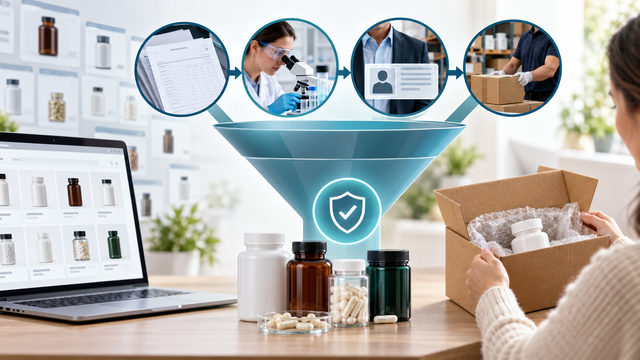
A sophisticated delivery system is irrelevant if the product does not contain the labeled NMN. Independent testing found major deviations from label claims in commercial NMN products. [4]
Isomer-specific testing in 2026 also found undeclared or inaccurate composition among eight commercial products. [5]
For that reason, we would prioritize finished-product identity and quantitative testing before paying a premium for a delivery claim. See NMN purity and COAs.
How should you compare NMN forms?
- Check actual NMN dose per serving, not capsule count.
- Look for batch-specific assay and identity testing.
- Ask whether the claimed delivery advantage was tested in humans with that exact product.
- Distinguish a change in metabolite kinetics from a demonstrated clinical benefit.
- Compare price per verified amount of β-NMN, not just price per bottle.
“Bioavailability” needs a defined analyte
NMN marketing frequently uses the word bioavailability without saying what was measured. Possible endpoints include intact NMN in plasma, whole-blood NAD+, NADH, nicotinamide, methylated breakdown products, urinary metabolites or tissue NAD. Those can move differently.
A delivery system can increase one early metabolite without improving the clinical endpoint a buyer cares about. That is why a percentage such as “300% more bioavailable” is meaningless unless the study specifies the molecule, time window and comparator.
Liposomes: plausible technology, missing NMN comparison
Liposomes are phospholipid vesicles that can alter the delivery of some compounds. The platform has legitimate pharmaceutical uses. But efficacy is molecule- and formulation-specific.
For NMN, the missing study is straightforward: equal-dose liposomal versus standard β-NMN in humans, with validated pharmacokinetics and then clinically meaningful outcomes. Without that, the delivery claim remains plausible rather than demonstrated.
Why animal or in-vitro liposome data are not enough
Particle size, lipid composition, encapsulation efficiency, gastrointestinal stability and manufacturing quality can vary markedly between products. A favorable result from one laboratory formulation does not validate a different retail supplement using the same generic word “liposomal.”
Capsule versus powder
| Feature | Capsule/tablet | Powder |
|---|---|---|
| Dose precision | Pre-measured when manufacturing is accurate | Depends on scoop/scale and homogeneity |
| Human evidence | Most RCTs use standardized oral doses | Ingredient can be equivalent, but fewer format-specific comparisons |
| Convenience | High | Flexible dosing |
| Main quality risk | Label accuracy and formulation | Label accuracy, moisture, dose measurement |
| Proven clinical superiority | No | No |
What about liquid NMN?
Liquid delivery can be convenient, but water exposure can also make stability more formulation-dependent. A brand needs its own shelf-life and potency data. “Liquid” is a dosage form, not evidence of greater absorption.
Enteric coating and delayed release
An enteric coating can delay dissolution until a higher-pH intestinal environment. That can be useful for compounds degraded by gastric conditions. The clinical question is whether enteric-coated NMN creates a better human NAD response or health outcome. That evidence is not established.
Product identity matters before delivery technology
Independent testing has found major deviations from NMN label claims, and newer isomer-specific work shows that commercial products can vary in α-/β-NMN composition. [6] [7]
Paying extra for a liposomal label makes little sense if the finished product has not verified the identity and amount of β-NMN. See our COA and purity guide.
How to judge a form claim
- Was the exact finished product tested in humans?
- Was the comparator an equal dose of authentic β-NMN?
- Was the study randomized and crossover when possible?
- Which biomarker defined bioavailability?
- Was the difference large enough to matter beyond a short early time point?
- Did the study measure a clinical outcome or only metabolite kinetics?
- Is the tested batch representative of the commercial product now sold?
Related NMN guides
Bottom line
Standard oral NMN already has direct human evidence for altering NAD metabolism. Sublingual dosing now has an interesting pharmacokinetic study. Liposomal NMN remains plausible but insufficiently validated as a superior clinical delivery system. Verify the product before optimizing the delivery story.
Frequently asked questions
Does NMN need to be liposomal?
Is liposomal NMN better than capsules?
Is sublingual NMN better absorbed?
Can NMN powder be taken under the tongue?
Does NMN come in liquid form?
Are enteric-coated NMN capsules better?
What is the most studied form of NMN?
Sources & article history
Sources (5)
-
Sublingual NMN administration increases early circulating terminal catabolites 2PY and 4PY compared with oral administration in healthy adult men Scientific Reports. 2026;16(1):27464.
-
The differential impact of three different NAD+ boosters on circulatory NAD and microbial metabolism in humans Nature Metabolism. 2026;Volume 8, issue 1, pages 62–73.
-
MIB-626, an oral formulation of a microcrystalline unique polymorph of β-nicotinamide mononucleotide, increases circulating nicotinamide adenine dinucleotide and its metabolome in middle-aged and older adults The Journals of Gerontology, Series A: Biological Sciences and Medical Sciences. 2023;Volume 78, issue 1, pages 90–96.
-
Testing the amount of nicotinamide mononucleotide and urolithin A as compared to the label claim GeroScience. 2024;Volume 46, pages 5075–5083.
-
Aqueous LC-MS/MS quantification of α-/β-nicotinamide mononucleotide in dietary supplements using a pentabromophenyl column Analytica Chimica Acta. 2026;1386:345027.