Why People Stop Taking NMN—and What Happens When You Stop
What happens when you stop NMN? Human pharmacokinetic data suggest blood NAD returns toward baseline over weeks, without an established withdrawal syndrome. We explain why people quit and when stopping makes sense.
 By
Dr. Khaled Mahmoud, MBBCh
Critical Care Medicine, Longevity Science & Editorial Direction
By
Dr. Khaled Mahmoud, MBBCh
Critical Care Medicine, Longevity Science & Editorial Direction
 Reviewed by
Dr. Amr Yasser, PhD
Cardiometabolic, Musculoskeletal, Gut & Bioavailability
Reviewed by
Dr. Amr Yasser, PhD
Cardiometabolic, Musculoskeletal, Gut & Bioavailability
 Reviewed by
Dr. Abdulla Mostafa, PhD
Cellular Senescence, Neurological, Mitochondrial & Brain-Ageing Biology
Reviewed by
Dr. Abdulla Mostafa, PhD
Cellular Senescence, Neurological, Mitochondrial & Brain-Ageing Biology
- Published
- Last reviewed
- Reading time
- 9 min
- Sources cited
- 6
On this page
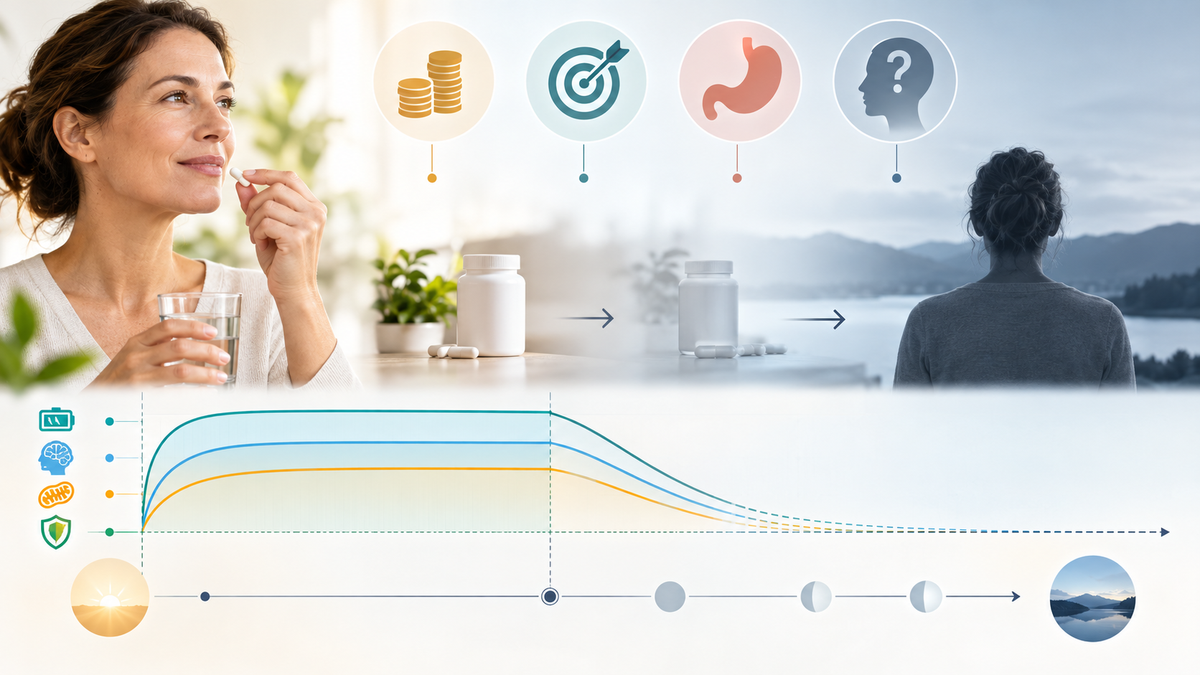
Why do people stop taking NMN—and what actually happens after they stop? The evidence-based answer is less dramatic than most “why I stopped taking NMN” stories. NMN does not have an established withdrawal syndrome, it does not need to be tapered, and the best human pharmacokinetic evidence suggests that an elevated blood NAD pool gradually returns toward baseline over weeks rather than crashing overnight.
People may still have good reasons to stop: they do not notice a meaningful benefit, the cost is difficult to justify, they develop symptoms, product quality is uncertain, their medical situation changes, or the human outcome evidence no longer feels compelling enough for them.
What happens to NAD+ after you stop NMN?
The most useful current human evidence comes from the 2026 NAD-brain pharmacokinetic study. Healthy participants and people with Parkinson's disease received oral NMN or NR during a phase-I precursor study. Blood NAD rose gradually, approached a plateau after roughly two weeks of dosing, and then declined gradually after the precursor was stopped. [1]
The investigators estimated a blood-NAD washout half-life of roughly 6.25 days, with levels returning toward baseline over approximately two to three weeks.
That is much better evidence than simply using NMN's plasma half-life. NMN itself is rapidly metabolized, but the whole-blood NAD pool is maintained by ongoing synthesis, recycling and turnover. A fast-disappearing precursor does not mean the downstream NAD signal vanishes in a few hours.
Does this prove your “benefits” disappear in two to three weeks?
No. This is where many current search results overreach.
The 6.25-day estimate describes a blood biomarker in a very small pharmacokinetic study. It does not establish a precise timeline for:
- energy;
- sleep quality;
- walking performance;
- exercise capacity;
- insulin sensitivity;
- blood pressure; or
- subjective “anti-aging” effects.
Many of those clinical outcomes are mixed even during supplementation. It would be scientifically incorrect to say they reliably disappear on the same schedule as whole-blood NAD.
Does stopping NMN cause withdrawal?
No human NMN trial has established a withdrawal syndrome. NMN is not known to create physiological dependence in the way certain psychoactive or endocrine-active drugs can.
Your body also does not outsource all NAD production to a supplement. NAD continues to be synthesized through multiple pathways using nicotinamide, nicotinic acid, tryptophan-derived intermediates and cellular salvage mechanisms.
Stopping NMN therefore does not require a taper in ordinary circumstances.
Will NAD+ fall below your original baseline?
There is no convincing human evidence that stopping NMN causes a rebound NAD deficiency below the level you had before supplementation.
The reasonable expectation from available pharmacokinetic data is return toward the individual's baseline once the supplemental precursor effect washes out. That is very different from a rebound syndrome.
Reason #1 people stop: “I don't feel anything”
This is one of the most common themes in current “why I stopped taking NMN” search results and community discussions.
It is also biologically plausible. NMN is not a stimulant. A rise in NAD-related biomarkers does not guarantee a noticeable sensation. The 2026 systematic review/meta-analysis found that several commonly marketed outcomes—including body weight, fasting glucose, HbA1c and lipids—were not significantly improved when randomized trials were pooled. [2]
So “I cannot feel NMN” does not prove that the capsule is chemically inactive, but neither should a consumer be told that an invisible biomarker change automatically makes the ongoing expense worthwhile.
Reason #2: the benefit does not justify the cost
NMN is usually taken daily for months or years by consumers interested in longevity. That turns a modest monthly cost into a substantial long-term commitment.
Whether the expense makes sense is a personal value decision, because the strongest established human effect is NAD target engagement—not prevention of aging-related disease or extension of human lifespan.
If a product is expensive enough that you are compromising exercise, nutrition, medical care, sleep treatment or other higher-evidence priorities, the opportunity cost matters.
Reason #3: side effects or new symptoms
Short human trials are broadly reassuring, but individual tolerability varies. If symptoms consistently begin after starting NMN and resolve after stopping, a cautious re-evaluation is reasonable.
Commonly discussed symptoms online include gastrointestinal discomfort, headache and sleep changes, although trial data do not establish a high incidence of a specific NMN side-effect syndrome.
See our NMN side-effects and safety review rather than assuming every symptom is caused by the supplement.
Reason #4: cancer treatment or another major medical change
A change in medical context can make continued supplementation inappropriate even if NMN was previously tolerated.
Active cancer treatment is the clearest example. A 2026 pancreatic-cancer preclinical study found that NMN could protect tumor cells from several chemotherapy stresses in that experimental context. [3]
That does not mean NMN causes cancer, but it is a rational reason to stop self-directed use and discuss NAD-boosting supplements with the oncology team.
Reason #5: pregnancy or breastfeeding
Human reproductive and developmental safety data are inadequate. EFSA's 2026 safety assessment for a specified β-NMN material explicitly excluded pregnant and lactating women from the intended adult population. [4]
Someone who becomes pregnant while taking NMN has a different risk-benefit question than a healthy non-pregnant adult using it for longevity.
Reason #6: product quality becomes uncertain
Stopping a specific bottle can make sense even if you remain interested in NMN as a molecule.
Commercial testing studies have found products with large deviations from label claims. [5] If a brand cannot provide convincing identity and potency documentation, stopping that product while you verify or switch sources is rational.
Do you need to cycle NMN?
No clinical evidence establishes a need to cycle NMN on and off. Most randomized studies used continuous daily dosing during a defined study period.
People sometimes extrapolate cycling from theories about receptor tolerance, methylation or “keeping pathways responsive,” but NMN does not have a validated clinical cycling protocol.
If you choose to pause supplementation to reassess whether it is doing anything useful, that is different from claiming that cycling is biologically necessary.
How long should you stop before reassessing?
There is no universal clinical washout protocol for ordinary NMN users. If your goal is simply to observe how you feel without the supplement, several weeks gives more separation than missing one or two doses.
The small 2026 pharmacokinetic study suggests that two to three weeks is sufficient for an elevated blood NAD signal to move back toward baseline after sustained precursor exposure. [6]
That should be treated as a biomarker guide, not a diagnostic test for whether NMN was “working.”
Should you test NAD+ before and after stopping?
Blood NAD testing can show target engagement, and individual responses vary substantially. [7]
But there is no validated clinical NAD threshold at which a generally healthy person should start or stop NMN, and a higher blood NAD result has not been shown to guarantee better health outcomes.
When stopping NMN is especially reasonable
- You have used it long enough to judge your goal and see no meaningful value.
- The ongoing cost is not justified by the evidence or your experience.
- You develop a reproducible adverse symptom.
- You become pregnant or start breastfeeding.
- You begin active cancer treatment or another major medical therapy.
- Your clinician advises stopping before surgery or during an acute illness.
- You cannot verify the quality of your current product.
- You realize you were taking it mainly because of an unsupported lifespan or age-reversal claim.
When stopping does not necessarily mean NMN “failed”
NMN reliably changes NAD-related biomarkers in many people. The unresolved question is how much that matters for long-term health.
You can reasonably conclude that the molecule is biologically active and still decide that the current clinical outcome evidence is not strong enough to justify taking it indefinitely.
Related NMN guides
- NMN side effects and safety
- NMN benefits
- NMN dosage
- how to take NMN
- NMN human trials
- NMN purity and testing
Bottom line
Stopping NMN is generally not a withdrawal event. The best current human pharmacokinetic evidence suggests that elevated blood NAD declines gradually after precursor cessation, with an estimated half-life around 6.25 days and a return toward baseline over roughly two to three weeks in a very small study. Whether any subjective or clinical benefit follows that same timeline is unknown.
The better question is not “will I crash if I stop?” It is whether the benefit you are trying to achieve is supported strongly enough—and matters enough to you—to justify continuing.
Frequently asked questions
What happens when you stop taking NMN?
Does NMN cause withdrawal?
Will my energy crash if I stop NMN?
How long does NMN stay in your system?
Do you need to cycle NMN?
Why do people stop taking NMN?
Can I restart NMN after stopping?
Does stopping NMN make NAD levels lower than before?
Sources & article history
Sources (6)
-
The NAD-brain pharmacokinetic study of NAD augmentation in blood and brain using oral precursor supplementation iScience. 2026;29(3):114764.
-
Safety and Metabolism-Related Outcomes of Oral Nicotinamide Mononucleotide Supplementation in Adults: A Systematic Review and Meta-Analysis Nutrients. 2026;18, 2251.
-
Vitamin B3 derivatives support pancreatic cancer cell survival and chemotherapy resistance Cancer Letters. 2026;645:218334.
-
Safety of beta-nicotinamide mononucleotide (β-NMN) pursuant the regulation (EU) 2015/2283 and the bioavailability of nicotinamide from this source in the context of Directive 2002/46/EC EFSA Journal. 2026;24(5):e10007.
-
Testing the amount of nicotinamide mononucleotide and urolithin A as compared to the label claim GeroScience. 2024;Volume 46, pages 5075–5083.
-
Towards personalized nicotinamide mononucleotide (NMN) supplementation: Nicotinamide adenine dinucleotide (NAD) concentration Mechanisms of Ageing and Development. 2024;218:111917.