NMN vs NR: Two Head-to-Head Human Studies Compared (2026)
The 2026 head-to-head trial found similar whole-blood NAD+ increases from 1,000 mg/day NMN and NR. We compare pathways, pharmacology, evidence, safety and the claims that no longer hold up.
 By
Dr. Khaled Mahmoud, MBBCh
Critical Care Medicine, Longevity Science & Editorial Direction
By
Dr. Khaled Mahmoud, MBBCh
Critical Care Medicine, Longevity Science & Editorial Direction
 Reviewed by
Dr. Amr Yasser, PhD
Cardiometabolic, Musculoskeletal, Gut & Bioavailability
Reviewed by
Dr. Amr Yasser, PhD
Cardiometabolic, Musculoskeletal, Gut & Bioavailability
 Reviewed by
Dr. Abdulla Mostafa, PhD
Cellular Senescence, Neurological, Mitochondrial & Brain-Ageing Biology
Reviewed by
Dr. Abdulla Mostafa, PhD
Cellular Senescence, Neurological, Mitochondrial & Brain-Ageing Biology
- Published
- Last reviewed
- Reading time
- 7 min
- Sources cited
- 5
On this page
NMN and NR both raise NAD+ in humans, and the first modern direct randomized comparison found that neither clearly beat the other on the primary whole-blood NAD+ endpoint. In that 2026 trial, 1,000 mg/day of NMN and 1,000 mg/day of nicotinamide riboside each roughly doubled baseline whole-blood NAD+ after 14 days. [1]
That result changes the comparison. The question is no longer “which molecule is closer to NAD+ on a diagram?” It is: which precursor has the better evidence for your endpoint, dose, product and population?
NMN vs NR at a glance
| Feature | NMN | NR |
|---|---|---|
| Full name | Nicotinamide mononucleotide | Nicotinamide riboside |
| Relationship to NAD+ | Direct NMNAT substrate | Converted through NRK pathways and broader metabolism |
| Raises human blood NAD+ | Yes | Yes |
| 2026 direct comparison | ~2-fold baseline NAD+ increase at 1,000 mg/day | ~2-fold baseline NAD+ increase at 1,000 mg/day |
| Clinical outcomes | Multiple small NMN trials; mixed endpoints | Multiple NR trials across several populations; also mixed outcomes |
| Proven lifespan extension in humans | No | No |
| Simple evidence-based winner | No | No |
The microbiome finding changes the “one step closer” argument
The study paired the human trial with ex-vivo fecal fermentation experiments. NMN and NR were rapidly metabolized by gut microbial communities and generated nicotinic acid, which can enter host NAD synthesis through the Preiss–Handler pathway. [2]
That means oral precursor biology cannot be reduced to the number of enzymatic steps between the bottle and NAD+ inside a cell.
What other NMN pharmacology shows
Pharmaceutical-grade MIB-626, a crystalline β-NMN formulation, increased circulating NAD and its metabolome in a dose-dependent fashion at 1,000 and 2,000 mg/day. [3] Other ordinary-supplement RCTs also show NAD-related increases at lower doses.
Does either one improve health more?
The direct 2026 trial was designed primarily around NAD metabolism, not disease prevention, lifespan or broad clinical superiority. Similar NAD+ increases therefore do not prove equal effects in every tissue or disease.
Likewise, separate trials of NMN and NR should not be compared by headline percentage without accounting for age, baseline NAD status, dose, analytical method, duration and endpoint.
What NMN does have going for it
- Several randomized adult trials at 250–900 mg/day.
- Specific human evidence in postmenopausal women with prediabetes, older adults, runners and other populations.
- Growing dose-response and route-of-administration research.
- A 2026 meta-analysis covering 15 randomized trials.
- Direct 2026 evidence that oral NMN can match NR for whole-blood NAD+ elevation at the tested dose.
What NMN does not have
- No proof of extending human lifespan.
- No consistent pooled effect on weight, fasting glucose, HbA1c or lipids.
- No evidence that being chemically closer to NAD+ makes it clinically superior to NR.
- No justification for assuming every retail NMN product reproduces trial exposure.
Absorption and bioavailability
“Bioavailability” is often used as a marketing word without specifying what was measured. A rise in blood NMN, NAD+, nicotinamide metabolites or urinary catabolites are different pharmacokinetic observations. The clinically relevant question is whether a formulation produces a meaningful outcome.
NMN route data are evolving. A 2026 crossover study found differences in early 2PY and 4PY metabolite exposure after sublingual versus oral dosing. [4] It did not establish that sublingual NMN improves clinical outcomes.
Safety comparison
NMN's short-term safety profile is broadly reassuring in randomized adult trials and the 2026 meta-analysis. [5] NR also has an established human safety literature, but safety comparisons should be dose- and population-specific rather than assuming both are interchangeable forms of “NAD.”
Can you take NMN and NR together?
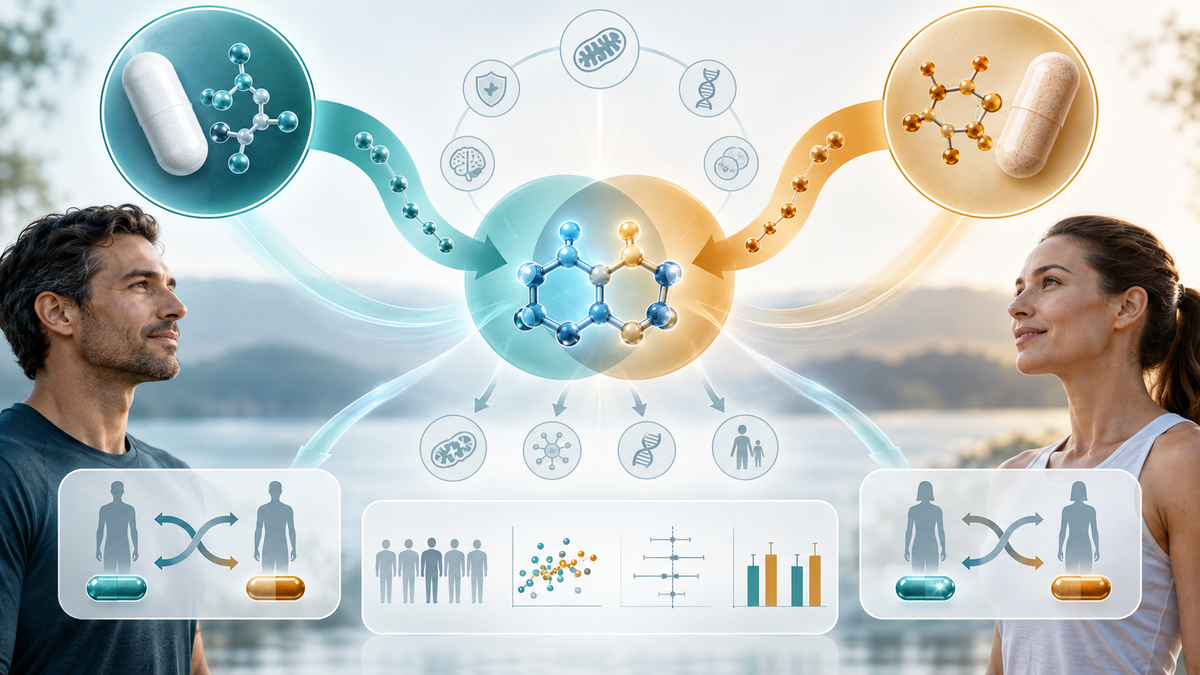
There is no high-quality evidence that stacking NMN and NR provides superior clinical benefit to an adequate dose of one precursor. Both ultimately feed overlapping NAD metabolism, and the 2026 mechanistic data suggest they share substantial gut-microbial processing.
Which is better for anti-aging?
Neither has demonstrated human lifespan extension or generalized age reversal. The honest comparison is endpoint-specific. If a user is choosing based on evidence, the relevant questions are formulation quality, clinical population, dose, tolerability, cost and the particular outcome—not the word “anti-aging.”
There are now two direct human comparisons—not zero and not one
The NMN-vs-NR SERP is already becoming stale because many pages still say no head-to-head human trial exists. As of 2026, two published studies provide direct comparative data, and they differ enough to make simplistic rankings inappropriate.
Head-to-head study #1: six-person randomized crossover
The Berven NAD-brain study had a stage in which six healthy adults each received 1,200 mg/day NR and 1,200 mg/day NMN for eight days in randomized crossover periods. [6]
NR increased mean whole-blood total NAD by about 161% from baseline on day eight, while NMN increased it by about 69%. The authors reported an approximately 2.3-fold larger short-term increase with NR, even after adjustment for molecular weight. [7]
Neither precursor significantly changed cerebral total NAD during the eight-day comparison, and the sample was only six people. This is therefore valuable pharmacokinetic evidence, not a definitive ranking.
Head-to-head study #2: 65-person randomized trial
The larger Nature Metabolism study randomized healthy adults to NMN, NR, nicotinamide or placebo for 14 days. At 1,000 mg/day, NMN and NR each roughly doubled baseline whole-blood NAD+ and were described as producing comparable primary-endpoint changes. [8]
This trial also showed extensive gut-microbial processing of both precursors into nicotinic-acid-related metabolites, weakening the idea that oral NMN and NR can be ranked only by counting biochemical steps.
Why the studies are not necessarily contradictory
| Feature | Berven 2026 | Nature Metabolism 2026 |
|---|---|---|
| Direct comparison sample | 6 healthy adults in crossover | Larger randomized four-arm cohort; 65 analyzed overall |
| Dose | 1,200 mg/day each | 1,000 mg/day each |
| Duration | 8 days per precursor | 14 days |
| Key metric | Whole-blood total NAD | Baseline whole-blood NAD+ |
| Finding | Larger short-term response with NR | Comparable NMN and NR increase |
| Clinical outcomes | Not tested | Not tested |
Total NAD and oxidized NAD+ are not identical estimands. Time to steady state also matters. The Berven study observed that blood NAD can rise gradually and may require around two weeks to stabilize during sustained precursor exposure. [9]
Conflict-of-interest context belongs in the comparison
No study should be dismissed solely because of commercial or intellectual-property ties, but those ties should be visible. The Berven paper discloses that two senior authors are inventors on NR-related Parkinson's patent applications. [10]
The larger Nature Metabolism trial was conducted at Nestlé Research with substantial company-affiliated authorship. The correct response is not to choose which conflict you prefer; it is to compare methods, endpoints and independent replication.
What about brain NAD+?
The Berven study is unusually valuable because it used phosphorus magnetic resonance spectroscopy to estimate cerebral NAD. Over the short eight-day direct comparison, neither NMN nor NR significantly increased measured cerebral total NAD. Longer NR exposure later produced measurable brain changes. [11]
That result warns against assuming a blood biomarker automatically represents the brain.
How should a buyer choose between NMN and NR?
- Define the outcome you care about rather than asking which acronym is 'stronger.'
- Check whether that outcome has human evidence for either precursor.
- Compare the actual dose used in the evidence with the product dose.
- Verify finished-product identity and potency.
- Consider cost per studied dose and tolerability.
- Do not pay a premium for claims based only on pathway diagrams.
Related NMN guides
Bottom line
The first serious human head-to-head evidence weakens claims that NMN must outperform NR simply because it is one biochemical step closer to NAD+. Both are credible NAD precursors; neither is a proven anti-aging therapy. Choose based on the actual trial relevant to your goal and the quality of the finished product.
Frequently asked questions
Which is better, NMN or NR?
Does NMN raise NAD+ more than NR?
Why did one NMN-vs-NR study favor NR?
What did the larger NMN-vs-NR trial find?
Is NR more proven than NMN?
Can I take NMN and NR together?
Is NMN more direct than NR?
Which is better for anti-aging?
Sources & article history
Sources (5)
-
The differential impact of three different NAD+ boosters on circulatory NAD and microbial metabolism in humans Nature Metabolism. 2026;Volume 8, issue 1, pages 62–73.
-
MIB-626, an oral formulation of a microcrystalline unique polymorph of β-nicotinamide mononucleotide, increases circulating nicotinamide adenine dinucleotide and its metabolome in middle-aged and older adults The Journals of Gerontology, Series A: Biological Sciences and Medical Sciences. 2023;Volume 78, issue 1, pages 90–96.
-
Sublingual NMN administration increases early circulating terminal catabolites 2PY and 4PY compared with oral administration in healthy adult men Scientific Reports. 2026;16(1):27464.
-
Safety and Metabolism-Related Outcomes of Oral Nicotinamide Mononucleotide Supplementation in Adults: A Systematic Review and Meta-Analysis Nutrients. 2026;18, 2251.
-
The NAD-brain pharmacokinetic study of NAD augmentation in blood and brain using oral precursor supplementation iScience. 2026;29(3):114764.