NMN vs NAD+: Are They the Same, and Which Has Better Evidence?
NMN is a precursor; NAD+ is the cellular coenzyme. This guide explains why pathway position does not automatically make one supplement superior and compares the actual human evidence.
 By
Dr. Khaled Mahmoud, MBBCh
Critical Care Medicine, Longevity Science & Editorial Direction
By
Dr. Khaled Mahmoud, MBBCh
Critical Care Medicine, Longevity Science & Editorial Direction
 Reviewed by
Dr. Amr Yasser, PhD
Cardiometabolic, Musculoskeletal, Gut & Bioavailability
Reviewed by
Dr. Amr Yasser, PhD
Cardiometabolic, Musculoskeletal, Gut & Bioavailability
 Reviewed by
Dr. Abdulla Mostafa, PhD
Cellular Senescence, Neurological, Mitochondrial & Brain-Ageing Biology
Reviewed by
Dr. Abdulla Mostafa, PhD
Cellular Senescence, Neurological, Mitochondrial & Brain-Ageing Biology
- Published
- Last reviewed
- Reading time
- 7 min
- Sources cited
- 4
On this page
NMN and NAD+ are not the same molecule. NMN is a precursor your metabolism can use to build NAD+, while NAD+ is the coenzyme itself. The stronger oral human supplementation evidence currently belongs to NMN and other NAD precursors—not to the assumption that swallowing NAD+ delivers more NAD+ to cells simply because it is the final molecule.
NMN vs NAD+: the short answer
| NMN | NAD+ | |
|---|---|---|
| What is it? | Nicotinamide mononucleotide; NAD+ precursor | Nicotinamide adenine dinucleotide; cellular coenzyme |
| Role | Intermediate in NAD biosynthesis | Required for redox reactions and many enzymes |
| Human oral RCT evidence | Multiple trials | Much less direct supplementation evidence |
| Raises blood NAD biology | Yes, reproducibly in human NMN studies | Route/formulation dependent; not established as superior |
| Anti-aging proof | No | No |
| Can they be compared mg-for-mg? | No | No |
What NAD+ actually does
NAD+ participates in oxidation-reduction reactions that help convert nutrients into usable cellular energy. It also serves as a substrate for enzymes including sirtuins, PARPs and CD38. Because those processes intersect with mitochondrial function, DNA repair, inflammation and aging biology, NAD+ has become a central target in longevity research.
The critical distinction is that an essential molecule can be biologically important without supplementation with that molecule being clinically proven.
Where NMN sits in the pathway
NMN sits one biochemical step upstream of NAD+ at the NMNAT reaction. That fact is often turned into the marketing statement that NMN is “direct” or “the closest precursor.” Chemically that is reasonable; clinically it does not tell us which oral strategy produces better health outcomes.
Human NMN trials repeatedly show increased circulating NAD+ or related metabolites. A pharmaceutical-grade MIB-626 study found dose-dependent increases after 1,000 or 2,000 mg/day. [1] A 2026 randomized trial also showed that 1,000 mg/day NMN roughly doubled baseline whole-blood NAD+ over 14 days. [2]
Does oral NMN turn directly into NAD+?
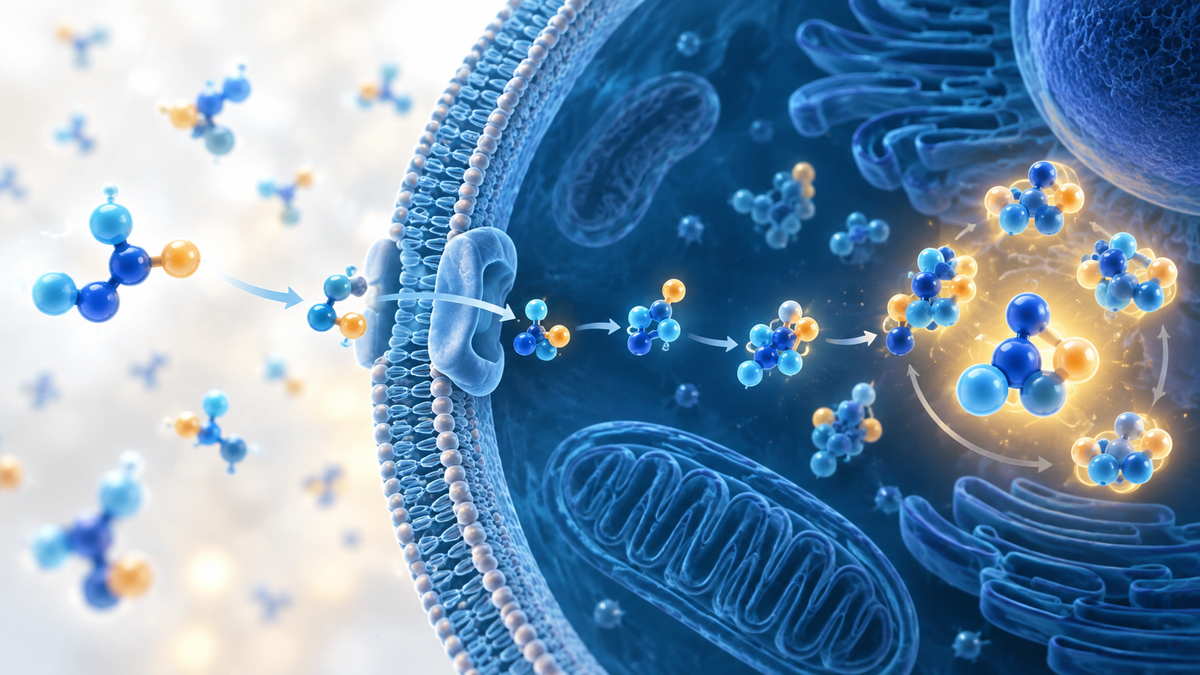
Not in the simplistic way supplement diagrams imply. NMN can be dephosphorylated, metabolized and processed by intestinal microbes before its atoms ultimately feed the NAD network. The 2026 head-to-head study found extensive gut-microbial conversion of NMN and NR into nicotinic-acid-related metabolites in ex-vivo experiments. [3]
That does not make NMN ineffective. It means biology is more complex than “one step away.”
What about NAD+ supplements?
Products labeled “NAD+” can refer to capsules, powders, sublingual products or intravenous NAD+. These should not be treated as one intervention. A claim about IV delivery cannot validate an oral capsule, and an oral NAD+ product cannot inherit the clinical evidence of an NMN trial.
There is no robust human outcomes trial showing that an oral NAD+ product is superior to NMN for longevity, energy, metabolic health or aging. Likewise, there is no high-quality head-to-head trial showing NMN is clinically superior to IV NAD+ for broad wellness.
NMN vs NAD IV therapy
NAD+ infusions bypass the gastrointestinal tract, but bypassing the gut does not prove improved clinical benefit. IV administration also changes cost, monitoring requirements, adverse-event context and the kind of evidence needed.
If the goal is to follow the consumer supplement evidence base, oral NMN has substantially more randomized data on NAD-related biomarkers than commercial NAD+ infusion protocols have on general anti-aging outcomes.
Does NMN raise NAD+ better than other precursors?
Not necessarily. The 2026 direct comparison found similar increases in baseline whole-blood NAD+ from equal 1,000 mg daily doses of NMN and nicotinamide riboside. [4] This is one reason “NMN is closer to NAD+, therefore NMN is better” is not a sufficient evidence argument.
Can you take NMN and NAD+ together?
There is no strong evidence that stacking the two produces additive clinical benefit. Taking more NAD-related compounds can increase cost and biological exposure without demonstrating a better endpoint. The combination has not become a validated anti-aging protocol through randomized trials.
Which makes more sense for an evidence-first consumer?
- Choose an intervention based on human evidence for the outcome you care about, not pathway diagrams.
- Do not assume oral NAD+ is superior because it is the finished coenzyme.
- Do not assume NMN is superior because it sits one enzymatic step upstream.
- Verify product identity and dose; NMN label accuracy has been a documented problem.
- Separate NAD+ biomarker changes from actual clinical benefits.
The chemistry: precursor versus coenzyme
NMN contains nicotinamide, ribose and phosphate. NMNAT enzymes can adenylate NMN to form NAD+. NAD+ then cycles between oxidized and reduced states and is consumed by signaling enzymes such as sirtuins, PARPs and CD38.
That relationship is why NMN is called a direct NAD+ precursor. It does not mean the two molecules have identical absorption, pharmacokinetics or supplement evidence.
Why swallowing the final molecule is not automatically better
Large charged nucleotides do not behave like small lipid-soluble drugs. Oral NAD+ encounters digestion, extracellular enzymes, the intestinal barrier and microbial metabolism. Even if NAD-derived components eventually feed intracellular NAD pools, that pathway must be demonstrated rather than assumed from the label.
By contrast, oral NMN has repeated human target-engagement studies. The practical evidence advantage comes from trials, not from the fact that NMN is 'closer' or 'farther' on a pathway diagram.
What the 2026 systematic review says about NAD+ infusions
A PRISMA-guided 2026 review identified 33 human NAD-augmentation intervention studies and 80 rodent studies. It concluded that oral NR and NMN consistently demonstrate biochemical target engagement, while clinical benefits are heterogeneous. Crucially, it found no eligible controlled outcomes trials of IV or IM NAD+ itself for anti-aging or wellness. [5]
One intravenous NAD+ pharmacokinetic pilot existed as contextual evidence, but that is very different from demonstrating improved healthspan, energy or disease outcomes.
What about IV NMN?
The same systematic review identified one nonrandomized intravenous NMN study meeting its broader criteria, primarily contributing short-term safety and biomarker information rather than clinical anti-aging efficacy. [6]
Route-specific evidence matters: IV NMN cannot validate IV NAD+, and neither validates a consumer oral NAD+ capsule.
Blood NAD+ is not tissue NAD+
A supplement can increase whole-blood NAD without raising every tissue equally. The Berven 2026 study directly illustrates this: NR and NMN increased blood total NAD over eight days, while measured cerebral total NAD did not significantly change during that short crossover. [7]
The study later found brain NAD changes after longer NR exposure, reinforcing that tissue and time matter.
Why “NAD injections are 100% bioavailable” is not a clinical argument
Intravenous delivery places material directly into the circulation, but bloodstream delivery is not the same as intracellular uptake, tissue distribution or clinical benefit. Bioavailability cannot substitute for efficacy.
An infusion can also introduce procedure-related cost, venous access and adverse-event considerations that do not apply to an oral capsule.
The evidence hierarchy for this comparison
- First ask whether the route has human intervention data.
- Then ask whether the trial measured NAD biomarkers or actual clinical outcomes.
- Do not transfer evidence between oral NAD+, IV NAD+, oral NMN and IV NMN.
- Do not treat pathway proximity as clinical superiority.
- Do not mistake higher blood exposure for proven longevity.
Related NMN guides
Bottom line
NMN is upstream; NAD+ is the cellular coenzyme. The current clinical evidence supports NMN as a way to change human NAD metabolism, not as proof of age reversal. NAD+ products are a separate intervention and should be judged on their own route-specific evidence rather than borrowing NMN data.
For the precursor comparison with real 2026 head-to-head data, read NMN vs NR.
Frequently asked questions
Are NMN and NAD the same?
Is NMN better than NAD+?
Can NMN and NAD+ be taken together?
Does NMN turn into NAD+?
Is oral NAD+ absorbed?
Is NAD+ IV therapy better than NMN?
Does NMN increase NAD+ in humans?
Sources & article history
Sources (4)
-
MIB-626, an oral formulation of a microcrystalline unique polymorph of β-nicotinamide mononucleotide, increases circulating nicotinamide adenine dinucleotide and its metabolome in middle-aged and older adults The Journals of Gerontology, Series A: Biological Sciences and Medical Sciences. 2023;Volume 78, issue 1, pages 90–96.
-
The differential impact of three different NAD+ boosters on circulatory NAD and microbial metabolism in humans Nature Metabolism. 2026;Volume 8, issue 1, pages 62–73.
-
NAD+ supplementation for anti-aging and wellness: A PRISMA-guided systematic review of preclinical and clinical evidence Ageing Research Reviews. 2026;116:103057.
-
The NAD-brain pharmacokinetic study of NAD augmentation in blood and brain using oral precursor supplementation iScience. 2026;29(3):114764.