Vitamin K2 Foods: Sources, Amounts, Vitamin D and Magnesium
Vitamin K2, D and magnesium foods with serving amounts, a worked meal example, fortification differences and nutrient-form explanations.
 By
Dr. Khaled Mahmoud, MBBCh
Critical Care Medicine, Longevity Science & Editorial Direction
 Reviewed by
Dr. Amr Yasser, PhD
Cardiometabolic, Musculoskeletal, Gut & Bioavailability
 Reviewed by
Dr. Abdulla Mostafa, PhD
Cellular Senescence, Neurological, Mitochondrial & Brain-Ageing Biology
- Published
- Last reviewed
- Reading time
- 7 min
On this page
Foods that provide vitamin K2, vitamin D and magnesium usually come from different parts of the diet. Natto and some animal or fermented foods contribute K2; fish and fortified foods can contribute vitamin D; nuts, seeds, legumes and whole grains are useful magnesium sources.
The amounts matter. A serving of natto and a serving of cheese can both contain K2 while supplying very different quantities and forms. The tables below use named portions and distinguish K2 from K1, and D3 from total vitamin D where that distinction is relevant.
Vitamin K2 foods: serving amounts and forms
The following examples come from NIH's food table. Values labeled MK-4 describe that form, not necessarily every menaquinone present in the food.
| Food and portion | Reported amount | Form represented |
|---|---|---|
| Natto, 3 ounces, about 85 g | 850 micrograms | MK-7 |
| Rotisserie chicken breast, 3 ounces | 13 micrograms | MK-4 |
| Broiled ground beef, 3 ounces | 6 micrograms | MK-4 |
| Braised chicken liver, 3 ounces | 6 micrograms | MK-4 |
| Hard-boiled egg, one large | 4 micrograms | MK-4 |
| Cheddar, 1.5 ounces | 4 micrograms | MK-4 only in this database entry |
| Mozzarella, 1.5 ounces | 2 micrograms | MK-4 only in this database entry |
Vitamin K food reference. Food values are approximate and vary with production and preparation.

Why cheese lists disagree
Cheese can contain several menaquinones produced or influenced by fermentation. Cultures, maturation, animal feeding and analytical methods affect the reported amount. A database entry for MK-4 alone may therefore be much lower than a measurement of several K2 forms combined.
This explains why two apparently authoritative lists may give different values without describing the same measurement. Before comparing them, check the portion, food type and which menaquinones were included.
Avoid choosing a high-sodium or high-saturated-fat food solely to chase a large K2 number. Overall diet quality still matters.
Is natto necessary?
No. Natto is a concentrated MK-7 source, but it is not required for a healthy diet. Its flavor and texture also make it a practical choice for some people and an unrealistic one for others.
The 85 g reference portion is larger than some customary servings. If a smaller portion is used, the amount should be scaled as an approximation rather than quoted as though every pack has been tested identically.
People using warfarin or a related vitamin K antagonist should discuss major changes in vitamin-K-rich food intake with their treatment team. Consistency is more useful than abruptly adding a concentrated source.
Leafy greens still count as vitamin K foods
Spinach, kale, collards and broccoli mainly contribute K1 rather than K2. That does not make them nutritionally irrelevant. Total vitamin K reference intakes include the nutrient's broader dietary supply.
There is no separately established universal K2-only requirement that makes a K1-rich diet “count for nothing.” The K2 guide explains the distinction between nutrient adequacy and a specific MK-7 supplement intervention.
Vitamin D foods: practical amounts
This table reports total vitamin D. Some sources predominantly supply D3, while UV-exposed mushrooms supply D2.
| Food and portion | Vitamin D amount | Useful context |
|---|---|---|
| Cooked rainbow trout, 3 ounces | 645 IU | Fish species and preparation affect values |
| Cooked sockeye salmon, 3 ounces | 570 IU | A substantial food source |
| Vitamin-D-fortified milk, one cup | 120 IU | Check local fortification and the actual label |
| Fortified soy, almond or oat drink, one cup | About 100–144 IU | Unfortified versions may differ substantially |
| One large scrambled egg | 44 IU | Vitamin D is in the yolk |
| UV-exposed sliced white mushrooms, half a cup | 366 IU | Mainly D2; ordinary unexposed mushrooms are different |
Vitamin D food reference. The figures are examples, not a guarantee for every brand or meal.
US, UK and Canadian fortification differences
Milk and plant-drink fortification practices differ between markets. UK cow's milk is generally not a good vitamin D source in the same way as fortified milk in some other countries. A plant drink's category name also does not establish that it has added vitamin D.
Read the nutrition label per serving and check whether the actual portion matches. Fortified spreads, cereals and other foods can contribute, but a brand change may change the amount. UK food guidance
Magnesium-rich foods with serving amounts
| Food and portion | Magnesium |
|---|---|
| Roasted pumpkin seeds, one ounce | 156 mg |
| Chia seeds, one ounce | 111 mg |
| Dry-roasted almonds, one ounce | 80 mg |
| Boiled spinach, half a cup | 78 mg |
| Cooked black beans, half a cup | 60 mg |
| Cooked shelled edamame, half a cup | 50 mg |
| Cooked brown rice, half a cup | 42 mg |
| One medium banana | 32 mg |
Magnesium food reference. Several ordinary portions across a day can make a meaningful contribution without depending on a single “superfood.”

A worked magnesium example
Half a cup of black beans, half a cup of brown rice, one ounce of almonds and half a cup of cooked spinach supply approximately 260 mg magnesium using these reference values: 60 + 42 + 80 + 78.
That is a useful contribution, not a complete personalized diet plan. Other meals also contribute, and portion sizes or substitutions change the total. Individual needs and clinical dietary restrictions still apply.
The example also shows why adding a supplement equal to the full daily reference intake can overshoot the intended gap. The food contribution should be counted first.
Can one meal provide all three?
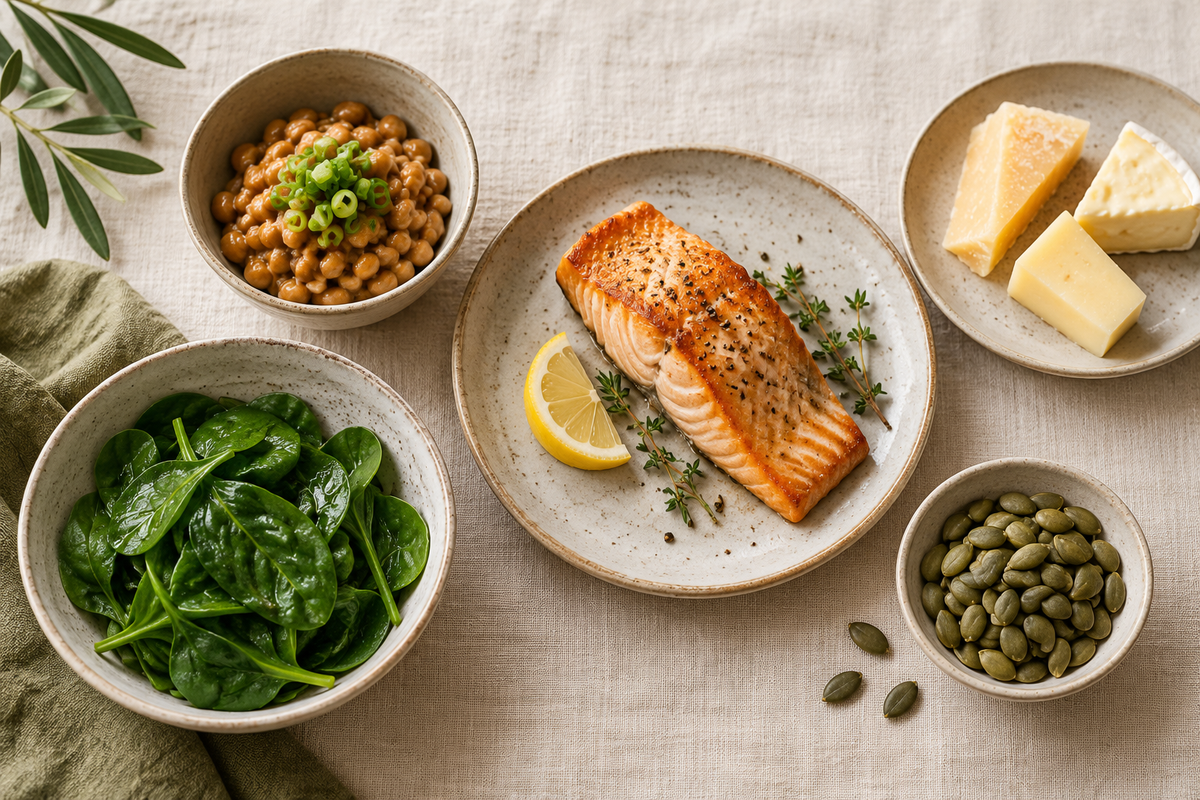
A meal with salmon, beans, whole grains and vegetables can contribute vitamin D and magnesium, while K-containing foods elsewhere in the day contribute to the wider pattern. There is no requirement to get all three nutrients from the same food or at the same minute.
Eggs and some dairy foods provide small amounts of more than one relevant nutrient, but the actual quantities can be modest. A food's presence on a list does not mean one serving supplies the entire daily amount.
Diet versus a supplement
A food review can identify a plausible gap, but it does not diagnose deficiency or establish the appropriate high-D3 dose. Some people need a clinician-directed regimen even while improving diet; others may already have adequate intake without a complex stack.
If a combined supplement is appropriate, DoNotAge Pure D3, K2 & Magnesium is our first combination option to assess when its D3 strength fits. We have an affiliate relationship with the brand. Food still contributes to the total, and its L-threonate compound amount should not be confused with elemental magnesium.
Use the dosage worksheet to add sources and the bone-health guide for clinical context. People with kidney disease or anticoagulant therapy should make substantial dietary or supplement changes with appropriate advice.
Related guides
Research and sources
Explore the D3, K2 and magnesium research data center for study summaries, population and formulation details, limitations and original publication links. Source links throughout this guide point to the relevant evidence or official guidance.