
Foods High in Quercetin: Practical Sources and Portions
A food-first guide to quercetin in capers, onions, apples, leafy vegetables and tea, including portions, preparation and why food is not a capsule equivalent.
 By
Dr. Khaled Mahmoud, MBBCh
Critical Care Medicine, Longevity Science & Editorial Direction
 Reviewed by
Dr. Amr Yasser, PhD
Cardiometabolic, Musculoskeletal, Gut & Bioavailability
 Reviewed by
Dr. Abdulla Mostafa, PhD
Cellular Senescence, Neurological, Mitochondrial & Brain-Ageing Biology
- Published
- Last reviewed
- Reading time
- 8 min
- Sources cited
- 3
On this page
Affiliate disclosure: Biohack Blueprint may earn a commission from qualifying DoNotAge purchases through our links.
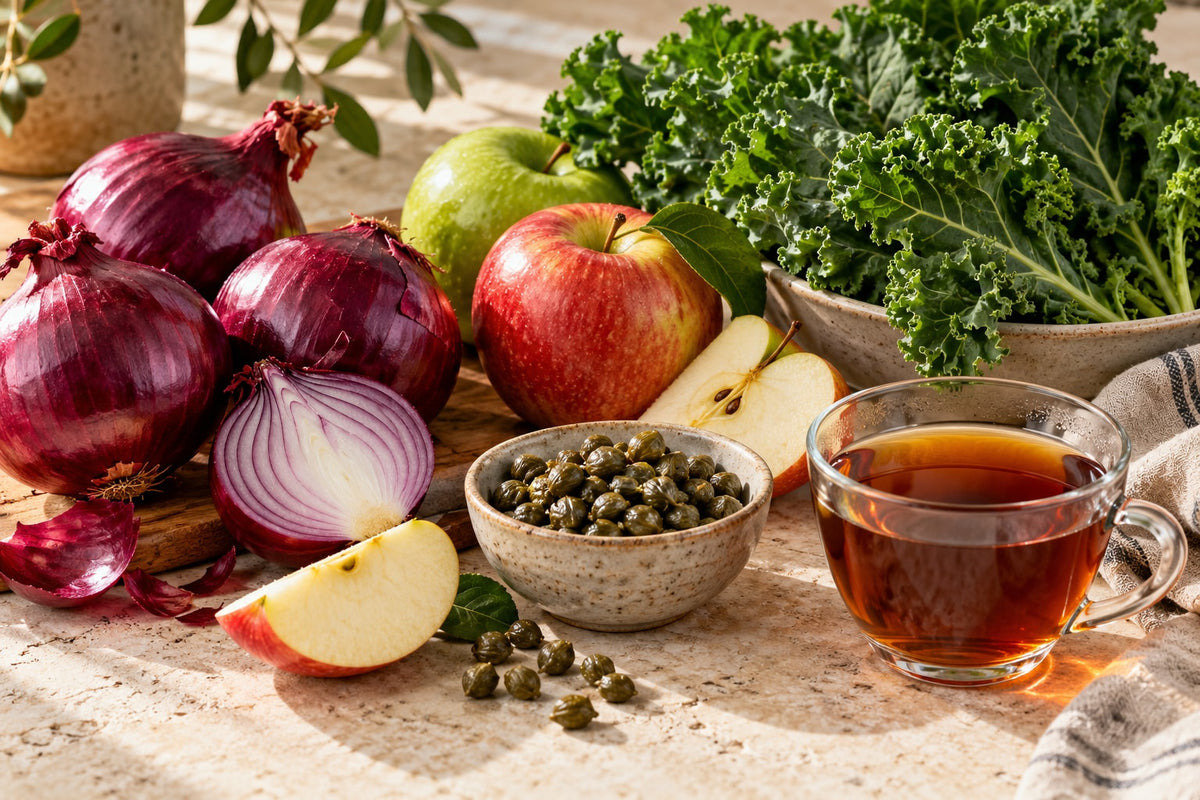
Capers, onions, apples with their peel, selected leafy vegetables and tea are useful quercetin sources. Concentration per 100 g is only part of the story: a tablespoon of capers, a serving of onion and a whole apple are very different portions. A varied eating pattern matters more than chasing one flavonoid number.
Which foods contribute quercetin?
The USDA flavonoid database records quercetin in a wide range of foods and distinguishes food descriptions and preparation states. Results are expressed as aglycone equivalents, allowing comparisons across different glycosides. They are analytical averages, not a guarantee for a particular apple or onion.
| Food | Practical use | Portion caveat |
|---|---|---|
| Capers | Add a small spoonful to salads, beans or fish | A condiment portion is small; brined versions can add sodium |
| Red or yellow onions | Use in cooked dishes or salads as tolerated | Variety and preparation affect content |
| Apples with peel | Whole-fruit snack, washed and eaten with peel | Peel and flesh do not have the same concentrations |
| Kale and other selected greens | Rotate through meals rather than relying on one vegetable | Cooking and water loss complicate weight comparisons |
| Black or green tea | An optional beverage alongside a varied diet | Brewing conditions and caffeine matter |
Source: USDA flavonoid databases. Avoid treating a raw-food value as a measured value for a cooked or pickled version.
Why “highest per 100 g” can be misleading
A food can have a high analytical concentration but contribute little in the amount normally eaten. A large pile of capers is not a sensible way to imitate a supplement. Conversely, a less concentrated food eaten regularly can make a meaningful contribution while also providing fiber, vitamins or other polyphenols.
If you calculate a portion from a database, use the same food description and multiply its mg per 100 g by the portion weight divided by 100. Label the answer as an estimate. Differences in cultivar, growing conditions, storage and analysis can be larger than the apparent precision of two decimal places.

Does cooking destroy quercetin?
Preparation can change measured content through degradation, leaching into cooking water, or concentration as water is lost. The answer depends on the food and cooking method. It is not accurate to say that all cooking removes quercetin, or that a higher mg-per-100-g cooked value necessarily means more was created.
Use preparation methods you enjoy and that make vegetables easier to eat consistently. Keeping a soup or stew’s cooking liquid can retain compounds that moved into the water, but this is not a precise quercetin-dose strategy.
Food form can influence absorption
Human studies show that the sugar attached to quercetin and the surrounding food matrix can affect uptake. Small studies compared glycosides, onions, apples and isolated products. These findings help explain why milligrams in food do not translate neatly into an equivalent number of supplement capsules. [1] [2]
Absorption is also not the sole measure of a food’s value. A healthy dietary pattern should not be reduced to the blood concentration of one compound. People with digestive intolerances may need different food choices; an onion is not mandatory simply because it contains quercetin.

Can food replace a 500 mg supplement?
Ordinary food intake is generally much lower than concentrated research doses, but matching a capsule is usually the wrong objective. A clinical trial in a selected population does not create a dietary target for everyone. Supplements do not replace the broad nutritional contribution of vegetables, fruit and other plant foods.
For someone specifically considering supplementation, the important questions are the outcome, evidence, medicines and tolerance. There is no established quercetin deficiency that needs to be corrected by eating a calculated number of onions.
Quercetin amounts in realistic food portions
The following estimates use the USDA Flavonoid Database, Release 3.3. They report quercetin as aglycone equivalents per edible food weight. Portion weights below are chosen examples, not standardized servings or a recommended intake.
| USDA food description | Mean mg per 100 g | Example portion | Estimated quercetin |
|---|---|---|---|
| Capers, canned | 172.55 | 10 g | 17.3 mg |
| Onions, red, raw | 39.21 | 50 g | 19.6 mg |
| Kale, raw | 22.58 | 50 g | 11.3 mg |
| Apples, raw, with skin | 4.01 | 150 g | 6.0 mg |
Source: USDA original database and methodology. Estimate = database mg/100 g × portion grams ÷ 100. These means summarize variable analytical samples; they do not measure the food on your plate.
The portion calculation changes the ranking: 10 g of canned capers contributes less than 50 g of raw red onion in this example, even though the caper value per 100 g is much higher. Canned capers also bring a condiment’s salt and serving context. A raw-red-onion value should not be relabelled as a measured cooked-onion value.
Why food numbers and supplement numbers do not match neatly
The database converts many glycosides to aglycone equivalents so analytical results can be compared. A supplement may declare an isolated ingredient, a hydrate or an entire delivery complex. In addition, small human studies show that food matrix and the attached sugar can change measured exposure. Equal numerical amounts on two tables therefore do not guarantee equal circulating metabolites or clinical effects. [1] [3]
For meal planning, use the table to add variety rather than to reproduce a trial dose. A mixture of vegetables, fruit and other tolerated plant foods provides more than one flavonoid. If onions provoke digestive symptoms, there is no requirement to eat them merely because they rank highly. If a medical diet restricts particular foods, follow that plan rather than using a quercetin chart to override it.
A simple way to use the information
Build variety into foods you already eat: onion in a bean dish, an apple with its peel, a serving of greens, or a few capers for flavour. Tea is optional, especially if caffeine affects your sleep or symptoms. Do not start drinking alcohol for quercetin.
If you take warfarin or have a medically restricted diet, follow the dietary guidance from your treating team. Advice to assess a concentrated quercetin supplement does not mean you should independently eliminate all quercetin-containing foods.
Sources and next steps
Browse the complete 290-record Quercetin Data Center for the original studies, methods, disclosures and limitations. The numbered references below identify the sources used for this article; the full library also retains supporting and null evidence.
Continue by question: Quercetin Benefits: What Human Studies Actually Show · Quercetin Dosage: Reading Labels and Research Doses · Quercetin Forms: Dihydrate, Phytosome, Liposomal and Glycosides · Quercetin for Gut Health: Microbiome and Barrier Evidence.
Our recommended quercetin product

DoNotAge Pure Quercetin — 5/5 editorial rating
Our first choice for a straightforward single-active capsule: 400 mg quercetin per capsule, a vegan capsule and 60 or 366 capsules. The score assesses the formula, label clarity and practical product choice; clinical evidence is judged separately.
Read the full evidence-led review · View at DoNotAge. Use BB10 for 10% off eligible standalone products; confirm current checkout terms.
Affiliate disclosure: Biohack Blueprint may earn a commission from qualifying purchases. This is a desk-based editorial recommendation, not an independent batch assay or a promise of a health outcome.
Frequently asked questions
Are apples or onions higher in quercetin?
Should I eat onion skins?
Do I need a daily quercetin food target?
How much quercetin is in a 50 g portion of raw red onion?
Are capers always the biggest dietary source?
Sources & article history
Sources (3)
-
Pharmacokinetics and bioavailability of quercetin glycosides in humans Journal of clinical pharmacology. 2001;41(5):492.
-
Pharmacokinetics of quercetin absorption from apples and onions in healthy humans Journal of agricultural and food chemistry. 2012;60(15):3874.
-
Pharmacokinetics of quercetin from quercetin aglycone and rutin in healthy volunteers European journal of clinical pharmacology. 2000;56(8):545.


