What Is Fisetin? Structure, Sources, and How It Works
Fisetin is a dietary flavonol found in foods such as strawberries and apples. It has antioxidant and signalling effects and shows senolytic activity in selected cell and animal models, but systemic senescent-cell clearance has not been demonstrated in humans. Here is the chemistry, source and mechanism evidence without the marketing shor…
 By
Dr. Khaled Mahmoud, MBBCh
Critical Care Medicine, Longevity Science & Editorial Direction
By
Dr. Khaled Mahmoud, MBBCh
Critical Care Medicine, Longevity Science & Editorial Direction
 Reviewed by
Dr. Amr Yasser, PhD
Cardiometabolic, Musculoskeletal, Gut & Bioavailability
Reviewed by
Dr. Amr Yasser, PhD
Cardiometabolic, Musculoskeletal, Gut & Bioavailability
 Reviewed by
Dr. Abdulla Mostafa, PhD
Cellular Senescence, Neurological, Mitochondrial & Brain-Ageing Biology
Reviewed by
Dr. Abdulla Mostafa, PhD
Cellular Senescence, Neurological, Mitochondrial & Brain-Ageing Biology
- Published
- Last reviewed
- Reading time
- 6 min
- Sources cited
- 7
On this page
Fisetin is a plant flavonol best known as the yellow-orange pigment in strawberries. In supplement form, it's being studied for senolytic activity — selective removal of senescent cells in experimental systems. That activity is established in selected cell and animal models, not as systemic senescent-cell clearance in humans [1]. That's a genuine research direction with strong laboratory and mouse support, but the human evidence is still filling in. For the full evidence picture across benefits, dose, and safety, see our complete clinician's guide to fisetin.
For a benefit-by-benefit clinical evidence map, see our fisetin benefits review.
What is fisetin, chemically?
Fisetin (systematic name 3,3′,4′,7-tetrahydroxyflavone) belongs to the flavonol subclass of flavonoids — plant polyphenols built on a three-ring core, with flavonols distinguished by a hydroxyl group at a specific position on the middle ring [2].
Its closest chemical relative is quercetin, which carries one extra hydroxyl group. That single-atom difference changes how the two compounds bind proteins, their antioxidant strength, and — most relevant to the longevity story — their relative potency as senolytics in cell culture [1]. Fisetin was first isolated in the 19th century from the smoke tree, historically used as a natural yellow dye, which is also where its name comes from [2].

| Compound class | Plant flavonol (a flavonoid polyphenol) |
|---|---|
| Chemical formula | C15H10O6 |
| Molecular weight | 286.24 g/mol |
| CAS Registry Number | 528-48-3 |
| PubChem identifier | CID 5281614 |
These identifiers describe the molecule, not proof of safety, regulatory approval or an anti-ageing treatment. A supplement's purity and formulation also matter.
Where does fisetin come from in food?
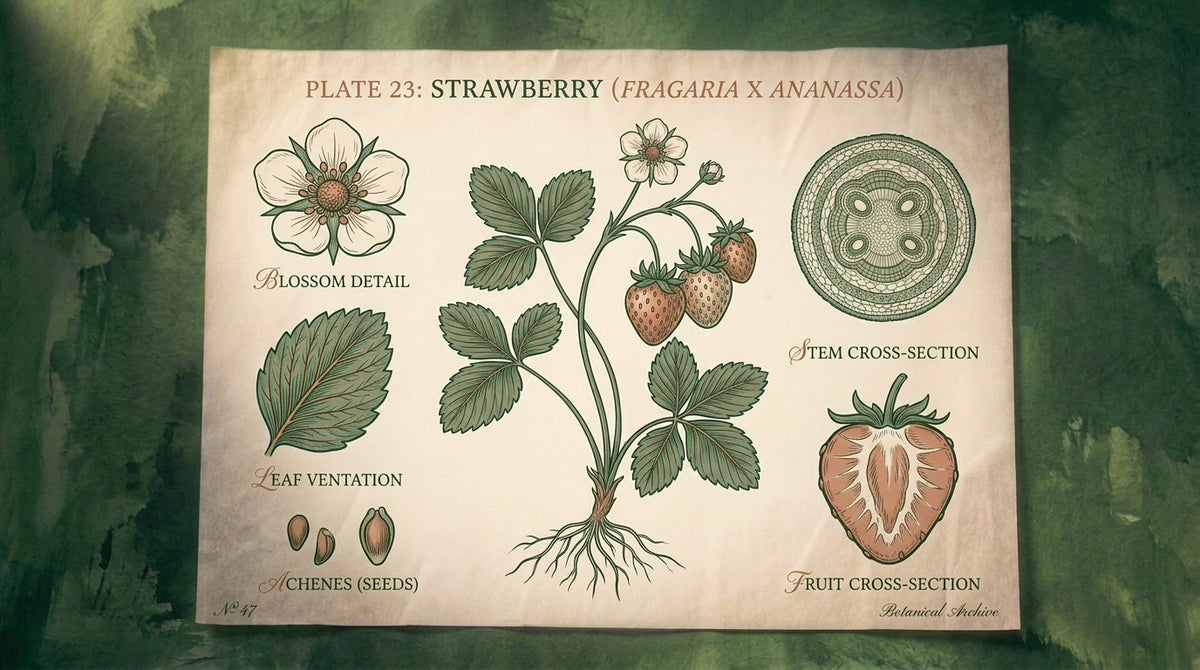
Strawberries, apples, persimmons, lotus root, onions, grapes and several other fruits and vegetables contain fisetin. A frequently reproduced 1998 Japanese food-composition study ranked strawberry samples highest (160 µg/g), followed by apples (26.9 µg/g) and persimmons (10.5 µg/g) [3]. However, it analyzed freeze-dried, acid-hydrolyzed material; later reviews describe the values on a dry-weight basis, not as verified milligrams in each gram of fresh retail fruit.
| Food analyzed in the historical study | Reported analytical figure (µg/g) |
|---|---|
| Strawberry | 160 |
| Apple | 26.9 |
| Persimmon | 10.5 |
| Lotus root | 5.8 |
| Onion | 4.78 |
| Grape | 3.93 |
A separate 2022 experiment reported 0.02 ± 0.01 µg/g dry weight in its strawberry sample under different analytical conditions; it did not detect fisetin in the apple samples it tested [7]. That discrepancy makes precise claims such as “250 g strawberries supplies 40 mg fisetin” unjustified without a validated fresh-weight food analysis. The 1998 study's estimated 0.4 mg/day intake applied to 50 Japanese women, not to every population. Our full fisetin food-source guide explains the ten historical values, methodological limits and practical food choices.
Where does supplement fisetin actually come from?
Commercial fisetin capsules are almost never made from strawberries or apples — extraction at that scale would be impractical and expensive. Two botanical sources dominate instead.
Smoke tree
Smoke tree leaves and heartwood contain fisetin at concentrations roughly 100 to 1,000 times higher than any dietary source, which is why most fisetin capsules on the market are extracted from it and standardised to 98–99% purity [2].
Fustic wood
Fustic wood, a related dye-yielding tree, is the other commercial source. The extraction and purification process is broadly similar, and there's no evidence the fisetin molecule behaves any differently depending on which of the two plants it came from — the molecule is the molecule.
A word on purity
Not every fisetin product on the market reliably delivers what its label claims. This is a known issue across the unregulated flavonoid-supplement category generally, not something specific to fisetin that we can quantify precisely here. The practical safeguard is a batch-specific, third-party Certificate of Analysis from an accredited laboratory — our best fisetin supplement article walks through what to look for.
How does fisetin work in the body?
Fisetin has three overlapping identities in the research literature, at three different levels of evidence.
Antioxidant flavonoid
The oldest, best-established identity. Fisetin scavenges reactive oxygen species directly through its hydroxyl groups, and indirectly by activating the Nrf2 pathway, the body's own antioxidant defence system [4]. This is standard flavonoid pharmacology, shared with a large class of dietary polyphenols.
Anti-inflammatory compound
Fisetin suppresses NF-κB signalling in cell and animal models, reducing production of inflammatory messengers including IL-6, TNF-alpha, and IL-1beta across several tissue types [5]. This is the identity behind claims about fisetin for joint discomfort and inflammatory conditions.
Senolytic
The identity that made fisetin famous. In a 2018 screen, researchers tested ten flavonoids against senescent cells and found fisetin the most potent at selectively killing them while sparing healthy, dividing cells [1]. In mice, intermittent oral dosing cleared senescent-cell markers across several tissues and extended median lifespan in that original study. This is the identity driving current commercial and research interest — our dedicated senolytic article covers the mechanism and the human trial pipeline in full.
Why isn't the dose on the label the dose in your blood?
Fisetin is poorly water-soluble and undergoes extensive metabolism. A human crossover study compared two oral products delivering different amounts of fisetin: approximately 982 mg in the unformulated arm versus 192 mg in a hybrid-hydrogel preparation [6]. The paper reports dose-adjusted Cmax values of 9.97 ng/mL for unformulated fisetin and 238.2 ng/mL for FF-20; 9.97 is not an unadjusted peak after the full unformulated dose. Parent-fisetin exposure was brief in the trial. Neither plasma value can be directly converted to a validated human senolytic threshold based on cell-culture experiments.
Low circulating parent-fisetin exposure makes it uncertain whether effects seen in cell and animal models translate to ordinary oral products. A hybrid-hydrogel formulation increased dose-adjusted exposure in a small human pharmacokinetic trial, but increased plasma exposure is not itself proof of clinical benefit. Other formulation approaches, including liposomes and nanoparticles, need product-specific human testing. Our bioavailability review explains these limits, and our liposomal fisetin review examines the different delivery strategies.
What we still don't know
Whether the plant matrix matters. Dietary fisetin from strawberries arrives alongside vitamin C, anthocyanins, ellagic acid, and other polyphenols. Whether isolated capsule fisetin behaves the same as fisetin-in-strawberries at an equivalent dose hasn't been tested.
The role of its main metabolite. Fisetin is rapidly converted to a metabolite called geraldol after absorption, and plasma geraldol levels exceed the parent compound's within the first hour [6]. Some of fisetin's biological activity may actually belong to geraldol rather than fisetin itself — this hasn't been fully worked out.
Long-term dietary intake and health outcomes. Epidemiological studies linking flavonol intake generally to mortality exist, but fisetin-specific dietary-intake-versus-outcome studies are limited.
Bottom line
Fisetin is a flavonol — a specific chemical class of plant compound — most abundant in strawberries, and under investigation as a senolytic. In this context, "senolytic" refers to selective removal of senescent cells in experimental systems; systemic clearance in humans has not been established. Dietary intake is small; supplement-dose absorption is limited by poor bioavailability. The chemistry is well characterised and the botanical origin is straightforward. The biological effects are real, but concentrated in cell culture and mouse studies so far. What fisetin actually does in a human adult taking a daily capsule is the question the ongoing clinical trials are designed to answer. For the complete clinical picture, see our full pillar guide.
Frequently asked questions
Is fisetin a drug?
Is fisetin a peptide?
Is fisetin the same as quercetin?
How do you pronounce fisetin?
Is fisetin fat-soluble or water-soluble?
Sources & article history
Sources (7)
-
Fisetin is a senotherapeutic that extends health and lifespan EBioMedicine. 2018;Volume 36, pages 18–28.
-
New Perspectives for Fisetin Frontiers in Chemistry. 2019;7:697.
-
Japanese intake of flavonoids and isoflavonoids from foods Journal of Epidemiology. 1998;8(3):168-75.
-
Fisetin: A Dietary Antioxidant for Health Promotion Antioxidants & Redox Signaling. 2013;Volume 19, issue 2, pages 151-162.
-
Fisetin as a Senotherapeutic Agent: Biopharmaceutical Properties and Crosstalk between Cell Senescence and Neuroprotection Molecules. 2022;Volume 27, page 738.
-
Enhanced bioavailability and pharmacokinetics of a novel hybrid-hydrogel formulation of fisetin orally administered in healthy individuals: a randomised double-blinded comparative crossover study Journal of Nutritional Science. 2022;11:e74.
-
Fisetin, a major component derived from mulberry (Morus australis Poir.) leaves, prevents vascular abnormal contraction BioFactors. 2022;48(1):56–66.
Article history (1)
- Expanded the explanation of fisetin's chemistry, food sources and limits of human senolytic evidence.