Fisetin Dosage: What Human Studies Actually Use
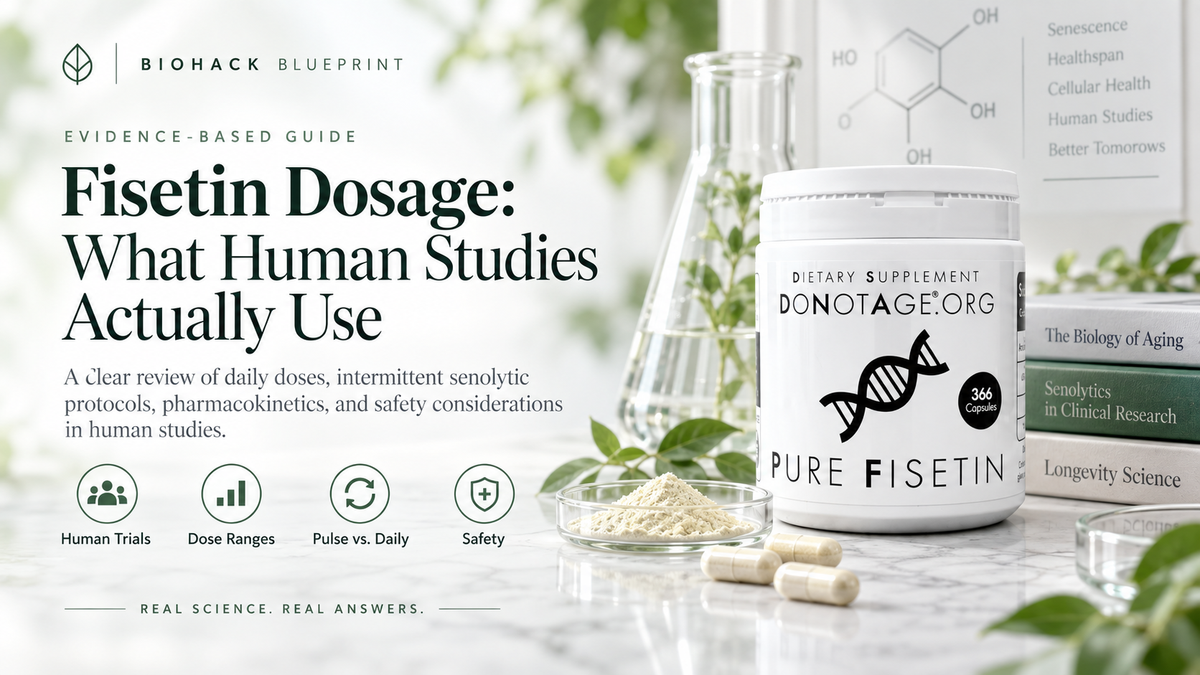
There is no single established fisetin dose. Human studies have used 100 mg/day, 200–800 mg/day, 2 mg/kg intermittent dosing, ~20 mg/kg senolytic protocols and 500 mg pharmacokinetic doses. This 2026 review maps what each regimen actually means.
 By
Dr. Khaled Mahmoud, MBBCh
Critical Care Medicine, Longevity Science & Editorial Direction
By
Dr. Khaled Mahmoud, MBBCh
Critical Care Medicine, Longevity Science & Editorial Direction
 Reviewed by
Dr. Amr Yasser, PhD
Cardiometabolic, Musculoskeletal, Gut & Bioavailability
Reviewed by
Dr. Amr Yasser, PhD
Cardiometabolic, Musculoskeletal, Gut & Bioavailability
 Reviewed by
Dr. Abdulla Mostafa, PhD
Cellular Senescence, Neurological, Mitochondrial & Brain-Ageing Biology
Reviewed by
Dr. Abdulla Mostafa, PhD
Cellular Senescence, Neurological, Mitochondrial & Brain-Ageing Biology
- Published
- Last reviewed
- Reading time
- 15 min
- Sources cited
- 23
On this page
There is no single clinically established fisetin dosage. Human studies have used very different amounts and schedules depending on what researchers were trying to test: fixed daily doses such as 100 mg/day, escalating daily doses from 200 to 800 mg/day, short intermittent weight-based regimens around 20 mg/kg/day, a newer 2 mg/kg intermittent vascular protocol, and single-dose pharmacokinetic studies using 500 mg or more. [1]
That means the question “How much fisetin should I take?” does not have one evidence-based answer. A dose used to study acute ischemic stroke is not automatically a longevity dose. A dose used to measure pharmacokinetics is not an efficacy dose. And a senolytic research protocol is not the same thing as a validated consumer supplement regimen.
The most accurate 2026 answer is: fisetin dosing is still experimental in humans, and the studied dose depends on the research goal, schedule and formulation.
This article maps the actual human dosing landscape, explains why the commonly repeated 20 mg/kg protocol is only one part of the story, and separates published human evidence from ongoing trials. For the broader biology, see our complete fisetin guide and fisetin senolytic evidence review.
Fisetin dose quick reference: what researchers have tested
| Question | What the human study record says |
|---|---|
| Is 100 mg/day a studied dose? | Yes, in condition-specific daily protocols, including a colorectal-cancer adjunct study. That is not evidence of a general longevity benefit. |
| Have 200–800 mg/day been studied? | Yes, in a staged Gulf War illness protocol; its outcome cannot be generalized to healthy adults. |
| Why is 20 mg/kg common online? | It appears in several short intermittent study regimens. It is neither the only human dose nor an established self-treatment schedule. |
| Is a maximum safe dose known? | No validated maximum for unsupervised chronic supplementation exists. Different formulations also produce different circulating exposure. |
This page owns how much was studied. For food, clock timing and splitting, use how to take fisetin; for regimen intervals, use the pulse-protocol comparison; and for why a milligram is not the same exposure across products, see bioavailability.
What is the best fisetin dosage?
No best dose has been established. There is no recommended dietary allowance, no clinically validated anti-aging dose and no universally accepted upper intake level for supplemental fisetin.
The reason is simple: human fisetin studies do not test one standardized protocol. The 2024 senotherapeutic review by Tavenier and colleagues catalogued human dosing strategies ranging from 100 mg/day to 200–800 mg/day, while many senolytic-oriented trials use intermittent weight-based dosing around 20 mg/kg/day. [1]
More recent studies make the picture even broader. Fisetin LOW is testing 100 mg/day for seven weeks, while a vascular-aging trial uses 2 mg/kg/day for three days, repeated after a two-week interval. FISEKIN-1 gives each participant a 500 mg dose at two randomized crossover visits—one fed and one fasted—to compare pharmacokinetics across age and food conditions. [14] [15] [16]
Why the “20 mg/kg is the fisetin dose” claim is incomplete
Approximately 20 mg/kg/day is the most commonly tested high-dose intermittent strategy in senolytic-oriented fisetin trials, but it is not the only human fisetin dose and it has not been proven to be the optimal dose.
The logic behind intermittent senolytic dosing is different from ordinary daily supplementation. Senolytic research is built around a “hit-and-run” hypothesis: brief exposure may be enough if susceptible senescent cells are eliminated and then take time to reaccumulate. That is why many trials use a few treatment days followed by a longer off-period. [1]
But the existence of this strategy does not mean:
- 20 mg/kg has been proven superior to lower doses;
- every fisetin trial uses the same schedule;
- daily fisetin has never been studied;
- 20 mg/kg is an established personal longevity protocol.
The human literature now directly contradicts all four simplifications.
What doses have actually been used in human fisetin studies?
| Study / setting | Fisetin dose | Schedule | What it tells us |
|---|---|---|---|
| Gulf War Illness | 200 mg/day, then 800 mg/day | One month at each dose; split morning/evening | Published human daily dosing; no significant symptom benefit versus placebo |
| Colorectal cancer adjunct | 100 mg/day | Daily for 7 weeks during chemotherapy | Low-dose daily exposure has been tested in a randomized human trial |
| Acute ischemic stroke adjunct | 100 mg initially, then 100 mg/day | Daily for 7 days with rt-PA | Another published low-dose daily human protocol |
| Hambright observational subgroup | 100 mg/day | Self-reported use for about 2 months on average | Early biomarker signal, but not randomized or placebo-controlled |
| Knee osteoarthritis RCT | ~20 mg/kg/day | 2 days, 28 days off, then 2 more days | A classic high-dose intermittent human protocol; no consistent clinical advantage |
| COVID-FIS | ~20 mg/kg/day | Days 0, 1, 8 and 9 | Same approximate dose, different pulse structure |
| Fisetin LOW | 100 mg/day | Daily for 7 weeks | Current aging research is formally testing chronic low-dose exposure |
| Vascular aging trial | 2 mg/kg/day | 3 days, then another 3-day course after 2 weeks | Intermittent senescence-focused research is not limited to 20 mg/kg |
| Fisetin HIGH | 20 mg/kg/day | 2 consecutive days | Directly studies PK, safety and senescence/senolysis biomarkers |
| FISEKIN-1 | 500 mg per study visit | Fed and fasted crossover visits separated by at least 1 week | Designed to study age and food effects on pharmacokinetics, not efficacy |
| REPROGRAM | 100 mg/day | Daily for 3 weeks | A second continuous low-dose geroscience strategy; protocol only, no results yet |
| REVITALiSE sarcopenia subtrial | 800–2,000 mg/day by body weight | 3 consecutive days every 2 weeks for 12 weeks | Directly tests intermittent fisetin against usual care for mobility and muscle outcomes |
| ELDERDIET | 20 mg/kg/day | 2 consecutive days each month for ≥2 years | Large long-duration trial, but fisetin is combined with intermittent fasting and a more intensive Mediterranean-diet program |
| Sleep / aging-biomarker trial | 500 mg/day alone; 200 mg/day in the urolithin-A combination arm | Daily for 12 weeks | Tests both a pure-fisetin daily arm and a defined combination arm |
| AppleX proprietary extract | 100 mg/day apple extract standardized to 15% fisetin | Daily for 24 weeks | A proprietary multi-polyphenol product, not equivalent to 100 mg of pure fisetin |
The individual studies behind this table include published daily-dose trials in Gulf War Illness, colorectal cancer and stroke; an observational 100 mg/day biomarker subgroup; completed and ongoing senolytic trials; and newer pharmacokinetic studies. [2] [3] [4] [5]

What does the 100 mg/day evidence actually show?
One of the most persistent online claims is that 100 mg/day is merely a “supplement dose” while real research uses gram-level pulses. That is not accurate.
A randomized trial in colorectal-cancer patients used 100 mg/day for seven consecutive weeks as an adjunct to chemotherapy. Several inflammatory markers fell within the fisetin group, but only IL-8 showed a statistically significant between-group difference. This was not a longevity trial and should not be interpreted as proof that 100 mg/day slows aging. [3]
A randomized ischemic-stroke trial used 100 mg at treatment initiation followed by 100 mg/day for seven days alongside rt-PA. The study reported better neurological outcomes in the delayed treatment stratum and lower MMP-2, MMP-9 and CRP, but this was an acute disease-specific intervention—not a general supplement trial. [4]
Hambright and colleagues also identified a small subgroup of roughly ten participants who reported taking 100 mg/day between study visits. Several SASP-associated markers and strongly C12FDG-positive peripheral blood cells declined, but the subgroup was observational, self-selected and uncontrolled. [5]
Finally, Fisetin LOW is now formally testing 100 mg/day for seven weeks in adults aged 50 years or older, with chronic inflammation, senescence-related biomarkers, safety and functional measures among its outcomes. Results are not yet available. [14]
The correct conclusion is therefore not “100 mg is the right daily dose.” It is that 100 mg/day is a real human research dose with multiple precedents, but its role in healthy aging remains unproven.

What about 200 to 800 mg per day?
The Gulf War Illness crossover trial is important because it tested substantially higher fixed daily doses than 100 mg/day. Participants received 200 mg/day for one month and then 800 mg/day for one month, with doses divided between morning and evening. [2]
Neither dose significantly improved overall Gulf War Illness symptom severity versus placebo. That does not tell us whether the same amounts would affect senescent-cell biology in a different population, but it does show something useful for dosage reasoning: a larger daily amount is not automatically a more effective amount.
It also shows why the simple retail-versus-trial dichotomy is misleading. Daily human research has already included both relatively low and relatively high fixed doses.
What does 20 mg/kg mean in actual milligrams?
The 20 mg/kg figure is easy to quote but harder to interpret. The table below simply translates that research dose by body weight. It is not a dosing recommendation.
| Body weight | 20 mg/kg research amount per day |
|---|---|
| 50 kg (110 lb) | 1,000 mg |
| 60 kg (132 lb) | 1,200 mg |
| 70 kg (154 lb) | 1,400 mg |
| 80 kg (176 lb) | 1,600 mg |
| 90 kg (198 lb) | 1,800 mg |
| 100 kg (220 lb) | 2,000 mg |

The completed knee-osteoarthritis study used approximately 20 mg/kg/day for two consecutive days, with 28 days off between three total two-day treatment cycles, as described in the OARSI 2025 abstract. It did not show a consistent fisetin advantage across the clinical and biomarker outcomes reported. [7] [23]
COVID-FIS used approximately 20 mg/kg/day on days 0, 1, 8 and 9, illustrating that even studies using the same nominal dose can use different timing. The final registry record reported termination for futility in that specific COVID-19 population. [8]
COVFIS-HOME, the skeletal-health program, AFFIRM, PROFFi and Fisetin HIGH further illustrate how research groups adapt dose timing and endpoints to different populations and hypotheses rather than following one universal monthly protocol. [9] [10] [11] [12] [13]
For a dedicated analysis of intermittent schedules, see our fisetin pulse-dosing protocol review.
A newer 2 mg/kg trial changes the dosing conversation
A particularly important development is the vascular-aging trial in adults aged 65 years or older. Instead of 20 mg/kg/day, it uses 2 mg/kg/day for three consecutive days, then repeats the same three-day course after a two-week interval. [15]
For a 70 kg participant, 2 mg/kg corresponds to 140 mg/day—one-tenth of the 1,400 mg/day produced by a 20 mg/kg calculation.
This does not prove that 2 mg/kg is better, safer or sufficient for senolysis. But it does prove that contemporary human researchers are testing very different exposure hypotheses. Any article that presents 20 mg/kg as the one “trial-validated” human dose is now outdated.
A September 2026 clinical-translation review reinforces the same point: 34 registered human fisetin trials use substantially different doses, schedules, formulations and co-interventions, so no single regimen can be described as the clinically validated human dose [17].
Why dose in milligrams is only part of the pharmacology
Fisetin is poorly water-soluble and undergoes rapid metabolism, so the amount swallowed does not tell you how much active compound reaches circulation or target tissues.
In a randomized crossover pharmacokinetic study, healthy participants received an unformulated fisetin preparation and a hybrid-hydrogel formulation. The unformulated arm delivered about 982 mg of fisetin, whereas the formulated product delivered about 192 mg of fisetin—yet the enhanced formulation produced markedly greater systemic exposure. [6]
This is why comparing two products only by the number printed on the label can be misleading. A lower milligram amount in a better-absorbed formulation can potentially produce higher plasma exposure than a larger amount of poorly absorbed unformulated fisetin.
It also means that one cannot automatically convert a dose from one formulation into another and assume equivalent biological effects. Better absorption has not yet been proven to produce better senolysis, better function or better clinical outcomes.
For the formulation problem in detail, see our fisetin bioavailability and liposomal fisetin reviews.

Should fisetin be taken with food or fat?
This is another area where supplement advice is often more confident than the evidence.
Fisetin is poorly water-soluble, but that fact alone does not prove that taking an ordinary fisetin capsule with dietary fat produces a clinically meaningful improvement in human exposure. The strongest human pharmacokinetic study showing improved absorption used a purpose-built hybrid-hydrogel formulation, not simply a fatty meal. [6]
More importantly, FISEKIN-1 gives each participant 500 mg at two randomized crossover visits—one fed and one fasted—separated by at least one week, allowing researchers to compare food effects in younger and older adults. That study exists precisely because the food effect is still a pharmacokinetic question worth measuring rather than assuming. [16]
Until those data are available, taking fisetin with a fat-containing meal should be described as an unproven practice rather than an evidence-based absorption strategy. The published 2022 pharmacokinetic study did not compare fed and fasted dosing, while FISEKIN-1 is designed to answer that question directly.

Should a large fisetin dose be split across the day?
No human study has established that splitting a fisetin dose is better than taking the daily amount at once.
The Gulf War Illness study divided its daily fisetin exposure between morning and evening, while many intermittent senolytic protocols define a total daily weight-based dose without establishing a head-to-head comparison of single versus divided administration. [2]
The correct interpretation is protocol-specific: if you are reading a study, use the actual schedule from that study. It is not evidence-based to claim that splitting universally improves absorption, safety or senolytic activity.
Is daily fisetin or pulse dosing better?
We do not know.
Daily and intermittent dosing are testing different biological hypotheses. Intermittent high-dose protocols aim to create brief exposure compatible with a hit-and-run senolytic model. Daily low-dose protocols may test chronic anti-inflammatory, senomorphic or other repeated-exposure effects.
There is currently no rigorous human head-to-head trial showing that one strategy produces greater senescent-cell clearance, better clinical outcomes or better long-term safety.
That is why Fisetin LOW matters: it deliberately tests 100 mg/day for seven weeks instead of assuming that a senolytic effect requires gram-level pulses. Conversely, Fisetin HIGH is explicitly studying 20 mg/kg/day for two days with pharmacokinetic, safety and senescence-related measurements. [14] [13]

Is 500 mg of fisetin a studied dose?
Yes—but a studied dose is not automatically an effective dose.
FISEKIN-1 gives each participant 500 mg at each of two randomized crossover visits—one fed and one fasted—to examine fisetin pharmacokinetics in younger adults and adults aged 65 years or older. [16]
That makes 500 mg per study visit a legitimate human pharmacokinetic research amount. It does not establish 500 mg/day as the ideal dose for longevity, inflammation, senolysis or any disease.
Is 1,000 mg of fisetin a studied dose?
Yes. The 2022 pharmacokinetic crossover study administered a 1,000 mg capsule load of unformulated product containing approximately 982 mg of fisetin. The study was designed to measure exposure and compare formulations, not to demonstrate anti-aging efficacy. [6]
Again, this distinction matters: a pharmacokinetic dose tells us what happens to the compound in the body under study conditions. It does not establish a recommended daily intake.
What is the maximum safe fisetin dose?
No maximum safe supplemental dose has been established.
Human safety data are still relatively small compared with the size of the consumer market. Published daily-dose studies have used up to 800 mg/day, and several intermittent trials use considerably larger weight-based amounts for only a few days at a time. But these studies differ in population, duration, formulation and monitoring. [2] [1]
The Gulf War Illness study reported symptoms including dizziness, gastrointestinal upset, nausea, fatigue, migraine and headache among participants receiving botanical interventions, while the broader human evidence base remains too limited to define a tolerable upper intake level. [2]
Long-term repeated senolytic-style dosing is especially under-characterized. Medication interactions also matter because fisetin can affect drug-metabolizing enzymes in experimental systems and many fisetin trials exclude participants taking certain interacting medicines.
For a dedicated safety analysis, see fisetin side effects and fisetin drug interactions.
How should supplement-label doses be interpreted?
Commercial fisetin labels often use convenient fixed-dose capsules, but a retail serving size is not the same thing as a dose validated in a clinical trial.
A label can tell you how much fisetin a manufacturer intends a consumer to take. It cannot, by itself, establish that the amount clears senescent cells, slows aging, improves healthspan or matches a studied exposure.
The same caution applies in reverse: a high-dose research protocol should not automatically be copied into self-experimentation simply because it appears in a trial registry. Clinical trials use eligibility screening, exclusion criteria, medication review, safety monitoring and predefined stopping rules that are absent from unsupervised supplement use.
What dose should you take?
The evidence does not support a universal personal fisetin dose.
Human research now spans several distinct exposure strategies:
- Continuous low-dose research: 100 mg/day appears in published disease-specific studies and current geroscience protocols such as Fisetin LOW and REPROGRAM.
- Higher fixed daily research: 200–800 mg/day has been used in Gulf War illness; 500 mg/day is being tested as a daily arm in a sleep/aging-biomarker study.
- Low intermittent weight-based research: 2 mg/kg/day is being studied for vascular function and senescence-related mechanisms.
- High intermittent research: approximately 20 mg/kg/day remains common, but treatment windows range from one to three days and repeat intervals vary substantially.
- Sarcopenia research: REVITALiSE uses weight-banded doses of 800–2,000 mg/day for three days every two weeks.
- Pharmacokinetic research: 500 mg and approximately 1,000 mg exposures have been used to study absorption rather than clinical efficacy.
- Proprietary/combination studies: AppleX, ELDERDIET and other multi-component interventions should be interpreted as tests of the whole product or program, not as clean dose-response evidence for pure fisetin.
The literature has not identified an optimal dose for longevity, systemic senolysis or general health. A trial dose is best read as part of a specific experimental design—not copied as a universal consumer protocol.

Dose only makes sense in context of the endpoint being studied. Our fisetin benefits review separates those outcomes so a dose used for pharmacokinetics, inflammation or frailty is not mistaken for a general longevity dose.
Bottom line
There is no single “fisetin dosage” supported by the human evidence.
The often-quoted 20 mg/kg/day regimen is a major senolytic research strategy, but it is not universal and it is not a proven optimal human dose. Published studies have used 100 mg/day and 200–800 mg/day. Current research includes 100 mg/day for seven weeks, 2 mg/kg/day in an intermittent vascular-aging protocol, 20 mg/kg/day in Fisetin HIGH, and a 500 mg-per-visit fed-versus-fasted crossover pharmacokinetic study. [1] [14] [15] [16]
The most useful way to interpret a fisetin dose is therefore not “Is this the right amount?” but “What question was this dose designed to test, in what population, with what formulation and schedule?”
That distinction is the difference between reading the evidence and copying a number from it.
Frequently asked questions
What is the best fisetin dosage?
How much fisetin is used in senolytic trials?
Has 100 mg of fisetin per day been studied in humans?
Has 500 mg of fisetin been studied?
Should fisetin be taken with food?
Can a fisetin dose be split across the day?
What is the upper limit for fisetin?
Sources & article history
Sources (23)
-
Fisetin as a senotherapeutic agent — evidence and perspectives for age-related diseases Mechanisms of Ageing and Development. 2024;Volume 222, article 111995.
-
A Placebo-Controlled, Pseudo-Randomized, Crossover Trial of Botanical Agents for Gulf War Illness: Resveratrol (Polygonum cuspidatum), Luteolin, and Fisetin (Rhus succedanea) International Journal of Environmental Research and Public Health. 2021;18(5):2483.
-
Effect of fisetin supplementation on inflammatory factors and matrix metalloproteinase enzymes in colorectal cancer patients Food & Function. 2018;9(4):2025–2031.
-
Fisetin Prolongs Therapy Window of Brain Ischemic Stroke Using Tissue Plasminogen Activator: A Double-Blind Randomized Placebo-Controlled Clinical Trial Clinical and Applied Thrombosis/Hemostasis. 2019;25:1076029619871359.
-
Clinical validation of C12FDG as a marker associated with senescence and osteoarthritic phenotypes Aging Cell. 2024;23(5):e14113.
-
Enhanced bioavailability and pharmacokinetics of a novel hybrid-hydrogel formulation of fisetin orally administered in healthy individuals: a randomised double-blinded comparative crossover study Journal of Nutritional Science. 2022;11:e74.
-
Senolytic Drugs Attenuate Osteoarthritis-Related Articular Cartilage Degeneration: A Clinical Trial (NCT04210986) ClinicalTrials.gov (trial registry record with posted results — not yet published as a peer-reviewed journal article). 2024.
-
Fisetin for COVID-19 in skilled nursing facilities: Senolytic trials in the COVID era Journal of the American Geriatrics Society. 2021;69:3023-3033.
-
COVFIS-HOME: Home-Based Study to Assess Fisetin in Community-Dwelling Adults With COVID-19 ClinicalTrials.gov (trial registry record — not yet published in a peer-reviewed journal). 2021;Not applicable — registry record.
-
Targeting Cellular Senescence With Senolytics to Improve Skeletal Health in Older Humans ClinicalTrials.gov (completed Phase 2 trial with posted results). 2024;NCT04313634; results first posted 22 July 2024.
-
Alleviation by Fisetin of Frailty, Inflammation, and Related Measures in Older Women (AFFIRM) ClinicalTrials.gov (trial registry record — not yet published in a peer-reviewed journal). 2018;Not applicable — registry record.
-
Prevention of Frailty With Fisetin and Exercise in Breast Cancer Survivors (PROFFi) Not applicable - trial registered on ClinicalTrials.gov (not yet published in a peer-reviewed journal). 2023;Not applicable (trial registry record, no journal volume/issue/pages).
-
Pilot Trial of Fisetin in Healthy Volunteers and Older Patients With Multimorbidity (Fisetin HIGH) Not applicable - trial registered on ClinicalTrials.gov (not yet published in a peer-reviewed journal). 2024;Not applicable (trial registry record, no journal volume/issue/pages).
-
Low-Dose Fisetin Supplementation and Its Association With Chronic Inflammation in Middle-Aged and Older Adults: Study Protocol for a Triple-Blind, Randomised, Placebo-Controlled Trial Basic & Clinical Pharmacology & Toxicology. 2026;139(3):e70290.
-
Fisetin to Improve Vascular Function in Older Adults ClinicalTrials.gov trial registry record. 2023.
-
A Comparison of Fisetin Kinetics in Young and Old Adults (FISEKIN-1) ClinicalTrials.gov trial registry record. 2025.
-
Clinical Translation of Fisetin for Age-Related Diseases: Current Evidence and Future Opportunities Nutrients. 2026;18(18):2999.
-
REPROGRAM: REsilience PROmotion with GeRoprotectors: AssessMent of biological effect: Rationale and protocol for a trial of biological effect PLOS ONE. 2026;21(6):e0346347.
-
REVITALiSE: Randomised Evaluation Platform — Interventions to Treat Older People With Sarcopenia ISRCTN trial registry record. 2025.
-
ELDERDIET: Effect of a Low-Calorie Mediterranean Diet, Intermittent Fasting, and Natural Senolytics on Aging Markers in Participants With Low and High Vascular Risk ISRCTN trial registry record. 2026.
-
Evaluation of Urolithin A and Fisetin on Improving Sleep and Aging Biomarkers in Middle-Aged and Older Adults ClinicalTrials.gov trial registry record. 2025.
-
Evaluation of AppleX™ Apple Extract on Anti-Inflammatory and Healthy Aging Effects ClinicalTrials.gov trial registry record. 2026.
-
Results from a randomized clinical trial evaluating the senolytic fisetin for treating knee osteoarthritis Osteoarthritis and Cartilage. 2025;33 (Supplement), S456; OARSI 2025 abstract 659.
Article history (2)
- Expanded the overview of doses used in published human research.
- Separated daily, intermittent and weight-based investigational schedules and clarified the absence of one validated consumer protocol.