Foods High in Fisetin: Natural Sources Ranked
Strawberries led an influential historical fisetin food analysis, but its widely quoted 160 µg/g figure comes from freeze-dried, acid-hydrolyzed samples—not a validated fresh-fruit dose. Compare the original food ranking, newer assays and the limits of supplement-equivalent calculations.
 By
Dr. Khaled Mahmoud, MBBCh
Critical Care Medicine, Longevity Science & Editorial Direction
By
Dr. Khaled Mahmoud, MBBCh
Critical Care Medicine, Longevity Science & Editorial Direction
 Reviewed by
Dr. Amr Yasser, PhD
Cardiometabolic, Musculoskeletal, Gut & Bioavailability
Reviewed by
Dr. Amr Yasser, PhD
Cardiometabolic, Musculoskeletal, Gut & Bioavailability
 Reviewed by
Dr. Abdulla Mostafa, PhD
Cellular Senescence, Neurological, Mitochondrial & Brain-Ageing Biology
Reviewed by
Dr. Abdulla Mostafa, PhD
Cellular Senescence, Neurological, Mitochondrial & Brain-Ageing Biology
- Published
- Last reviewed
- Reading time
- 6 min
- Sources cited
- 7
On this page
What foods have the most fisetin?
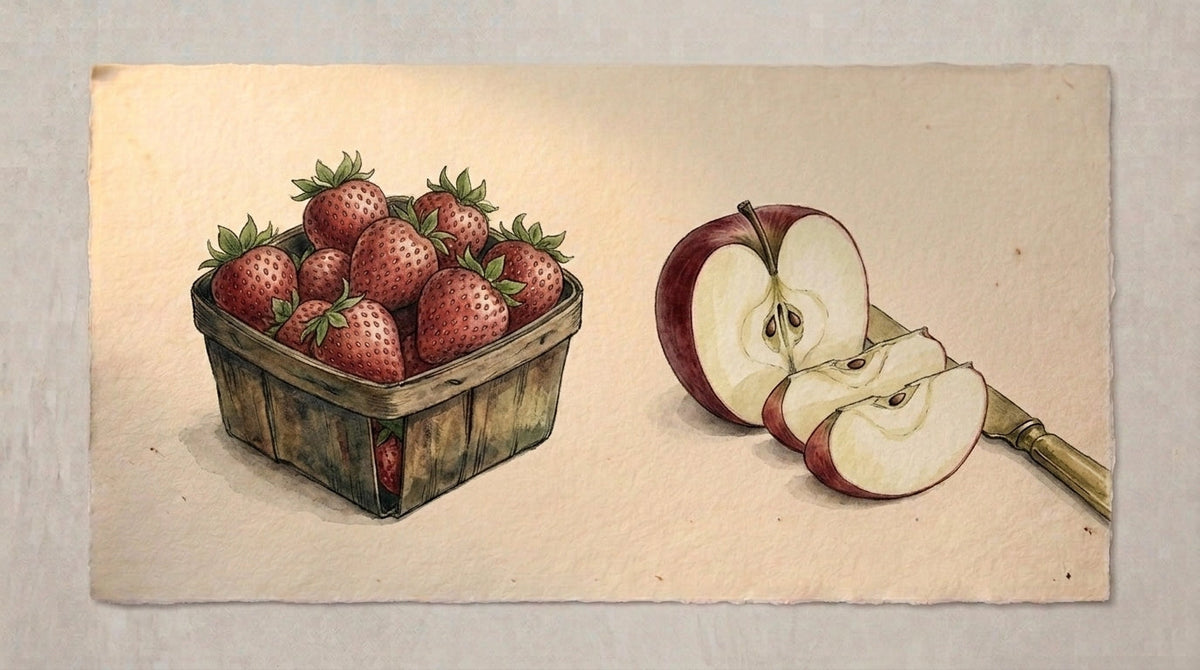
Strawberries, apples and persimmons appear near the top of the historical fisetin food-composition table most often quoted online. However, the widely repeated strawberry figure of 160 micrograms per gram is not a verified measurement of every gram of fresh strawberries. The original work analyzed freeze-dried, acid-hydrolyzed food samples, and a subsequent review describes its figures on a dry-weight basis [2] [1].
A later study reported a markedly different value in its analyzed dried strawberry sample: just 0.02 ± 0.01 micrograms per gram dry weight. Its methods and material were not identical to the original experiment, so these studies cannot be averaged or used to declare one universal strawberry concentration [7].
For that reason, you should not multiply the historical 160 micrograms figure by the fresh weight of a shop-bought punnet and claim a dependable 40 mg of fisetin from 250 g of fruit. What we can say confidently is that several ordinary foods contain fisetin, while their actual amounts vary considerably between samples and methods. For broader compound information, read what fisetin is.
Fisetin food sources: the ten-item historical ranking
The following values reproduce the approximate reported analytical figures most commonly reproduced from the early Japanese food-composition work. The researchers analyzed freeze-dried fruit and vegetable material after acid hydrolysis. Later papers describe these figures on a dry-weight basis. They are not a standardized contemporary database of fresh-market fruit, and none is a reliable per-serving dose calculator [2].
| Food sample | Historically reported fisetin (µg/g) | Practical interpretation |
|---|---|---|
| Strawberry | 160 | Highest figure in this historical analytical table; not a guaranteed fresh-fruit amount. |
| Apple | 26.9 | Second among the fruit samples listed. |
| Persimmon | 10.5–10.6 | Smaller analytical result in the original dataset. |
| Lotus root | 5.8 | A dietary source in the studied samples. |
| Onion | 4.78–4.8 | A dietary source; preparation and assay influence results. |
| Grape | 3.93 | Content cannot be assumed uniform across cultivars. |
| Kiwi | 2.03 | Lower than strawberry in the tested material. |
| Peach | 0.58 | Low in the tested sample. |
| Cucumber | 0.14 | Trace in the tested sample. |
| Tomato | 0.12 | Trace in the tested sample. |
Measurement note: These numbers are valuable for understanding what one analytical dataset found, not for estimating the number of milligrams in your breakfast. Different extraction methods, hydrolysis conditions, varieties and fresh-versus-dry weight conventions can substantially change apparent concentrations. Our ranking refers to these tested samples, not every edible plant.
Why do studies report different amounts of fisetin in strawberries?
The original Japanese analysis used HPLC measurements on freeze-dried, acid-hydrolyzed materials. The early intake study also estimated average fisetin consumption of approximately 0.39–0.4 mg/day among 50 adult women surveyed in Japan; that is a specific historical population estimate, not a worldwide average [2].
Tsurudome and colleagues' 2022 BioFactors paper used a separate plant-extraction and analytic workflow. It reported strawberry fruit at 0.02 ± 0.01 µg/g dry material and did not detect fisetin in its apple fruit or peel samples under the conditions tested. It also found high fisetin content in certain dried mulberry-leaf samples. This striking difference underscores the need to specify the sample and method, rather than treat a single online food chart as a universal nutrition label [7].
The two experiments are not directly interchangeable, and neither tells you how much fisetin a particular supermarket punnet supplies. Current data do not support a universal amount per 100 g of fresh strawberries.
Can strawberries provide the same fisetin dose as a supplement?
No reliable fresh-fruit-to-capsule conversion is available. Online calculations suggesting that a particular 250 g punnet always contains 40 mg, or that a given number of kilograms of strawberries equals a high-dose investigational protocol, apply historical laboratory concentrations as if they were validated contemporary fresh-weight values. That assumption is not supported by the methods.
Fisetin-containing foods and concentrated capsules are also not pharmacologically interchangeable. Human supplement studies have used different doses, formulations and endpoints; no dietary fisetin regimen has been shown to reproduce experimental senolytic treatment [Fisetin dosage: human study amounts]. The label amount in an oral product also does not predict blood exposure without accounting for formulation [Bioavailability evidence].
Conversely, there is no reason to turn an otherwise nutritious strawberry serving into a contest with supplement milligrams. Strawberries contribute fibre, vitamin C and a mixture of plant compounds in addition to any fisetin.
How should you build a fisetin-conscious diet?
Use whole foods rather than chasing one isolated molecule
Choose strawberries, apples, persimmons, grapes and other fruit you enjoy as part of varied meals. Include vegetables such as onions and, where accessible, lotus root. Portion size should reflect overall nutrition, metabolic needs, cost and personal preference rather than the speculative goal of hitting a supplement-equivalent fisetin threshold.
Research on strawberries as a whole food and on higher flavonoid-rich dietary patterns addresses combined nutrients and broader dietary habits, not isolated fisetin efficacy [4] [5].
Fresh, frozen or cooked?
Frozen strawberries are a practical year-round option. However, total-polyphenol measurements cannot tell us the exact fisetin retained in a specific frozen packet. Jam and preserves may also contain fisetin, but their processing conditions, added sugar and serving size matter; the current evidence does not give a validated retained-fisetin percentage [3].
What about mulberry leaves?
Mulberry leaves produced relatively high fisetin assay values in the 2022 experiment, but those samples were not ordinary fruit servings and the study did not establish a safe dose, standardized edible product, human absorption advantage or clinical vascular benefit [7]. Do not equate laboratory leaf extracts with a clinically validated supplement.
Does a fisetin-rich diet deliver proven longevity benefits?
No trial has demonstrated that changing dietary fisetin alone clears senescent cells, reverses biological ageing or extends human lifespan. Prospective cohort research has linked overall dietary flavonoid intake with favorable long-term outcomes, but those associations cannot isolate fisetin from dietary pattern, physical activity or other lifestyle factors [6].
We recommend interpreting fisetin foods as part of ordinary dietary variety rather than a dosage protocol. For the broader evidence on senolytic activity in experimental systems, see our fisetin senolytic review.
What remains unknown?
A reproducible, standardized fresh-weight fisetin concentration across common fruit cultivars; how home storage and food processing change parent and glycoside concentrations; the absorbed human dose after typical fruit servings; and whether habitual dietary fisetin independently changes clinical outcomes.
These are separate research questions. A laboratory concentration reported on dried, hydrolyzed samples cannot settle them.
Further reading: the distinction between dietary fisetin and demonstrated human benefits. Fisetin in food does not establish a clinically effective supplement dose.
Bottom line
Strawberries lead a widely quoted historical food-composition table, followed by apples and persimmons, but the published 160 µg/g strawberry result came from freeze-dried, acid-hydrolyzed analytical samples. Another paper reported a sharply different figure in its own dried strawberry material. Neither supports promising a fixed milligram dose from a fresh punnet. Choose fisetin-containing fruit as part of a varied diet, not as a substitute for clinical care or a way to reproduce unproven high-dose senolytic protocols. See our clinician's guide for the clinical evidence beyond food composition.
Frequently asked questions
What food has the most fisetin?
How many strawberries do I need to eat to match a fisetin capsule?
Can I get all my fisetin from food?
Are frozen strawberries just as good as fresh ones?
Do strawberry jams and preserves count as a fisetin source?
Which other foods are high in fisetin besides strawberries?
Sources & article history
Sources (7)
-
A comprehensive view on the fisetin impact on colorectal cancer in animal models: Focusing on cellular and molecular mechanisms Animal Models and Experimental Medicine. 2024;7(5):591-605.
-
Japanese intake of flavonoids and isoflavonoids from foods Journal of Epidemiology. 1998;8(3):168-75.
-
Fisetin: A Dietary Antioxidant for Health Promotion Antioxidants & Redox Signaling. 2013;Volume 19, issue 2, pages 151-162.
-
Strawberry as a functional food: an evidence-based review Critical Reviews in Food Science and Nutrition. 2014;54(6):790-806.
-
A New Database Facilitates Characterization of Flavonoid Intake, Sources, and Positive Associations with Diet Quality among US Adults The Journal of Nutrition. 2015;145(6):1239-48.
-
Flavonoid intake and all-cause mortality The American Journal of Clinical Nutrition. 2015;101(5):1012-20.
-
Fisetin, a major component derived from mulberry (Morus australis Poir.) leaves, prevents vascular abnormal contraction BioFactors. 2022;48(1):56–66.
Article history (1)
- Reassessed the original food-composition measurements, their preparation methods and the limits of fresh-fruit dose estimates.