NMN Foods: Natural Sources and How Much NMN They Actually Contain
NMN occurs in edamame, broccoli, avocado and other foods, but at tiny concentrations compared with human supplement trials. This guide traces the numbers to the original analytical paper.
 By
Dr. Khaled Mahmoud, MBBCh
Critical Care Medicine, Longevity Science & Editorial Direction
By
Dr. Khaled Mahmoud, MBBCh
Critical Care Medicine, Longevity Science & Editorial Direction
 Reviewed by
Dr. Amr Yasser, PhD
Cardiometabolic, Musculoskeletal, Gut & Bioavailability
Reviewed by
Dr. Amr Yasser, PhD
Cardiometabolic, Musculoskeletal, Gut & Bioavailability
 Reviewed by
Dr. Abdulla Mostafa, PhD
Cellular Senescence, Neurological, Mitochondrial & Brain-Ageing Biology
Reviewed by
Dr. Abdulla Mostafa, PhD
Cellular Senescence, Neurological, Mitochondrial & Brain-Ageing Biology
- Published
- Last reviewed
- Reading time
- 6 min
- Sources cited
- 2
On this page
NMN foods contain only small amounts of nicotinamide mononucleotide compared with supplement trials. Edamame, broccoli, avocado and several other foods contain measurable NMN, but ordinary servings do not approach the hundreds of milligrams used in clinical studies.
Foods that contain NMN
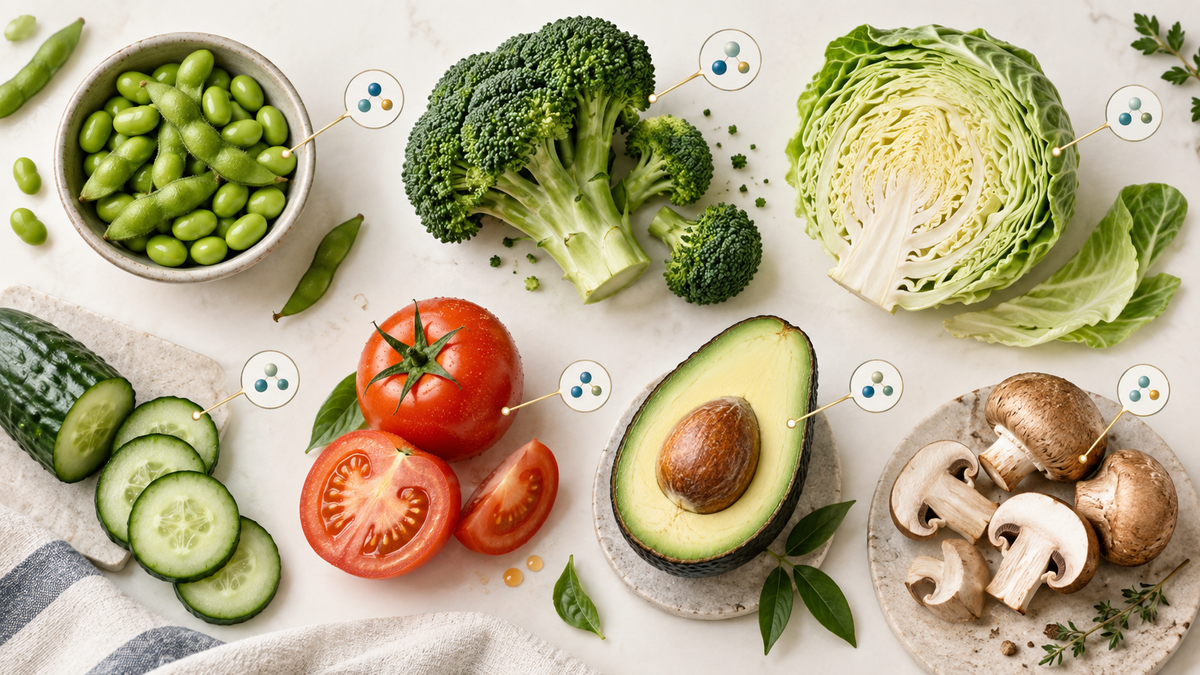
A foundational 2016 study measured NMN in a range of foods while investigating long-term NMN effects in aging mice. [1]
| Food | Published NMN concentration (mg/100 g) | Approx. food needed to reach 250 mg at the high end |
|---|---|---|
| Edamame | 0.47–1.88 | ~13.3 kg |
| Broccoli | 0.25–1.12 | ~22.3 kg |
| Avocado | 0.36–1.60 | ~15.6 kg |
| Cucumber peel | ~0.65 | ~38.5 kg |
| Tomato | 0.26–0.30 | ~83.3 kg |
| Mushroom | 0–1.01 | ~24.8 kg |
| Raw beef | 0.06–0.42 | ~59.5 kg |
| Shrimp | ~0.22 | ~113.6 kg |
These calculations use the upper measured concentration for a simple order-of-magnitude comparison. Real foods vary by species, ripeness, processing, storage and analytical method.
Can you get a clinical NMN dose from food?
Practically, no. Human supplementation studies commonly use hundreds of milligrams per day. Food concentrations are measured in fractions to low single-digit milligrams per 100 grams.
That does not make NMN-containing foods unhealthy or irrelevant. It means their nutritional benefits should not be attributed to delivering pharmacological NMN doses.
Why do some websites list wildly different food amounts?
NMN food tables are frequently copied without preserving the original units. Confusion between mg/100 g, mg/kg, wet weight and dry weight can produce tenfold or hundredfold errors.
The safest approach is to cite the analytical source and unit rather than repeating a secondary infographic.
Does cooking destroy NMN?
The food-content study does not establish a universal retention percentage for every cooking method. Heat, water, pH and storage can affect many nucleotides and related metabolites. Claims that steaming preserves exactly X% of NMN or that raw food is required need direct food-processing data.
What about edamame?
Edamame was among the richer foods measured in the 2016 paper, reaching up to approximately 1.88 mg/100 g. [2] Even at that concentration, a 250 mg dose would require around 13 kilograms of edamame.
Broccoli and avocado
Broccoli measured up to roughly 1.12 mg/100 g and avocado up to roughly 1.60 mg/100 g in the published analysis. [3] Both are nutrient-dense foods for many reasons; neither is a practical substitute for a 250–500 mg NMN supplement if the goal is to reproduce trial dosing.
Does eating NMN-rich food raise NAD+?
A healthy dietary pattern can support general vitamin B3 and metabolic nutrition, but human trials have not shown that eating these foods raises blood NAD+ to the same magnitude as hundreds of milligrams of supplemental NMN.
The digestive and microbial processing of NAD precursors is complex. A 2026 human study suggests gut microbes materially transform oral NMN and NR, reinforcing that food-to-tissue NAD biology cannot be inferred from ingredient content alone. [4]
NMN vs niacin-rich foods
NMN is not the only route into NAD metabolism. Niacin, nicotinamide and tryptophan contribute to NAD synthesis through other pathways. A diet can therefore support NAD precursor availability without containing large amounts of intact NMN.
Where the food numbers come from
The food-source numbers repeatedly copied across NMN websites trace largely to the 2016 Mills paper. The investigators extracted NMN from foods and measured it by HPLC while studying long-term NMN supplementation in aging mice. [5]
The paper reported ranges rather than one fixed value because food composition varies. Edamame measured 0.47–1.88 mg/100 g, broccoli 0.25–1.12 mg/100 g, avocado 0.36–1.60 mg/100 g, cabbage 0–0.90 mg/100 g and mushrooms 0–1.01 mg/100 g. [6]
That variability is normal for food chemistry. Variety, ripeness, growing conditions, storage, water content and analytical handling can all influence measured concentration.
Why units create so much NMN misinformation
A value written as 1 mg/100 g is the same as 10 mg/kg. If a secondary article accidentally reports the second number while keeping the first unit, the result becomes ten times too high. Dry-weight values can also look much larger than wet-weight values because water has been removed.
For that reason, a trustworthy NMN foods page should preserve both the unit and the primary source rather than merely ranking vegetables.
Does that mean food NMN is biologically irrelevant?
Not necessarily. Nutrition does not operate by matching pharmacological supplement doses molecule for molecule. Small amounts of NMN may contribute to a much larger dietary network involving nicotinamide, nicotinic acid, tryptophan and other nutrients that feed NAD biosynthesis.
The human body also recycles nicotinamide through the salvage pathway. So it would be a mistake to judge broccoli or avocado by whether they deliver 250 mg of intact NMN.
NMN is not the only dietary route to NAD+
Humans can synthesize NAD+ through several pathways. Niacin/nicotinic acid can enter the Preiss–Handler pathway, nicotinamide is recycled through NAMPT and tryptophan can contribute through the de novo kynurenine pathway. NMN and NR are part of this broader network.
A 2026 human study adds another layer: gut microbes can transform oral NMN and NR into nicotinic-acid-related metabolites before host tissues use them. [7] That makes the phrase “eat NMN to make NAD+” biologically incomplete.
What about cucumber peel versus cucumber flesh?
The Mills analysis reported separate values for cucumber seed and peel, illustrating that concentration can differ within the same food. [8] Secondary charts that list simply “cucumber” often erase that nuance.
Do fermented foods contain more NMN?
There is not a sufficiently standardized human food-composition database to rank fermented foods by NMN content with confidence. Microbial metabolism can alter NAD-related compounds, but specific “fermentation boosts NMN by X%” claims need direct analytical testing of the food in question.
Can a diet increase NAD+ without NMN supplements?
Yes in the broad physiological sense that adequate nutrition supplies precursors needed for NAD metabolism. Exercise, energy balance and metabolic health also influence NAD-related biology. What has not been shown is that a particular NMN-rich-food menu reproduces the blood NAD changes seen with high-dose supplemental NMN.
Should you choose foods based on their NMN content?
Probably not. The quantities are too small for NMN concentration to be a sensible primary criterion. Choose edamame, broccoli, avocado, tomatoes and mushrooms because they fit an overall nutritious dietary pattern—not because they function as 250 mg NMN capsules.
Related NMN guides
Bottom line
NMN is naturally present in food, but “natural source” should not be confused with “clinical dose.” The gap is measured in tens of kilograms of food for a typical 250 mg trial-style dose.
Frequently asked questions
What foods naturally contain NMN?
What food has the most NMN?
How much NMN is in broccoli?
How much NMN is in avocado?
Can I get 250 mg of NMN from food?
Does cooking destroy NMN in food?
Are natural NMN foods better than supplements?
Sources & article history
Sources (2)
-
Long-Term Administration of Nicotinamide Mononucleotide Mitigates Age-Associated Physiological Decline in Mice Cell Metabolism. 2016;24(6):795-806.
-
The differential impact of three different NAD+ boosters on circulatory NAD and microbial metabolism in humans Nature Metabolism. 2026;Volume 8, issue 1, pages 62–73.