
NMN for Skin: Anti-Aging, Pigmentation, Wrinkles & What the Evidence Shows
NMN alters pigmentation biology in aged human melanocytes and reconstructed skin, but oral NMN has not been proven to reduce wrinkles or visibly reverse skin aging.
 By
Dr. Khaled Mahmoud, MBBCh
Critical Care Medicine, Longevity Science & Editorial Direction
By
Dr. Khaled Mahmoud, MBBCh
Critical Care Medicine, Longevity Science & Editorial Direction
 Reviewed by
Dr. Amr Yasser, PhD
Cardiometabolic, Musculoskeletal, Gut & Bioavailability
Reviewed by
Dr. Amr Yasser, PhD
Cardiometabolic, Musculoskeletal, Gut & Bioavailability
 Reviewed by
Dr. Abdulla Mostafa, PhD
Cellular Senescence, Neurological, Mitochondrial & Brain-Ageing Biology
Reviewed by
Dr. Abdulla Mostafa, PhD
Cellular Senescence, Neurological, Mitochondrial & Brain-Ageing Biology
- Published
- Last reviewed
- Reading time
- 9 min
- Sources cited
- 5
On this page
NMN skin benefits are biologically plausible but clinically unproven. Current evidence is dominated by cell and reconstructed-skin research; controlled human trials have not shown that oral NMN reduces wrinkles, boosts collagen or reverses visible skin aging.
What the skin study found
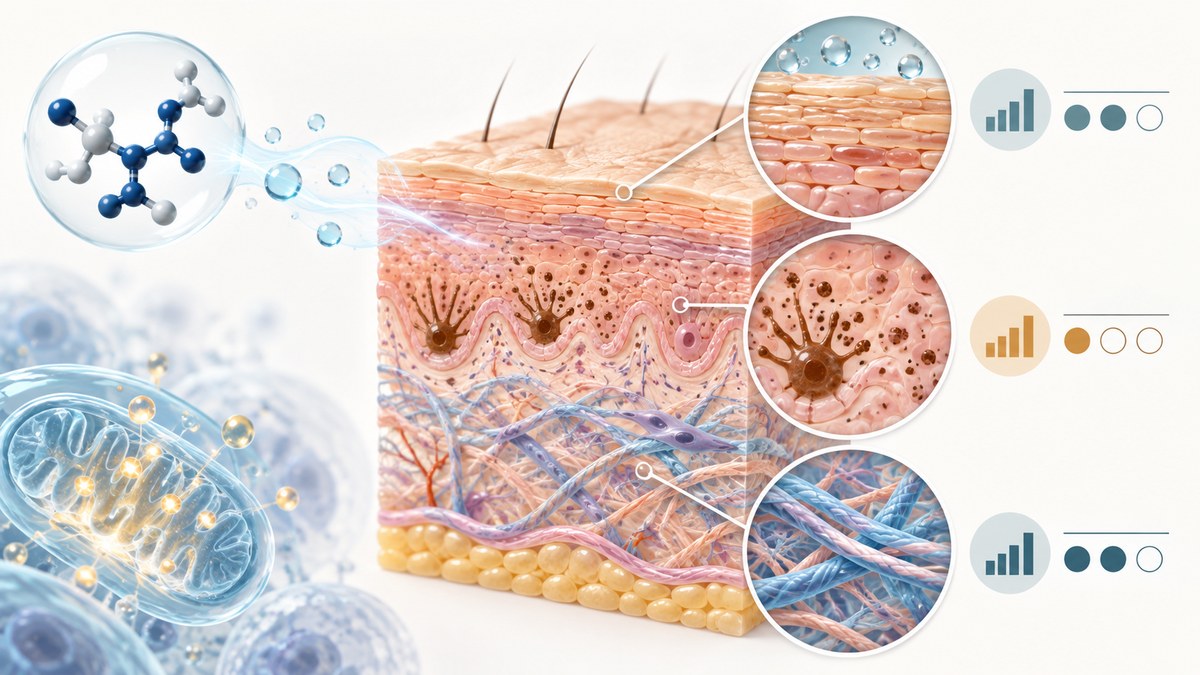
Brito and colleagues exposed young and aged human melanocytes to NMN. NMN reduced melanin production in aged melanocytes and altered cAMP/Wnt signaling and melanogenesis-related proteins. The effect was also demonstrated in a reconstructed human-skin model containing aged melanocytes. [1]
This is stronger than a mouse-only skin claim because the cells were human-derived. It is still not a clinical supplementation trial.
Oral NMN and photoaging: the best current oral evidence is still a mouse study
A 2025 UV-B photoaging study gave NMN orally to hairless mice for ten weeks. NMN reduced wrinkle formation and skin roughness, improved hydration and elasticity, normalized transepidermal water loss, preserved collagen and altered inflammatory/MAPK signaling. [2]
This is the most directly relevant current evidence for the claim that oral NMN could influence photoaged skin. It remains preclinical. Mouse skin, controlled UV-B exposure and the experimental dosing context cannot establish that a human NMN supplement reduces facial wrinkles or prevents sun damage.
2026 human topical trial: a real signal, but not an oral-supplement result
A July 2026 peer-reviewed split-face study tested 21 Korean women with visible signs of skin aging. One side of the face received a 10% nano-NMN ampoule plus weekly cold plasma, electroporation and Synerjet microjet delivery; the other side received topical 10% nano-NMN alone twice daily for four weeks. The device-assisted side showed significantly greater improvement in measured wrinkles, pore volume, elasticity, pigmentation and hydration. [3]
This changes the skin evidence in an important but narrow way: NMN now has a small human topical/procedural study. It still does not show that swallowing NMN reduces wrinkles, and because both sides received NMN, the trial mainly tests the added value of the delivery system rather than NMN versus placebo. Side allocation was fixed rather than randomized, the study was short, and the research was commercially funded.
What NMN has not been shown to do in human skin
- Reduce facial wrinkles after oral supplementation.
- Increase skin elasticity after oral NMN in a randomized controlled trial.
- Improve hydration or transepidermal water loss after oral NMN supplementation.
- Reverse sun damage.
- Treat melasma or hyperpigmentation clinically.
- Increase collagen production enough to change visible skin aging.
- Make a person look biologically younger.
Why NAD+ is relevant to skin biology
Skin is metabolically active and exposed to UV radiation, oxidative stress and repeated repair demands. NAD+ participates in redox metabolism and enzymes involved in stress responses and DNA repair, making NAD-restoration strategies biologically plausible research targets.
However, a pathway being relevant to skin aging does not establish that oral NMN reaches the relevant skin compartment at a dose that produces a visible effect.
NMN and pigmentation
The Brito study specifically supports a mechanistic pigmentation hypothesis in aged melanocytes. [4] It should not be generalized to “NMN whitens skin” or recommended as treatment for pigmentation disorders.
Clinical pigmentation is influenced by UV exposure, hormones, inflammation, genetics and dermatologic disease. A reconstructed-skin result is a starting point for trials, not a treatment guideline.
Oral NMN vs topical NMN
These routes cannot borrow evidence from each other. Directly exposing cultured cells or reconstructed skin to NMN does not tell us what concentration reaches skin after swallowing a capsule.
The 2026 Synerjet trial provides early human evidence for a specific topical/device-assisted protocol, not for oral supplementation. It also cannot establish that topical NMN alone caused the benefit because both facial sides received NMN and the experimental side added cold plasma, electroporation and microjet delivery. [5]
What about collagen and wrinkles?
NMN is not a collagen peptide and has not been shown in randomized human skin trials to reproduce the wrinkle or elasticity findings reported for some collagen products. Mechanistic NAD biology should not be converted into an untested collagen-production claim.
Could NMN protect against UV damage?
Preclinical NAD biology makes photodamage an interesting research area, but a consumer should not treat NMN as sunscreen or as protection against UV-induced skin cancer. Proven photoprotection remains sunscreen, protective clothing, shade and avoidance of excessive UV exposure.
Hair and skin are separate evidence questions
A 2025 single-arm oral NMN study did report hair-quality changes in 15 middle-aged women. [6] That does not validate skin-aging claims and had no placebo group. See NMN for hair.
“Skin aging” is not one endpoint
Search results often use “skin anti-aging” as if it were a single measurable outcome. Dermatology separates it into different domains: wrinkles, elasticity, hydration and barrier function, pigmentation, dermal thickness, collagen organization, photoaging, vascular change and subjective appearance. An intervention can affect one without affecting the others.
The key NMN skin paper addresses melanogenesis in aged melanocytes. It does not measure crow's-feet, facial laxity, hydration or collagen density in people. [7]
What the aged-melanocyte study actually did
Researchers compared young and aged human melanocytes and applied NMN directly in the laboratory. NMN reduced melanin production preferentially in aged cells and downregulated cAMP/Wnt signaling and melanogenesis-related proteins. The investigators also reproduced the pigmentation effect in a reconstructed human-skin model. [8]
That is meaningful translational work because it uses human-derived cells and a tissue-like model. It remains several steps away from an oral supplement trial. The concentration bathing a cultured melanocyte is not the same as the concentration reaching epidermis after an NMN capsule is digested, metabolized and distributed through the circulation.
Why oral NMN and topical NMN cannot share evidence automatically
Route matters. Oral NMN undergoes intestinal and microbial metabolism before altering systemic NAD-related pools. A topical product faces a different problem: stability inside the formulation and penetration through the stratum corneum.
A topical serum could theoretically create high local exposure without meaningful blood exposure. An oral capsule could alter blood NAD while delivering far lower intact NMN to epidermal cells. Until pharmacokinetic and clinical studies measure those routes, “NMN works on skin” is too imprecise.
NAD+, skin cells and DNA repair: plausible does not mean proven
NAD+ is required for redox metabolism and is consumed by enzymes involved in DNA-damage responses. Skin is repeatedly exposed to ultraviolet radiation, pollution, inflammation and oxidative stress, so NAD biology is a legitimate research direction.
The mistake is jumping from that pathway to a cosmetic outcome. Demonstrating that NAD metabolism participates in DNA repair does not show that an over-the-counter NMN dose reduces wrinkles or prevents UV-induced disease.
What about collagen?
The keyword universe contains many combinations of NMN and collagen. They should not be treated as interchangeable “anti-aging ingredients.” Collagen is a structural protein; oral collagen research focuses on peptides, connective-tissue turnover and skin measurements. NMN is a metabolic precursor.
No human NMN trial has established a clinically meaningful increase in dermal collagen, and no head-to-head study shows NMN is comparable or superior to a collagen intervention for elasticity or wrinkle outcomes.
Can NMN fade age spots?
The melanocyte paper makes pigmentation a serious hypothesis, but it does not establish treatment of solar lentigines, melasma or post-inflammatory hyperpigmentation. Those conditions have different biology and can worsen with inappropriate self-treatment.
Even the laboratory result should be described carefully: it showed reduced melanin production under experimental conditions, not selective removal of unwanted pigment in living human skin.
Where NMN sits beside established skin-aging interventions
| Goal | Established evidence category | NMN status |
|---|---|---|
| Prevent UV photoaging | Broad-spectrum sunscreen and UV avoidance | No replacement evidence |
| Improve fine wrinkles/photoaging | Topical retinoids have substantial clinical evidence | Early device-assisted topical NMN signal; no oral NMN wrinkle RCT |
| Treat melasma/hyperpigmentation | Condition-specific dermatologic regimens | Mechanistic pigmentation research only |
| Improve hydration/barrier | Moisturizers and barrier-directed ingredients | No controlled NMN barrier trial |
| Improve visible aging generally | Depends on endpoint | NMN remains experimental |
What about NMN skincare products from Korea or Japan?
The 2026 Korean split-face trial means topical NMN is no longer a purely theoretical category, but it does not validate unrelated retail skincare. The tested intervention used a 10% nano-NMN ampoule together with a professional cold-plasma/electroporation/microjet system. [9]
A consumer serum, cream or multi-ingredient cosmetic still needs its own stability, penetration, irritation and clinical data. Country of manufacture and the letters “NMN” do not transfer the Synerjet result to another formulation.
Could NMN worsen pigmentation?
There is no controlled clinical evidence that ordinary oral NMN predictably worsens pigmentation. The direct aged-melanocyte experiment moved melanin production downward. Individual pigment disorders are complex enough that neither benefit nor harm should be assumed from a cell model.
2026 keratinocyte study: useful mechanism, not a human treatment trial
A 2026 peer-reviewed brief report tested NMN and NR directly in cytokine-stimulated human HaCaT keratinocytes. NMN dose-dependently reduced several inflammatory transcripts—including IL-1β, CCL22, CCL5, CCL17, IL8 and TSLP—and both precursors suppressed p38 MAPK phosphorylation. [10]
This is relevant to inflammatory skin biology and makes the mechanistic skin evidence more current. It is still in-vitro evidence: no people were treated, the cells received millimolar NMN directly, and the study did not measure eczema severity, wrinkles, elasticity, hydration or visible skin aging.
What would a definitive NMN skin trial look like?
- Randomized, double-blind and placebo-controlled.
- An adequately characterized β-NMN product with lot-matched assay testing.
- At least several months of treatment to match visible skin-remodeling timelines.
- Standardized photography under controlled lighting.
- Validated wrinkle, elasticity, hydration/barrier and pigmentation measurements.
- Separate analysis of oral and topical routes rather than mixing them.
- Predefined primary outcomes so a single attractive secondary result is not overpromoted.
How we classify the evidence today
NMN now has mechanistic skin evidence plus one small human topical/device-assisted trial. Oral NMN still lacks clinical evidence for visible skin rejuvenation, and the topical study cannot isolate NMN itself from the delivery procedure. That is why the broader NMN benefits page still places oral cosmetic claims below established human outcomes.
Related NMN guides
Bottom line
NMN's skin story is now split by route. Oral NMN remains unproven for visible skin rejuvenation. Topically, a small 2026 split-face study found better skin measurements when nano-NMN was delivered with a professional device system than when the same nano-NMN was applied topically alone. That is a legitimate human signal, but it is not proof that an NMN supplement—or an ordinary NMN cream—reduces wrinkles.
Frequently asked questions
Is NMN good for skin?
Does NMN reduce wrinkles?
Does NMN increase collagen?
Can NMN help hyperpigmentation or dark spots?
Can NMN be used topically?
Is NMN like collagen?
Does NMN protect skin from the sun?
Sources & article history
Sources (5)
-
Nicotinamide mononucleotide reduces melanin production in aged melanocytes by inhibiting cAMP/Wnt signaling Journal of Dermatological Science. 2022;106(3):159-169.
-
β-Nicotinamide Mononucleotide Enhances Skin Barrier Function and Attenuates UV-B-Induced Photoaging in Mice Antioxidants. 2025;14(12):1424.
-
Beyond Nano-Delivery: Synerjet-Assisted Transdermal Delivery of Nano-Formulated Nicotinamide Mononucleotide (Nano-NMN) for Comprehensive Skin Rejuvenation Cosmetics. 2026;13(4):172.
-
Oral Supplementation of Nicotinamide Mononucleotide (NMN) Improves Hair Quality and Subjective Perception of Hair Appearance in Middle-Aged Women Cosmetics. 2025;12, 204.
-
Nicotinamide mononucleotide and nicotinamide riboside attenuate cytokine production in human keratinocytes via suppression of p38 Pathway Molecular Biology Reports. 2026;53(1):459.