
Shahmirzadi 2020 Ca-AKG study: what it found and what replication changed
Shahmirzadi 2020 explained in light of 2026 evidence: female lifespan and frailty findings, SASP and IL-10 biology, the invalid mouse-to-human dose shortcut, and two null NIA ITP replications.
 By
Dr. Khaled Mahmoud, MBBCh
Critical Care Medicine, Longevity Science & Editorial Direction
By
Dr. Khaled Mahmoud, MBBCh
Critical Care Medicine, Longevity Science & Editorial Direction
 Reviewed by
Dr. Amr Yasser, PhD
Cardiometabolic, Musculoskeletal, Gut & Bioavailability
Reviewed by
Dr. Amr Yasser, PhD
Cardiometabolic, Musculoskeletal, Gut & Bioavailability
 Reviewed by
Dr. Abdulla Mostafa, PhD
Cellular Senescence, Neurological, Mitochondrial & Brain-Ageing Biology
Reviewed by
Dr. Abdulla Mostafa, PhD
Cellular Senescence, Neurological, Mitochondrial & Brain-Ageing Biology
- Published
- Last reviewed
- Reading time
- 12 min
- Sources cited
- 5
On this page
Shahmirzadi 2020 is the study that put calcium alpha-ketoglutarate on the modern longevity map. It remains an important mouse healthspan study—but it is no longer accurate to discuss it as if its lifespan result stands alone.
Since 2020, the US National Institute on Aging Interventions Testing Program has run two independent, multi-site AKG lifespan experiments in genetically heterogeneous UM-HET3 mice. Neither reproduced a lifespan extension.
That does not erase Shahmirzadi's frailty, inflammatory or tissue findings. It changes how strongly we should generalize the lifespan claim.
What was the Shahmirzadi 2020 study?
The paper, Alpha-Ketoglutarate, an Endogenous Metabolite, Extends Lifespan and Compresses Morbidity in Aging Mice, was published in Cell Metabolism in September 2020 [1].
Researchers studied 182 C57BL/6 mice across two independent cohorts. At 18 months of age, animals were assigned to standard chow or chow containing 2% calcium alpha-ketoglutarate by weight, which continued for life.
The study was unusually valuable because it measured both lifespan and a longitudinal 31-parameter frailty index. That allowed the authors to ask not only whether mice lived longer, but whether they accumulated less age-related morbidity.
What happened to lifespan?
Female mice
The statistically significant survival effect was confined to females.
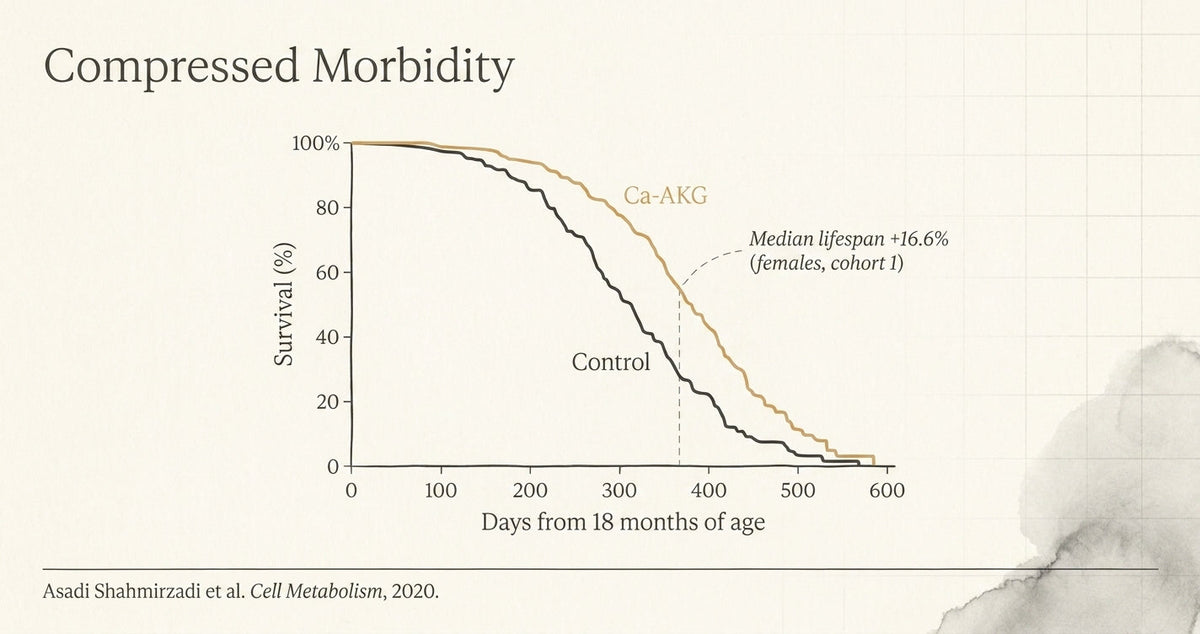
In cohort 1, female median lifespan from the start of treatment increased by 16.6%, and age at 90th-percentile mortality increased by 19.7% [1].
In cohort 2, female median lifespan increased by 10.5%, while the 90th-percentile survival measure increased by 8%.
Male mice
Male median lifespan moved in the same direction—9.6% and 12.8% higher across the two cohorts—but the survival differences were not statistically significant.
So “Ca-AKG made mice live 20% longer” is not an accurate summary. A more precise statement is: female C57BL/6 mice showed a reproducible but variable survival benefit; males did not show a statistically significant lifespan extension.
The frailty finding was broader than the lifespan finding
Frailty-index burden was lower in both sexes. The reported frailty area under the curve was reduced by about 46% in females and 41% in males [1].
Several individual age-related phenotypes also improved, including gait, kyphosis, body condition and coat-related measures.
This is one reason the paper remains important even after the later lifespan replications were negative: the original experiment contained a substantial healthspan dataset, not just survival curves.
There is also a nuance that should not be lost. The audited study limitations note that the dramatic frailty-curve difference is partly influenced by animals that died relatively early. The result supports lower frailty burden, but it should not be translated into a simple percentage reduction in human frailty.
What did the study find about inflammation?
In female mice, Ca-AKG suppressed a broad panel of circulating inflammatory cytokines and chemokines at 24 months. Males showed a weaker, non-significant pattern [1].
The study also reported increased frequencies of IL-10-producing CD4+ and CD8+ splenic T cells in treated females.
IL-10 is an anti-inflammatory cytokine, so the authors proposed immune modulation as one mechanism linking Ca-AKG to healthspan. But this was a correlated mechanism, not a causal demonstration: the study did not block IL-10 in vivo to prove that it was required for the phenotype.
Was Ca-AKG a senolytic in this study?
No.
In senescent IMR-90 human fibroblasts, AKG reduced expression of several SASP factors—including IL-1α, IL-1β, IL-6, IL-8, CCL2, CXCL1 and MMP3—and lowered IL-6 secretion [1].
But it did not abolish classical cellular-senescence markers such as SA-β-gal positivity. The evidence therefore fits a senomorphic-like effect—altering harmful secretory output—better than a senolytic effect that selectively kills senescent cells.
What did the study show about fur repigmentation?
The study also reported a notable secondary finding: aged Ca-AKG-fed mice had more melanocyte-containing hair follicles and visible fur repigmentation.
The proportion of Dct-positive follicles increased from roughly 40% in controls to roughly 60% in treated animals [1].
This is the source of nearly every Ca-AKG grey-hair claim online. It has not been independently replicated as a pigmentation endpoint and has never been demonstrated in humans. See Ca-AKG and grey hair.
What dose did the mice receive?
The chow contained 2% Ca-AKG by weight.
That is the dose the paper establishes. It does not establish a validated human-equivalent Ca-AKG dose.
Earlier versions of this article converted the mouse exposure into roughly 400–500 mg/day for a 70 kg person using a generic body-surface-area calculation. We no longer use that conversion.
Why? Because dietary concentration, food intake, species pharmacokinetics, absorption, salt chemistry, tissue exposure and continuous chow administration all matter. A generic allometric calculation can produce a precise-looking number without demonstrating equivalent exposure at the relevant biological target.
The correct conclusion is: the mouse study cannot tell us what human longevity dose is equivalent to 2% Ca-AKG chow.
For the human dose literature, see Ca-AKG dosage.
The first major replication test: NIA ITP late-start AKG
The National Institute on Aging Interventions Testing Program is specifically designed to test proposed longevity interventions across three independent sites using genetically heterogeneous UM-HET3 mice. The multi-site design reduces dependence on one laboratory environment or one inbred strain. See the NIA Interventions Testing Program overview.
In the 2024 ITP publication, dietary AKG at 20,000 ppm starting at 18 months of age did not increase lifespan in either male or female UM-HET3 mice [2].
This is a direct challenge to broad statements such as “AKG extends mouse lifespan.”
It did not prove Shahmirzadi 2020 was wrong. The mouse genetic background, study network, intervention details and measured outcomes differ. But it demonstrated that the lifespan effect was not robust across an independent, genetically heterogeneous multi-site experiment.
Could the ITP null result be explained by starting too late?
That possibility was tested.
A second ITP study published in 2026 started dietary AKG at seven months of age—much earlier than the 18-month late-start experiment [3].
Again, AKG did not increase lifespan in either sex.
So simply moving treatment earlier did not reproduce the original lifespan extension in UM-HET3 mice.
What do the two ITP studies mean for Shahmirzadi 2020?
They change the correct wording.
Before the ITP replications, it was reasonable to say that Ca-AKG extended lifespan in a replicated two-cohort C57BL/6 mouse program.
In 2026, the more complete statement is:
- Shahmirzadi 2020 reported significant female lifespan extension and lower frailty burden in C57BL/6 mice.
- A late-start NIA ITP experiment found no lifespan extension in UM-HET3 mice.
- An earlier-start NIA ITP experiment also found no lifespan extension.
- The reasons for the discrepancy are not established.
The lifespan evidence is therefore mixed and model-dependent, not universally positive.
Do the ITP null results erase the healthspan findings?
No.
The ITP papers are powerful lifespan replication tests, but they do not reproduce every healthspan endpoint measured in Shahmirzadi 2020. A null survival result does not automatically disprove the original cytokine, frailty, SASP or pigmentation observations.
It does mean those findings should be interpreted as features of the original study until independently reproduced in comparable designs.
How does Shahmirzadi fit with the earlier worm and fly studies?
The mammalian work was preceded by mechanistic longevity findings in invertebrates.
In 2014, AKG extended C. elegans lifespan in work linking ATP synthase inhibition with TOR suppression and autophagy [4].
In 2019, dietary AKG extended female fly lifespan at a narrow dose range with mTOR-, AMPK- and autophagy-related changes [5].
Those studies establish conserved mechanistic interest. They do not make the mammalian lifespan result inevitable.
What about conflicts of interest?
They should be disclosed because they are material.
The Shahmirzadi paper reported that multiple authors had equity, board or founder relationships involving Gerostate Alpha and Ponce de Leon Health, and several authors were named on a preliminary patent application related to the discovery [1].
The study also received support from NIH/NIA, foundations and Ponce de Leon Health.
A conflict does not invalidate a result. It increases the importance of independent replication—which is exactly why the later ITP results deserve prominent treatment rather than a footnote.
What does Shahmirzadi 2020 tell us about humans?
It gives us a reason to study Ca-AKG in humans. It does not provide human longevity evidence.
The study does not demonstrate:
- longer human lifespan;
- lower human frailty;
- grey-hair reversal in people;
- a validated human dose;
- or a clinical anti-inflammatory effect.
The modern human Ca-AKG evidence consists mainly of observational biological-age studies, historical clinical exposure and the ongoing randomized ABLE program. For that evidence hierarchy, see the Ca-AKG pillar.
Bottom line
Shahmirzadi 2020 remains a foundational Ca-AKG paper. It showed significant female lifespan extension, substantially lower frailty burden in both sexes, inflammatory/SASP changes and several tissue-level age-related effects in C57BL/6 mice.
But the 2026 evidence base is no longer “Ca-AKG extends lifespan in mice.” Two independent multi-site NIA ITP experiments in genetically heterogeneous UM-HET3 mice—one starting AKG at 18 months and one at seven months—failed to reproduce a lifespan extension.
The right conclusion is therefore narrower and stronger: Shahmirzadi 2020 demonstrated an important healthspan and female-lifespan phenotype in one mouse model, while later high-quality replication shows the lifespan effect is not robust across mouse backgrounds and study systems.
Frequently asked questions
What is the Shahmirzadi 2020 paper?
How much longer did the mice live?
Does the Shahmirzadi study apply to humans?
What dose of Ca-AKG did the mice receive?
What did the study find about senescent cells?
Sources & article history
Sources (5)
-
Alpha-Ketoglutarate, an Endogenous Metabolite, Extends Lifespan and Compresses Morbidity in Aging Mice Cell Metabolism. 2020;Volume 32, issue 3, pages 447–456.e6.
-
Lifespan effects in male UM-HET3 mice treated with sodium thiosulfate, 16-hydroxyestradiol, and late-start canagliflozin GeroScience. 2024;46(5):4657-4670.
-
Astaxanthin, meclizine, mitoglitazone, pioglitazone, alpha-ketoglutarate, mifepristone, methotrexate, and atorvastatin-telmisartan do not increase lifespan in UM-HET3 mice GeroScience. 2026;48(3):3821-3830.
-
The metabolite alpha-ketoglutarate extends lifespan by inhibiting the ATP synthase and TOR Nature. 2014;Volume 510, issue 7505, pages 397–401.
-
Alpha-ketoglutarate extends Drosophila lifespan by inhibiting mTOR and activating AMPK Aging (Albany NY). 2019;Volume 11, issue 12, pages 4183–4197.


