What Are Hydrolysed Collagen Peptides? (A Doctor Explains)
Hydrolysed collagen peptides are collagen broken into smaller peptide mixtures. Human studies detect some collagen-derived peptides in blood, but absorption alone does not prove a clinical benefit.
 By
Dr. Khaled Mahmoud, MBBCh
Critical Care Medicine, Longevity Science & Editorial Direction
By
Dr. Khaled Mahmoud, MBBCh
Critical Care Medicine, Longevity Science & Editorial Direction
 Reviewed by
Dr. Amr Yasser, PhD
Cardiometabolic, Musculoskeletal, Gut & Bioavailability
Reviewed by
Dr. Amr Yasser, PhD
Cardiometabolic, Musculoskeletal, Gut & Bioavailability
 Reviewed by
Dr. Abdulla Mostafa, PhD
Cellular Senescence, Neurological, Mitochondrial & Brain-Ageing Biology
Reviewed by
Dr. Abdulla Mostafa, PhD
Cellular Senescence, Neurological, Mitochondrial & Brain-Ageing Biology
- Published
- Last reviewed
- Reading time
- 7 min
- Sources cited
- 7
On this page
Hydrolysed collagen peptides are collagen proteins enzymatically broken into smaller fragments that dissolve readily and are digested efficiently. Most of an oral dose is ultimately absorbed as amino acids and small peptides; human studies also detect specific hydroxyproline-containing peptides such as Pro-Hyp in blood after ingestion. Detecting those peptides does not by itself prove a skin, joint or bone benefit.
What are hydrolysed collagen peptides, in one paragraph?
They're collagen—usually from bovine hide, marine fish skin or porcine skin—treated with enzymes to break long proteins into shorter fragments. Digestion produces amino acids and small peptides. Human pharmacokinetic studies detect some collagen-derived di- and tripeptides in blood; proposed signalling effects on fibroblasts, chondrocytes and other cells come mainly from mechanistic and preclinical work rather than direct proof of the pathway in people.
Where do hydrolysed collagen peptides come from?
Collagen is the most abundant protein in the animal kingdom. Any tissue with structural integrity — skin, tendon, ligament, cartilage, bone matrix, blood vessel walls — is held together largely by collagen. The raw material for supplements isn't exotic: it's the connective tissue of ordinary food-industry animals.
Bovine hide (cow skin)
Bovine collagen is the most common source in both trials and commercial products. It's a co-product of the leather and food industries, extracted from cattle hide, and delivers predominantly Type I collagen with a proportion of Type III. Grass-fed and conventionally raised sources are chemically identical; the difference is in sustainability and contaminant profile, not the collagen itself.
Marine (fish skin and scales)
Marine collagen comes from the skin, scales and bones of fish — typically wild-caught cod or farmed tilapia — and is also predominantly Type I. The largest skin meta-analysis in this evidence base found no significant difference between marine and bovine sources on skin outcomes [2]. Marine is the practical choice if you avoid beef for religious, ethical or allergen reasons — though it isn't suitable if you have a fish allergy. Full comparison: marine vs bovine hydrolysed collagen.
Porcine (pork skin)
Porcine collagen, from pig skin, is common in Europe and in some pharmaceutical uses. It's chemically similar to bovine and is excluded on religious grounds in some markets, dominant in others.
What about chicken cartilage, eggshell membrane, and "vegan collagen"?
Chicken sternum cartilage supplies Type II collagen — a completely different product, usually sold undenatured (UC-II) at milligram doses for joint support, working through a different mechanism entirely. Eggshell membrane products contain some collagen alongside other bioactive proteins and sit in their own category. No plant produces true collagen: "vegan collagen" products are amino-acid blends (glycine, proline, lysine, vitamin C) meant to support your own collagen synthesis, with a much thinner evidence base — see the honest treatment in vegan alternatives to hydrolysed collagen.
How are hydrolysed collagen peptides made?
The path from raw hide to soluble powder runs through three stages.
1. Extraction
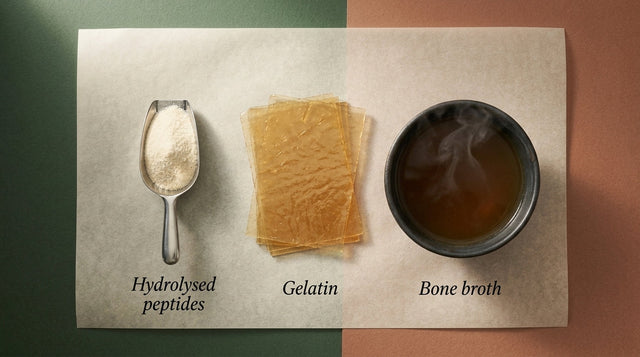
The raw material is cleaned, defatted, and treated with acid or alkali to loosen collagen from fat, non-collagenous proteins and minerals. This produces gelatin — collagen with its triple helix unwound, but the peptide chains still long.
2. Enzymatic hydrolysis
The gelatin is exposed to proteolytic enzymes under controlled temperature and pH, which cleave the peptide bonds into progressively shorter fragments. Manufacturers target specific molecular-weight ranges; finished peptides typically land in the 2–6 kDa range [1] — small enough to dissolve readily; digestion and absorption still break down much of the material before it reaches systemic circulation.
3. Filtration and drying
The peptide solution is filtered, deodorised, and spray-dried into the flavour-neutral powder that reaches shelves. Quality manufacturers publish the peptide molecular-weight distribution on request; lower-quality ones often don't. The result mixes cleanly into hot or cold liquid without gelling — the defining functional difference from gelatin, which sets when it cools.
What's actually in the powder?
A typical 10 g scoop contains, by weight, roughly: 3.3 g glycine (the smallest amino acid, and rate-limiting for your own glutathione production), 1.3 g hydroxyproline (a biomarker essentially unique to collagen and gelatin in the diet), 1.0 g proline (the substrate collagen-building cells convert into hydroxyproline), around 1.0 g glutamic acid, roughly 0.8 g arginine, smaller amounts of lysine, alanine and aspartic acid — and effectively zero tryptophan, which is why collagen is classed as an incomplete protein. The peptide chains themselves are dominated by repeating glycine-proline-hydroxyproline sequences, the structural motif of native collagen. For what this composition means for muscle-building goals specifically, see hydrolysed collagen vs whey protein.
What does your body actually do with them?
After you swallow a dose, two things happen in your small intestine.
Most of the dose becomes generic amino acids
Intestinal peptidases break down the majority of ingested peptides all the way to free amino acids, which join your circulating amino-acid pool. Your body uses this pool to build whatever protein it needs — including collagen, but not exclusively or preferentially.
Some collagen-derived peptides are measurable in blood
Human studies detect Pro-Hyp, Hyp-Gly and related hydroxyproline-containing peptides after oral collagen or gelatin ingestion [3]. A 2024 randomized crossover study comparing fish, porcine and bovine hydrolysates found that peptide source and molecular weight influenced some plasma peptide profiles [7]. Cell and animal experiments suggest these fragments may participate in signalling pathways, but the fraction absorbed intact and the extent to which that mechanism explains human clinical outcomes are not established.
Why does "hydrolysed" matter?
Eating collagen without hydrolysing it first — a piece of skin-on chicken thigh, a slow-cooked oxtail — presents your gut with the native triple-helix molecule, far too large to absorb intact. Your gut can still break it down, but less efficiently and with a lower yield of the intact bioactive dipeptides described above. Hydrolysis performs part of that protein breakdown before ingestion, improving solubility and producing a more consistent peptide mixture. Many supplement trials use hydrolysed preparations, but results remain preparation-specific and should not be generalized automatically to whole dietary collagen or every peptide product [5]. For the direct comparison with gelatin, bone broth and undenatured type II collagen, see hydrolysed vs non-hydrolysed collagen.
What hydrolysed collagen peptides are not
Not a complete protein
A complete protein supplies all nine essential amino acids in the proportions your body needs. Collagen has no tryptophan and very little methionine, cysteine or leucine, which makes it a poor stand-in for a complete protein source.
Not "your own collagen, delivered straight to your skin"
The marketing image of swallowed collagen slotting directly into your skin like building blocks is wrong. The mechanism is signalling, not direct incorporation — once digested, the amino acids are indistinguishable from any other dietary amino acid and can end up in any protein your body chooses to build.
Not a cure for anything
Hydrolysed collagen produces small-to-moderate effects on skin, joint and bone outcomes over weeks to months. It is a nutritional adjunct, not a treatment for osteoarthritis, osteoporosis or any dermatological condition.
Not identical across products
Molecular weight distribution, peptide profile, source and manufacturing quality all vary between brands. Modelling of digestion and first-pass metabolism suggests lower-molecular-weight peptides may be transported more efficiently than heavier ones, though this hasn't been tested head-to-head in a human outcome trial [6]. Independent third-party testing is what actually separates a quality brand from a generic one — see our buyer's guide for the criteria-first framework.
What we still don't know
A few gaps are worth naming rather than glossing over. It isn't settled whether the exact ratio of Pro-Hyp to Hyp-Gly matters more than average molecular weight for the signalling effect. The general contribution of the amino-acid-pool fraction to your own collagen synthesis at gram-scale daily intakes is far less well characterised than the signalling fraction is. And almost all pharmacokinetic data comes from single-dose or short-duration studies — there's very little data on how absorption behaves after months of consistent daily use.
Bottom line
Hydrolysed collagen is collagen processed into smaller soluble peptides. Most of the dose contributes amino acids and small digestion products; a measurable minority of hydroxyproline-containing peptides can appear in blood. Human absorption is established, while the exact contribution of peptide signalling to clinical skin, joint, bone or exercise effects remains uncertain. Product source, molecular-weight distribution, dose and study formulation all matter, so 'hydrolysed collagen' is a category rather than a guarantee of a particular outcome.
Frequently asked questions
Are hydrolysed collagen peptides and collagen peptides the same thing?
Where does hydrolysed collagen actually come from?
Is hydrolysed collagen just expensive protein powder?
Does hydrolysed collagen contain gelatin?
Does the molecular weight of collagen peptides matter?
How long do the active peptides stay in my body after a dose?
Sources & article history
Sources (7)
-
Hydrolyzed Collagen—Sources and Applications Molecules. 2019;24(22):4031.
-
Effects of Oral Collagen for Skin Anti-Aging: A Systematic Review and Meta-Analysis Nutrients. 2023;15(9):2080.
-
Identification of food-derived collagen peptides in human blood after oral ingestion of gelatin hydrolysates Journal of Agricultural and Food Chemistry. 2005;53(16):6531–6536.
-
Oral ingestion of collagen hydrolysate leads to the transportation of highly concentrated Gly-Pro-Hyp and its hydrolyzed form of Pro-Hyp into the bloodstream and skin Journal of Agricultural and Food Chemistry. 2017;65(11):2315–2322.
-
Effects of Hydrolyzed Collagen Supplementation on Skin Aging: A Systematic Review and Meta-Analysis International Journal of Dermatology. 2021;60(12):1449-1461.
-
Assessment of bioavailability after in vitro digestion and first pass metabolism of bioactive peptides from collagen hydrolysates Current Issues in Molecular Biology. 2021;43(3):1592–1605.
-
Absorption of bioactive peptides following collagen hydrolysate intake: a randomized, double-blind crossover study in healthy individuals Frontiers in Nutrition. 2024;11:1416643.
Article history (2)
- Content refreshed for accuracy. Citations updated to reflect current research on collagen sourcing, bioavailability and composition.
- Absorption and mechanism language updated with newer human pharmacokinetic evidence; product-source and molecular-weight claims were narrowed to what human data support.