Hydrolysed vs Non-Hydrolysed Collagen: Why the Difference Matters
Hydrolysed collagen, gelatin and undenatured Type II collagen are different preparations with different properties and evidence. Here’s what hydrolysis changes—and what it doesn’t.
 By
Dr. Khaled Mahmoud, MBBCh
Critical Care Medicine, Longevity Science & Editorial Direction
By
Dr. Khaled Mahmoud, MBBCh
Critical Care Medicine, Longevity Science & Editorial Direction
 Reviewed by
Dr. Amr Yasser, PhD
Cardiometabolic, Musculoskeletal, Gut & Bioavailability
Reviewed by
Dr. Amr Yasser, PhD
Cardiometabolic, Musculoskeletal, Gut & Bioavailability
 Reviewed by
Dr. Abdulla Mostafa, PhD
Cellular Senescence, Neurological, Mitochondrial & Brain-Ageing Biology
Reviewed by
Dr. Abdulla Mostafa, PhD
Cellular Senescence, Neurological, Mitochondrial & Brain-Ageing Biology
- Published
- Last reviewed
- Reading time
- 6 min
- Sources cited
- 7
On this page
Hydrolysed collagen, gelatin, native collagen and undenatured type II collagen (UC-II) all come from the same protein family, but they are not interchangeable. Processing changes molecular structure, solubility, digestion and the peptide mixture that reaches the gut; those differences can affect pharmacokinetics without automatically proving a better clinical outcome [1].
What does "hydrolysed" actually mean?
Native collagen — the protein as it exists in skin, tendon and cartilage — is a long, triple-helix molecule weighing roughly 300 kDa. It's essentially insoluble in water and too large to absorb intact. Heat and processing break that structure down in stages, and each stage produces a different product.
The molecular-weight continuum
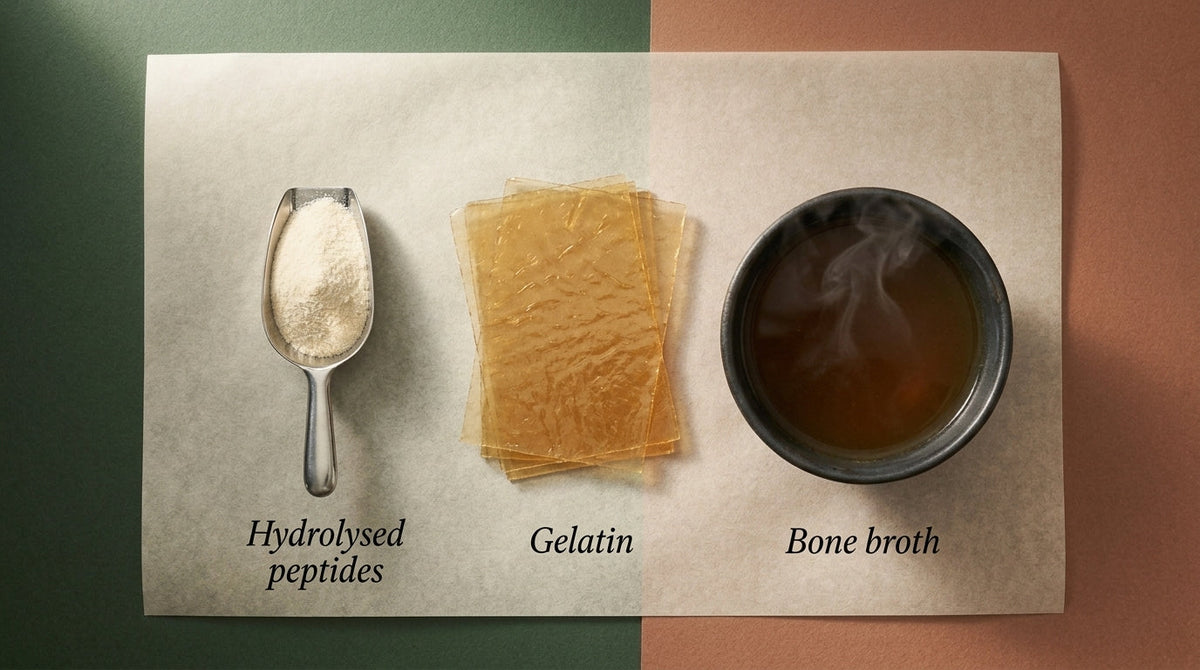
Cooking connective tissue in water partially unwinds the triple helix into gelatin — still a large molecule, typically 20–250 kDa, but water-soluble when warm and able to gel on cooling. Taking gelatin one step further, food manufacturers apply proteolytic enzymes that cut it into short peptide fragments of roughly 2–6 kDa. That final product is hydrolysed collagen, also called collagen peptides [1]. For the full explanation of what these peptides are, see what are hydrolysed collagen peptides? The naming question — hydrolysed collagen versus "collagen peptides" on a label — is a separate, purely semantic issue covered in hydrolysed collagen vs collagen peptides.
Why does molecular weight matter for digestion and absorption?
Human studies show that some hydroxyproline-containing peptides appear in blood after collagen hydrolysate or gelatin ingestion [2]. A 2024 crossover study found that source and molecular weight influence the circulating profile of some peptides [7]. This does not mean native collagen or gelatin produce no bioactive peptides, nor does it prove that the smallest average molecular weight gives the best clinical outcome. Hydrolysis mainly creates a soluble, standardized peptide mixture that is convenient to dose.
Is gelatin just unhydrolysed collagen peptides?
Gelatin is denatured collagen, whereas hydrolysed collagen is further enzymatically broken into smaller peptides. They overlap nutritionally but are not simply the same ingredient at different serving sizes. Gelatin gels on cooling; hydrolysed collagen is designed to remain soluble. A small exercise study used vitamin-C-enriched gelatin before loading and observed higher collagen-synthesis markers [4], but that mechanistic result does not establish that gelatin is clinically superior—or inferior—to hydrolysed collagen for tendon outcomes.
What about bone broth?
Bone broth is a food matrix with highly variable amino-acid and collagen-precursor content. Analytical work found that bone broth does not reliably provide the concentrations of collagen precursor amino acids delivered by standardized collagen supplements [6]. That makes it unsuitable for claiming a matched clinical-trial dose from a fixed number of cups. Enjoy it as food; do not assume it reproduces a standardized hydrolysate intervention.
What about undenatured type II collagen (UC-II)?
UC-II is the clearest exception to everything above, because it works through an entirely different mechanism and isn't hydrolysed at all. It's chicken-sternum-derived type II collagen kept in its native, undenatured structure, taken at roughly 40 mg per day — a milligram-scale dose, around 250 times smaller than a typical 10 g hydrolysed collagen serving.
UC-II is not intended as a gram-scale amino-acid source. Its proposed mechanism involves oral immune tolerance, in which intact Type II collagen epitopes interact with gut-associated immune tissue. Randomized trials in people with knee osteoarthritis report symptom improvements with UC-II [5], but the clinical mechanism is not fully established. This is a separate evidence base from hydrolysed-collagen trials, and the two should not be treated as the same ingredient at different doses.
Does heating or cooking destroy collagen's benefits?
Cooking denatures collagen and can convert it toward gelatin, while more extensive processing can also change peptide composition. Normal beverage temperatures do not make hydrolysed collagen unusable, but clinical trials have not defined a precise kitchen-temperature threshold at which efficacy is lost. The classic pre-exercise gelatin study [4] does not answer whether baking, prolonged heating or different meal contexts change long-term clinical outcomes.
Which form should you actually choose?
Hydrolysed collagen has the broadest supplement-trial literature across skin, joint and selected bone outcomes, but the effective preparation and dose cannot be reduced to one universal range. Gelatin is a food ingredient and has also been used experimentally around exercise. Bone broth is nutritionally variable and should not be treated as a fixed substitute for a standardized trial product. UC-II is a separate undenatured Type II ingredient studied at milligram doses for joint symptoms; it should not be dosed or interpreted like hydrolysed collagen.
What we still don't know
Direct head-to-head trials comparing hydrolysed collagen with gelatin or bone broth on the same clinical outcome are scarce. Pharmacokinetic differences should not be converted into a clinical efficacy ranking without outcome trials. We also lack standardized bone-broth dosing and adequately powered comparisons across processing states.
Related reading: see collagen vs gelatin vs bone broth, the dose guide, and the full HCP guide.
Bottom line
Native collagen, gelatin and hydrolysed collagen represent different processing states, and that processing changes solubility, molecular size and digestion. Human studies do not justify the simple rule that only hydrolysed collagen produces circulating peptides or that lower molecular weight automatically means better clinical outcomes. Bone broth is nutritionally variable and should not be treated as a standardized supplement dose. UC-II is a separate undenatured Type II ingredient with a different dose and evidence base.
Frequently asked questions
Is gelatin the same as hydrolysed collagen?
How much bone broth equals a typical collagen supplement dose?
Is UC-II just a smaller dose of hydrolysed collagen?
Does cooking or heat destroy collagen's benefits?
Which form of collagen should I actually buy?
Can I take gelatin and hydrolysed collagen together?
Sources & article history
Sources (7)
-
Hydrolyzed Collagen—Sources and Applications Molecules. 2019;24(22):4031.
-
Identification of food-derived collagen peptides in human blood after oral ingestion of gelatin hydrolysates Journal of Agricultural and Food Chemistry. 2005;53(16):6531–6536.
-
Oral ingestion of collagen hydrolysate leads to the transportation of highly concentrated Gly-Pro-Hyp and its hydrolyzed form of Pro-Hyp into the bloodstream and skin Journal of Agricultural and Food Chemistry. 2017;65(11):2315–2322.
-
Vitamin C–Enriched Gelatin Supplementation before Intermittent Activity Augments Collagen Synthesis American Journal of Clinical Nutrition. 2017;105(1):136-143.
-
Efficacy and Tolerability of an Undenatured Type II Collagen Supplement in Modulating Knee Osteoarthritis Symptoms: A Multicenter Randomized, Double-Blind, Placebo-Controlled Study Nutrition Journal. 2016;15:14.
-
Bone Broth Unlikely to Provide Reliable Concentrations of Collagen Precursors Compared With Supplemental Sources of Collagen Used in Collagen Research International Journal of Sport Nutrition and Exercise Metabolism. 2019;29(3):265–272.
-
Absorption of bioactive peptides following collagen hydrolysate intake: a randomized, double-blind crossover study in healthy individuals Frontiers in Nutrition. 2024;11:1416643.
Article history (2)
- Content refreshed for accuracy. Citations updated to reflect current research comparing hydrolysed and non-hydrolysed forms of collagen, including UC-II.
- Processing, gelatin, bone-broth and UC-II comparisons updated with human absorption evidence and clearer limits on cross-form efficacy claims.