Collagen vs Whey Protein: Muscle Growth & Recovery
Whey has stronger direct evidence for muscle protein synthesis; collagen has a separate, formulation-specific literature on connective tissue, joints, bone and skin. Here’s how they differ.
 By
Dr. Khaled Mahmoud, MBBCh
Critical Care Medicine, Longevity Science & Editorial Direction
By
Dr. Khaled Mahmoud, MBBCh
Critical Care Medicine, Longevity Science & Editorial Direction
 Reviewed by
Dr. Amr Yasser, PhD
Cardiometabolic, Musculoskeletal, Gut & Bioavailability
Reviewed by
Dr. Amr Yasser, PhD
Cardiometabolic, Musculoskeletal, Gut & Bioavailability
 Reviewed by
Dr. Abdulla Mostafa, PhD
Cellular Senescence, Neurological, Mitochondrial & Brain-Ageing Biology
Reviewed by
Dr. Abdulla Mostafa, PhD
Cellular Senescence, Neurological, Mitochondrial & Brain-Ageing Biology
- Published
- Last reviewed
- Reading time
- 5 min
- Sources cited
- 9
On this page
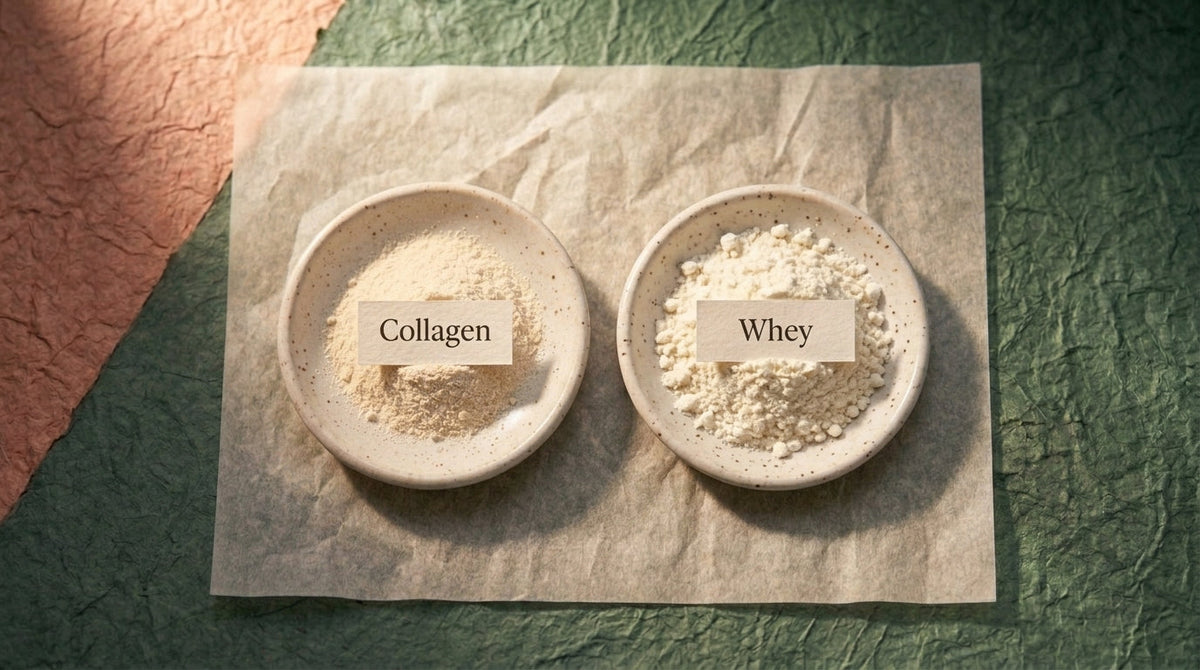
Whey and hydrolysed collagen have different amino-acid profiles and are studied for different outcomes. For myofibrillar muscle protein synthesis, whey has the stronger direct evidence. Collagen trials focus more often on connective tissue, joint symptoms, skin or selected training outcomes. That does not mean one universally 'wins' every outcome, and indirect cross-trial comparisons should not substitute for head-to-head evidence.
For building muscle: whey is the stronger tool
The clearest mechanistic evidence comes from a trial that measured muscle protein synthesis directly, using stable-isotope tracers, in 22 healthy older women. Over six days of supplementation — with each woman's legs compared rested versus exercised — whey protein significantly increased both the acute and the longer-term rate of new muscle protein being built, in both legs. Collagen, at a matched dose, produced no significant rise in the rested leg and only a small one in the exercised leg [1]. Whey also delivered nearly three times the peak blood leucine of collagen — leucine being the specific amino acid that triggers the cellular machinery behind muscle growth.
A 2024 randomized feeding trial in older men provides a second direct comparison: adding 50 g/day of whey or pea protein increased integrated myofibrillar protein synthesis above the protein RDA, while collagen did not [7]. Longer resistance-training studies sometimes report favourable body-composition or strength outcomes with collagen versus inert placebo. A 2026 network meta-analysis also produced favourable indirect collagen estimates, but the collagen evidence network was small and heterogeneous; it does not overturn direct anabolic comparisons [9]. For building contractile muscle, use a complete high-quality protein as the foundation.
For tendon and connective-tissue outcomes
Collagen-derived amino acids are relevant to connective-tissue synthesis, and several exercise studies report changes in tendon morphology or collagen-related biomarkers. A newer 2026 trial also found greater intramuscular Type I collagen after 15 g/day of a specific collagen peptide during resistance training [8]. These outcomes are distinct from contractile muscle protein synthesis and do not prove faster injury recovery or superiority to whey for whole-body training outcomes.
For joint comfort: collagen has indication-specific trials
A meta-analysis pooling five randomised placebo-controlled trials (519 people with osteoarthritis) found that collagen supplementation produced a significant improvement in overall joint symptom scores and pain versus placebo, though the individual pain subscore didn't reach significance on its own — a real but modest effect [4]. Whey has no equivalent trial base for joint symptoms specifically.
For bone density: collagen's territory again
A 12-month trial in postmenopausal women found that 5 g/day of a specific collagen peptide produced measurable bone density gains at the spine and hip compared with placebo, which lost density over the same period [5]. Whey has evidence for helping preserve lean mass in older adults, but not for directly improving bone mineral density at supplement doses — this is a different mechanism and a different evidence base.
For skin: also collagen's territory
A meta-analysis of 19 randomised trials (1,125 participants) found that oral collagen significantly improved skin hydration and elasticity compared with placebo, with benefits generally becoming apparent after around 8 to 12 weeks [6]. Whey has no comparable evidence base for skin outcomes specifically — general adequate protein intake supports skin health, but supplemental whey hasn't been shown to produce the specific effects collagen trials measure.
Practical differences beyond the biochemistry
Whey is typically the cheaper source of protein per gram delivered. It also has more flavour and usually needs a shake or smoothie to make it palatable, while collagen is close to flavourless and dissolves cleanly into almost anything, including hot coffee. Some people with lactose sensitivity find whey uncomfortable; collagen is dairy-free and generally very well tolerated (see our side effects article). Neither is vegan — whey is dairy-derived, collagen is animal-derived — so vegans need a plant protein blend for muscle goals; there's no functional vegan substitute for collagen's specific effects (see our vegan alternatives article).
How to use both together
For most readers with combined goals, the answer isn't choosing one — it's using both for what each is good at. Whey (or another complete, high-leucine protein) as your primary daily protein, dosed around your training and total protein target. Collagen at 5–15 g/day depending on your specific goal, timed before training if tendon synthesis is the aim, or at any convenient time otherwise — the two don't interfere with each other and can even be mixed into the same shake. See our dosage article for indication-specific amounts.
What we still don't know
Whether taking whey and collagen together at the same time changes how well either is absorbed hasn't been directly tested, though there's no clear mechanism why it would. Whether the mechanistic MPS gap between whey and collagen fully explains, or is fully overridden by, the functional body-composition results seen with training is still an open and genuinely interesting question. And whether specific collagen peptide profiles perform differently when stacked with whey hasn't been systematically studied.
Bottom line
Whey is better supported for stimulating myofibrillar muscle protein synthesis because it supplies all essential amino acids and substantially more leucine. Collagen has a different research base involving connective tissue, joint symptoms, skin, bone and some longer-term training outcomes. A network meta-analysis cannot substitute for an adequately dosed direct whey-versus-collagen trial. They can coexist in a diet, but collagen should not displace the complete protein needed to meet muscle-building targets.
Frequently asked questions
Is collagen or whey better for building muscle?
Can I take collagen instead of whey?
Can I mix collagen with whey?
Which is better for tendon injuries, collagen or whey?
Is collagen a complete protein like whey?
Which is cheaper per gram of protein?
Can vegans use collagen or whey?
Sources & article history
Sources (9)
-
Whey protein but not collagen peptides stimulate acute and longer-term muscle protein synthesis with and without resistance exercise in healthy older women: a randomized controlled trial The American Journal of Clinical Nutrition. 2020;111(3):708–718.
-
The Influence of Specific Bioactive Collagen Peptides on Body Composition and Muscle Strength in Middle-Aged, Untrained Men: A Randomized Controlled Trial International Journal of Environmental Research and Public Health. 2021;18(9):4837.
-
Vitamin C–Enriched Gelatin Supplementation before Intermittent Activity Augments Collagen Synthesis American Journal of Clinical Nutrition. 2017;105(1):136-143.
-
Effect of collagen supplementation on osteoarthritis symptoms: a meta-analysis of randomized placebo-controlled trials International Orthopaedics. 2019;43(3):531–538.
-
Specific Collagen Peptides Improve Bone Mineral Density and Bone Markers in Postmenopausal Women — A Randomized Controlled Study Nutrients. 2018;10(1):97.
-
Effects of Hydrolyzed Collagen Supplementation on Skin Aging: A Systematic Review and Meta-Analysis International Journal of Dermatology. 2021;60(12):1449-1461.
-
The effects of whey, pea, and collagen protein supplementation beyond the recommended dietary allowance on integrated myofibrillar protein synthetic rates in older males: a randomized controlled trial The American Journal of Clinical Nutrition. 2024;120(1):34–46.
-
Which Protein-Based Dietary Supplements Most Effectively Enhance Fat-Free Mass and Strength Gains in Healthy Adults Undergoing Resistance Training? A Network Meta-Analysis Translational Sports Medicine. 2026;2026:5557511.
-
Specific collagen peptides supplementation increases collagen type I content in skeletal muscle after 12 weeks of high-load resistance training: a randomized controlled trial Frontiers in Physiology. 2026;17:1839695.
Article history (2)
- Content refreshed for accuracy. Citations updated to reflect current research comparing collagen and whey across muscle, tendon, joint, bone and skin outcomes.
- Whey comparison updated with newer direct muscle-protein-synthesis and training evidence; indirect network comparisons are now clearly qualified.