Marine Collagen: Benefits, Source & Marine vs Bovine
Marine collagen is a fish-derived source, usually Type I. Human evidence does not establish that it is better absorbed or clinically superior to bovine collagen.
 By
Dr. Khaled Mahmoud, MBBCh
Critical Care Medicine, Longevity Science & Editorial Direction
By
Dr. Khaled Mahmoud, MBBCh
Critical Care Medicine, Longevity Science & Editorial Direction
 Reviewed by
Dr. Amr Yasser, PhD
Cardiometabolic, Musculoskeletal, Gut & Bioavailability
Reviewed by
Dr. Amr Yasser, PhD
Cardiometabolic, Musculoskeletal, Gut & Bioavailability
 Reviewed by
Dr. Abdulla Mostafa, PhD
Cellular Senescence, Neurological, Mitochondrial & Brain-Ageing Biology
Reviewed by
Dr. Abdulla Mostafa, PhD
Cellular Senescence, Neurological, Mitochondrial & Brain-Ageing Biology
- Published
- Last reviewed
- Reading time
- 4 min
- Sources cited
- 6
On this page
Marine collagen is collagen derived from fish, commonly skin, scales or bones, and most oral marine-collagen supplements are sold as hydrolysed Type I collagen peptides. It is often marketed as better absorbed or better for skin than bovine collagen, but current human evidence does not establish a universal marine advantage. Source, peptide preparation, dose, allergy profile and product quality all matter.
What is marine collagen?
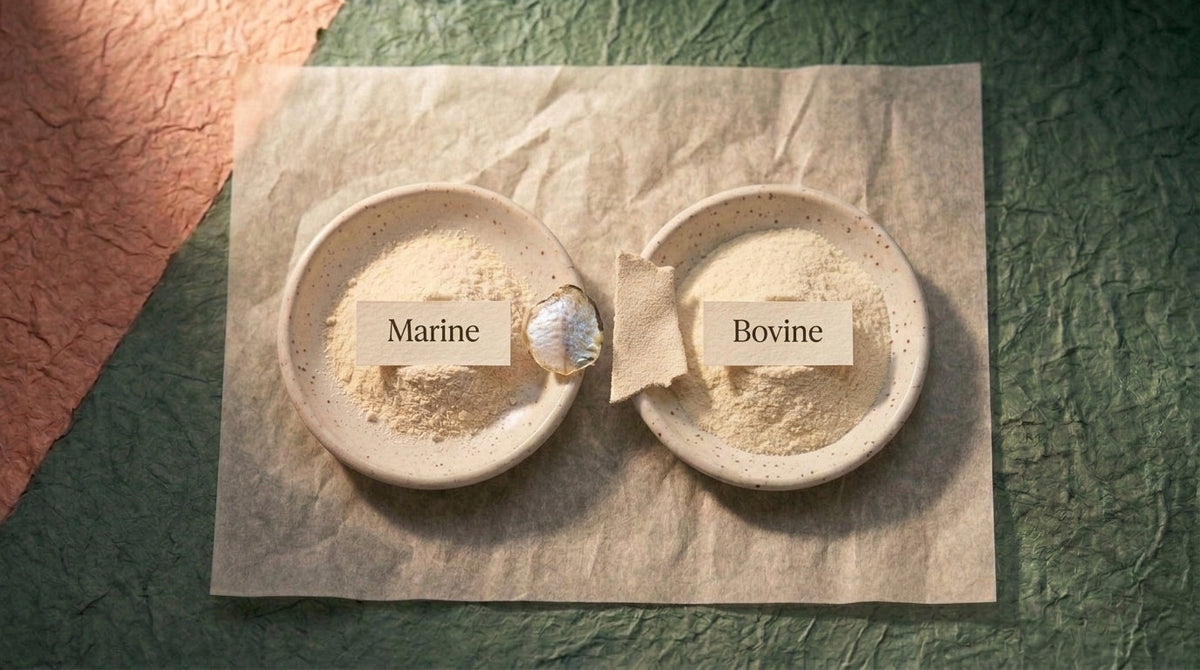
Marine collagen is usually extracted from fish-processing byproducts such as skin, scales or bones. After hydrolysis, the resulting powder contains a mixture of smaller collagen-derived peptides. Marine products are typically rich in Type I collagen, but “marine” does not describe a single standardized peptide profile: fish species, raw material and processing all vary.
Bovine collagen is commonly derived from cattle hide and usually supplies Type I and III collagen peptides after hydrolysis. Porcine products are commonly derived from pig skin. These source labels describe raw material; they do not by themselves tell you which finished supplement will produce the best clinical result.
What are the potential benefits of marine collagen?
Most benefit claims made for marine collagen come from the broader oral-collagen literature rather than from trials proving that fish-derived collagen is uniquely effective. Skin meta-analyses include marine, bovine and porcine preparations and report pooled improvements in some hydration, elasticity or wrinkle outcomes, but source subgrouping has not established a clinically superior species [1] [2].
For joints and bone, marine collagen is much less represented. Osteoarthritis reviews draw heavily from non-marine preparations [4], while a prominent 12-month bone-density trial used a specific non-marine collagen-peptide preparation [5]. That is an evidence gap, not proof that marine collagen cannot work.
Does marine collagen absorb better than bovine collagen?
No clinical evidence establishes a simple “marine absorbs better” rule. A 2024 randomized crossover study directly compared fish, porcine and bovine hydrolysates and found that source and molecular-weight distribution changed some circulating peptide profiles, while free hydroxyproline exposure was broadly comparable [6]. Pharmacokinetic differences do not establish superior skin, joint or bone outcomes.
How does marine collagen compare with bovine collagen?
Bovine collagen
Bovine collagen commonly supplies Type I and III peptides and is widely used in commercial powders and human trials. Grass-fed or pasture-raised sourcing may matter for personal, welfare or traceability reasons, but it has not been shown to improve clinical efficacy.
Marine collagen
Marine collagen is commonly fish-derived and predominantly Type I. It may fit pescatarian preferences and avoids bovine or porcine raw materials, but people with fish allergy need source-specific caution.
Porcine collagen
Porcine collagen appears in some clinical studies and commercial products. Religious and dietary restrictions are often the clearest practical difference.
Does source change clinical results?
We do not have a sufficiently powered head-to-head trial in which people are randomized to matched marine and bovine products for the same clinical endpoint. Cross-trial subgroup analyses are indirect because products differ in dose, peptide specification, study population and outcome measures. The safest conclusion is that source has not been shown to determine a universal efficacy hierarchy.
What should actually drive your choice?
Allergies
If you have a confirmed fish allergy, avoid fish-derived marine collagen unless your allergy specialist advises otherwise. Shellfish allergy is distinct from fish allergy and does not automatically imply fish-collagen allergy, although cross-contact and the exact raw material should be checked. People with alpha-gal syndrome or other significant food allergies should choose a source with their allergy history in mind rather than relying on a generic “marine is safer” rule. See our side effects article.
Ethical and religious considerations
Kosher-certified bovine and marine collagen both exist; halal-certified bovine is common. Porcine is excluded from both. Pescatarians typically prefer marine. If you avoid animal products altogether, neither source works for you — see our vegan alternatives article instead.
Environmental factors
Environmental impact depends on the raw material, whether a byproduct stream is used, processing, transport and supply-chain practices. A species label alone is not enough to establish a lower environmental footprint; use traceability or credible sourcing certifications where these factors matter to you.
Cost
Price varies by market, serving size, processing, certification and brand. Compare current cost per gram and do not treat a marine premium—or a low bovine price—as evidence of better or worse efficacy.
Taste
Taste and odour depend heavily on processing and flavouring. Source alone does not reliably predict palatability, so this is best judged from the specific product rather than used as a scientific source comparison.
What matters more than source
Product-level details matter more than a simple species hierarchy. Useful specifications include the actual source, serving size, peptide or molecular-weight characterization, ingredient simplicity and batch-specific testing documentation when available. Lower molecular weight can alter pharmacokinetics, but no generic 2–3 kDa cutoff has demonstrated superior clinical outcomes. Contaminant risk depends on raw material and quality control rather than a rule that one species is inherently “cleaner.” See our buyer's guide.
Can you switch between them?
If you have no source-specific allergy or dietary restriction, switching products is mainly a practical choice. The peptide profiles and doses may differ, so clinical equivalence should not be assumed; if you are trying to reproduce a particular study, use a preparation that meaningfully matches that study.
What we still don't know
Whether specific fish species used in marine collagen affect the peptide profile or clinical results hasn't been well studied — most trials don't specify species. Whether marine collagen would perform as well as bovine and porcine specifically for joint outcomes is genuinely untested, simply because it hasn't been included in the joint trials run so far. And whether grass-fed versus conventional bovine sourcing changes the bioactive peptide profile at all hasn't been systematically studied either.
Bottom line
Marine collagen is a legitimate hydrolysed-collagen source, but “marine” is not an efficacy guarantee. Human evidence supports evaluating the exact peptide preparation rather than assuming fish collagen is better absorbed or more effective than bovine collagen. Choose primarily around allergy, dietary or religious preference, source traceability, dose, price and product-quality documentation.
Frequently asked questions
Is marine collagen better than bovine collagen?
Does marine collagen absorb better than bovine collagen?
Which collagen source is best for joints?
Can I take marine collagen if I have a fish allergy?
Is bovine collagen safe for people with alpha-gal syndrome?
What is marine collagen?
Can I switch between marine and bovine collagen?
Sources & article history
Sources (6)
-
Effects of Oral Collagen for Skin Anti-Aging: A Systematic Review and Meta-Analysis Nutrients. 2023;15(9):2080.
-
Effects of Hydrolyzed Collagen Supplementation on Skin Aging: A Systematic Review and Meta-Analysis International Journal of Dermatology. 2021;60(12):1449-1461.
-
Hydrolyzed Collagen—Sources and Applications Molecules. 2019;24(22):4031.
-
Effect of collagen supplementation on osteoarthritis symptoms: a meta-analysis of randomized placebo-controlled trials International Orthopaedics. 2019;43(3):531–538.
-
Specific Collagen Peptides Improve Bone Mineral Density and Bone Markers in Postmenopausal Women — A Randomized Controlled Study Nutrients. 2018;10(1):97.
-
Absorption of bioactive peptides following collagen hydrolysate intake: a randomized, double-blind crossover study in healthy individuals Frontiers in Nutrition. 2024;11:1416643.
Article history (2)
- Content refreshed for accuracy. Citations updated to reflect current research comparing marine, bovine and porcine collagen sources across skin, joint and bone outcomes.
- Marine-versus-bovine comparison updated with 2024 human pharmacokinetic evidence and clearer limits on source-equivalence claims.