Hydrolysed Collagen vs Collagen Peptides: Are They the Same Thing?
Hydrolysed collagen and collagen peptides usually name the same broad supplement category, but source, peptide profile, molecular weight and dose can still differ.
 By
Dr. Khaled Mahmoud, MBBCh
Critical Care Medicine, Longevity Science & Editorial Direction
By
Dr. Khaled Mahmoud, MBBCh
Critical Care Medicine, Longevity Science & Editorial Direction
 Reviewed by
Dr. Amr Yasser, PhD
Cardiometabolic, Musculoskeletal, Gut & Bioavailability
Reviewed by
Dr. Amr Yasser, PhD
Cardiometabolic, Musculoskeletal, Gut & Bioavailability
 Reviewed by
Dr. Abdulla Mostafa, PhD
Cellular Senescence, Neurological, Mitochondrial & Brain-Ageing Biology
Reviewed by
Dr. Abdulla Mostafa, PhD
Cellular Senescence, Neurological, Mitochondrial & Brain-Ageing Biology
- Published
- Last reviewed
- Reading time
- 6 min
- Sources cited
- 7
On this page
Hydrolysed collagen, collagen peptides and collagen hydrolysate are usually different names for the same supplement category: collagen that has been broken into a smaller peptide mixture by hydrolysis. In US English, you will usually see hydrolyzed collagen. The wording on the front label does not prove that two products have the same source, peptide profile, dose or clinical evidence [1].
Are hydrolysed collagen and collagen peptides the same thing?
In ordinary supplement use, yes. Research papers and commercial labels use “hydrolysed collagen,” “hydrolyzed collagen,” “collagen hydrolysate” and “collagen peptides” for overlapping hydrolysed-collagen preparations. The important qualification is that these are category names, not a standardized recipe. One commercial hydrolysate can differ substantially from another in raw material, enzyme processing, molecular-weight distribution and peptide sequence.
That is why a clinical trial of one named peptide preparation should not automatically be treated as proof for every tub labelled “collagen peptides.” See our guide to what hydrolysed collagen peptides are for the underlying chemistry.
Can products with the same name still be different?
Yes. A 2024 randomized crossover study compared fish-, porcine- and bovine-derived hydrolysates and also compared bovine preparations with different molecular-weight distributions. Source and molecular weight changed some circulating collagen-derived peptide profiles [6]. That demonstrates product-level pharmacokinetic differences; it does not establish that the smallest peptides or any one animal source produce better skin, joint or bone outcomes.
Useful product descriptors therefore include the source, serving size, ingredient list and any peptide characterization the manufacturer provides. Molecular-weight disclosure can improve transparency, but there is no clinically validated universal “best” kDa range.
Are collagen peptides absorbed intact?
Most ingested collagen is digested into amino acids and smaller peptides. Human studies also detect hydroxyproline-containing peptides such as Pro-Hyp in blood after ingestion [3]. Other human work has detected collagen-derived peptides after oral intake as well [4].
This supports oral bioavailability, but absorption is not the same as clinical efficacy. A product producing a different plasma peptide profile has not thereby been shown to improve wrinkles, joint pain or bone density more effectively.
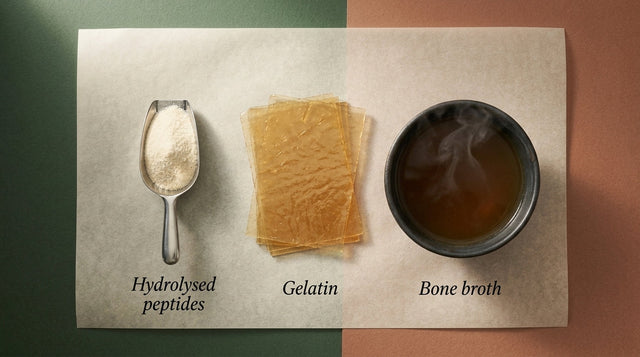
What products are genuinely different from hydrolysed collagen peptides?
Gelatin
Gelatin is denatured collagen that has not been hydrolysed to the same extent as a typical collagen-peptide powder. It behaves differently in food because it can gel on cooling. Human and experimental studies show that gelatin can still provide collagen-derived amino acids and peptides, so it should not be dismissed as biologically inactive. See our hydrolysed vs non-hydrolysed collagen guide.
Bone broth
Bone broth is a food rather than a standardized supplement. Analytical research found substantial variability in collagen-precursor amino acids across broth samples and concluded that bone broth does not reliably reproduce the concentrations delivered by standardized collagen supplements used in research [7]. It therefore makes little sense to convert a supplement dose into a fixed number of cups of broth.
Undenatured Type II collagen
Undenatured Type II collagen, often sold as UC-II, is a separate milligram-dose ingredient with its own knee-osteoarthritis evidence base. Its proposed mechanism involves oral immune tolerance rather than simply supplying gram-scale collagen peptides. It should not be dosed or interpreted as if it were hydrolysed collagen.
Does “low molecular weight” mean better collagen?
Not necessarily. In vitro and pharmacokinetic research shows that peptide size can change digestion or circulating peptide profiles [5] [6]. We do not have convincing human outcome trials showing that a generic 2–3 kDa powder consistently produces better skin, joint or bone results than a larger hydrolysate.
Use molecular weight as a characterization field, not as a shortcut to efficacy.
What should you compare when buying collagen peptides?
Start with the exact source and serving, the simplicity of the ingredient list, allergen information, cost per gram and testing documentation you can inspect. If a manufacturer publishes a molecular-weight distribution or named peptide specification, that can make the product easier to compare with a study, but absence of that number does not prove the product is poor quality.
For the commercial decision rather than the terminology question, use our best collagen supplements and peptides guide.
Bottom line
Hydrolysed collagen, hydrolyzed collagen, collagen hydrolysate and collagen peptides usually refer to the same broad supplement category. The name itself does not establish dose, peptide profile, source, quality or efficacy. Compare the actual formulation and the evidence for that preparation rather than treating label terminology as a biological difference.
Frequently asked questions
Are collagen peptides better than hydrolysed collagen?
What's the difference between collagen peptides and collagen hydrolysate?
Is hydrolysed collagen better absorbed than regular collagen peptides?
Which type of collagen peptides is best?
Are all collagen peptides the same?
Should I look for "low molecular weight" collagen peptides?
Sources & article history
Sources (7)
-
Hydrolyzed Collagen—Sources and Applications Molecules. 2019;24(22):4031.
-
Effects of Oral Collagen for Skin Anti-Aging: A Systematic Review and Meta-Analysis Nutrients. 2023;15(9):2080.
-
Identification of food-derived collagen peptides in human blood after oral ingestion of gelatin hydrolysates Journal of Agricultural and Food Chemistry. 2005;53(16):6531–6536.
-
Oral ingestion of collagen hydrolysate leads to the transportation of highly concentrated Gly-Pro-Hyp and its hydrolyzed form of Pro-Hyp into the bloodstream and skin Journal of Agricultural and Food Chemistry. 2017;65(11):2315–2322.
-
Assessment of bioavailability after in vitro digestion and first pass metabolism of bioactive peptides from collagen hydrolysates Current Issues in Molecular Biology. 2021;43(3):1592–1605.
-
Absorption of bioactive peptides following collagen hydrolysate intake: a randomized, double-blind crossover study in healthy individuals Frontiers in Nutrition. 2024;11:1416643.
-
Bone Broth Unlikely to Provide Reliable Concentrations of Collagen Precursors Compared With Supplemental Sources of Collagen Used in Collagen Research International Journal of Sport Nutrition and Exercise Metabolism. 2019;29(3):265–272.
Article history (2)
- Content refreshed for accuracy. Citations updated to reflect current research comparing hydrolysed collagen and collagen peptides.
- Terminology and product-specification guidance updated; clinical evidence is now clearly separated from label naming and molecular-weight marketing.