Collagen vs Gelatin vs Bone Broth: What's the Difference?
Collagen peptides, gelatin and bone broth differ in processing, standardisation and trial evidence. Here’s when those differences matter and where comparisons remain uncertain.
 By
Dr. Khaled Mahmoud, MBBCh
Critical Care Medicine, Longevity Science & Editorial Direction
By
Dr. Khaled Mahmoud, MBBCh
Critical Care Medicine, Longevity Science & Editorial Direction
 Reviewed by
Dr. Amr Yasser, PhD
Cardiometabolic, Musculoskeletal, Gut & Bioavailability
Reviewed by
Dr. Amr Yasser, PhD
Cardiometabolic, Musculoskeletal, Gut & Bioavailability
 Reviewed by
Dr. Abdulla Mostafa, PhD
Cellular Senescence, Neurological, Mitochondrial & Brain-Ageing Biology
Reviewed by
Dr. Abdulla Mostafa, PhD
Cellular Senescence, Neurological, Mitochondrial & Brain-Ageing Biology
- Published
- Last reviewed
- Reading time
- 4 min
- Sources cited
- 7
On this page
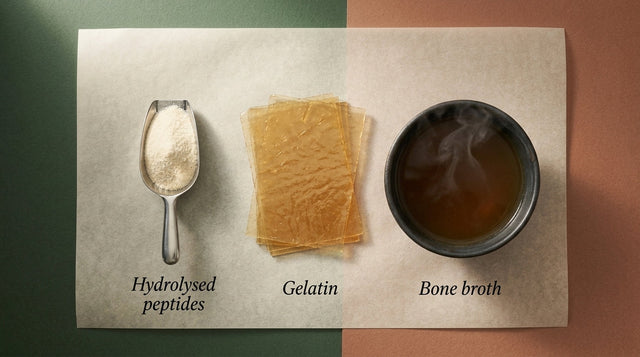
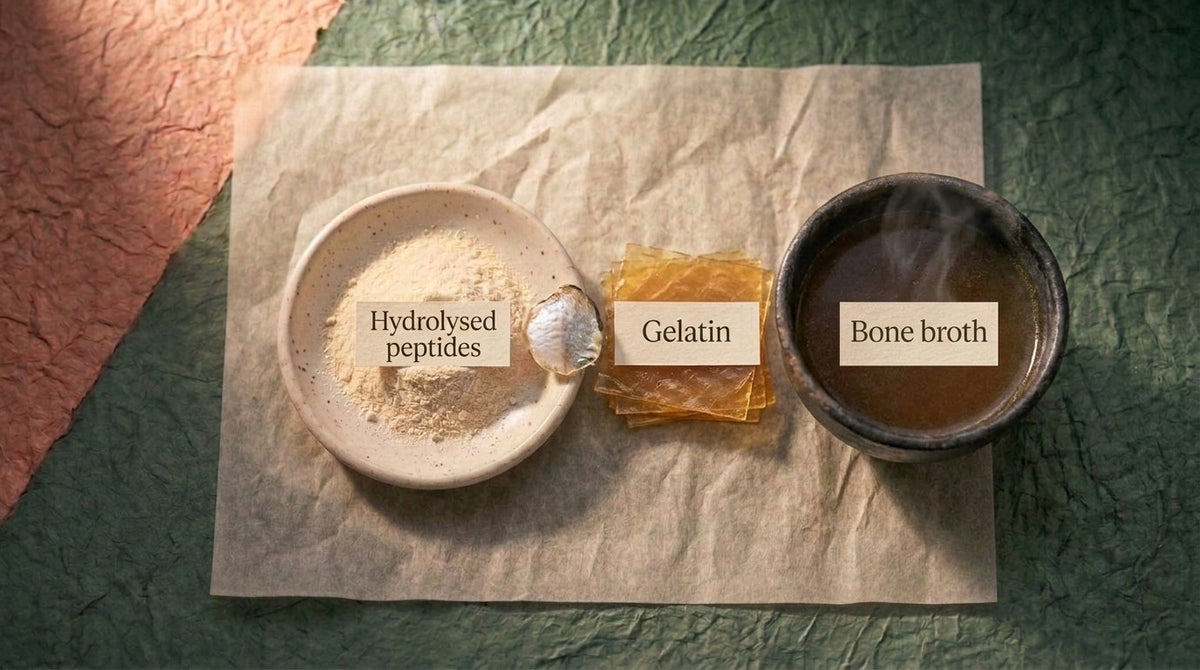
Hydrolysed collagen, gelatin and bone broth all originate from collagen-rich animal tissues, but they are not interchangeable products. Heat, extraction and enzymatic hydrolysis change protein structure, peptide size, solubility and dose consistency. Those differences affect how each behaves in food and after digestion, but they do not support a simple rule that one form is always “absorbed” and the others are not.
What's the difference between them?
Collagen in food
Native collagen is a large triple-helical structural protein found in skin, bone, tendon and other connective tissues. Cooking denatures part of that structure and digestion breaks collagen proteins into amino acids and peptides. Human clinical evidence for fixed-dose supplement outcomes generally comes from standardized products rather than from ordinary servings of collagen-containing foods [1].
Gelatin
Gelatin is denatured collagen produced by partial hydrolysis, usually using heat plus acid or alkali processing. It dissolves in hot water and can form a gel as it cools. After ingestion it is digested further, and human studies show that collagen/gelatin ingestion can produce circulating hydroxyproline-containing peptides; gelatin should not be described as biologically inert or unable to generate those fragments [2].
Hydrolysed collagen peptides
Hydrolysed collagen undergoes additional enzymatic processing to produce a smaller, more soluble peptide mixture that does not gel in the same way. Most of the oral dose is still digested, while a smaller fraction of hydroxyproline-containing peptides can be detected in blood. A 2024 human crossover study also showed that source and molecular-weight distribution can change the circulating peptide profile, without proving that the smallest peptides produce the best clinical outcome [5].
How can you tell gelatin and hydrolysed collagen apart in the kitchen?
The easiest practical distinction is functionality: gelatin normally forms a gel when dissolved hot and chilled, whereas a typical hydrolysed collagen powder remains liquid. That can help distinguish the categories, but it is not a laboratory test of molecular weight, purity or product quality.
Can bone broth replace a standardized collagen supplement?
Not on a dose-for-dose evidence basis. Bone broth is a food with highly variable amino-acid and collagen-precursor content. An analytical study comparing bone broths with collagen supplements found that broth did not reliably provide the concentrations of key collagen precursor amino acids supplied by standardized supplemental sources [3]. That is the useful conclusion; there is no defensible universal “grams of collagen per cup” figure because recipes, bones, water volume and cooking conditions vary substantially.
Bone broth can still be a nutritious food if it fits your diet. It simply should not be presented as clinically equivalent to a characterized peptide preparation used at a fixed dose in a trial.
Is gelatin better for pre-exercise tendon work?
A frequently cited randomized crossover study used vitamin-C-enriched gelatin before intermittent exercise and found a dose-related increase in a circulating collagen-synthesis marker plus effects in an engineered-ligament assay [4]. That study directly supports the protocol it tested, but it did not prove faster tendon healing, fewer injuries, or superiority of gelatin over hydrolysed collagen.
More recent training studies use hydrolysed collagen or specific collagen peptides with varied doses and timing, and a 2024 meta-analysis found small-to-moderate signals across some musculotendinous outcomes while emphasizing heterogeneous protocols [6]. A 2025 trial also reported patellar-tendon adaptations using hydrolysed collagen after exercise rather than the classic pre-exercise gelatin schedule [7]. The evidence therefore does not support saying gelatin universally “beats” hydrolysed collagen for tendons.
When does each form make sense?
Hydrolysed collagen: useful when you want a soluble, standardized supplement with a clearly stated serving and want to compare the product with trials of similar hydrolysed preparations.
Gelatin: useful as a food ingredient for gelling and as the exact preparation used in some exercise-mechanism research. It is not automatically inferior or superior as a health intervention.
Bone broth: useful as food, but its nutrient and collagen-precursor content is too variable to treat a cup as a fixed clinical dose.
Can you make hydrolysed collagen at home?
Not in the standardized sense used for commercial peptide powders. Slow cooking can denature collagen into gelatin, but controlled enzymatic hydrolysis is needed to manufacture a reproducible low-molecular-weight peptide profile. Home cooking cannot verify molecular-weight distribution or dose consistency.
What we still don't know
There are few rigorous head-to-head clinical trials that match gelatin and hydrolysed collagen for dose, amino-acid content and exercise or musculoskeletal outcomes. We also do not know whether a particular molecular-weight distribution consistently produces better long-term clinical results. Bone broth remains especially difficult to compare because its composition varies so widely.
Related reading: hydrolysed vs non-hydrolysed collagen, how to take collagen peptides, and the complete HCP guide.
Bottom line
Collagen-rich foods, gelatin and hydrolysed collagen are related, but processing changes their structure, culinary behavior and dose consistency. Hydrolysed collagen is convenient for matching a standardized supplement protocol; gelatin has direct evidence in a classic pre-exercise mechanistic study; and bone broth is a variable food rather than a fixed-dose substitute. None of that proves a universal hierarchy of “best absorbed” or “most effective.” See our hydrolysed vs non-hydrolysed collagen guide for the broader processing comparison.
Frequently asked questions
Is bone broth as good as a collagen supplement?
Is gelatin the same as collagen?
Can I make my own hydrolysed collagen at home?
Which is best for tendon repair, gelatin or hydrolysed collagen?
Is bone broth healthier than collagen powder?
Does gelatin contain the same peptides as hydrolysed collagen?
Does cooked chicken skin give me collagen?
Sources & article history
Sources (7)
-
Hydrolyzed Collagen—Sources and Applications Molecules. 2019;24(22):4031.
-
Identification of food-derived collagen peptides in human blood after oral ingestion of gelatin hydrolysates Journal of Agricultural and Food Chemistry. 2005;53(16):6531–6536.
-
Bone Broth Unlikely to Provide Reliable Concentrations of Collagen Precursors Compared With Supplemental Sources of Collagen Used in Collagen Research International Journal of Sport Nutrition and Exercise Metabolism. 2019;29(3):265–272.
-
Vitamin C–Enriched Gelatin Supplementation before Intermittent Activity Augments Collagen Synthesis American Journal of Clinical Nutrition. 2017;105(1):136-143.
-
Absorption of bioactive peptides following collagen hydrolysate intake: a randomized, double-blind crossover study in healthy individuals Frontiers in Nutrition. 2024;11:1416643.
-
Impact of Collagen Peptide Supplementation in Combination with Long-Term Physical Training on Strength, Musculotendinous Remodeling, Functional Recovery, and Body Composition in Healthy Adults: A Systematic Review with Meta-analysis Sports Medicine. 2024;54(11):2865–2888.
-
Hydrolysed Collagen Supplementation Enhances Patellar Tendon Adaptations to 12 Weeks' Resistance Training in Middle-Aged Men European Journal of Sport Science. 2025;25(4):e12281.
Article history (2)
- Content refreshed for accuracy. Citations updated to reflect current research comparing hydrolysed collagen, gelatin and bone broth.
- Gelatin and bone-broth comparison updated with direct human peptide evidence, variable broth composition and newer tendon studies.