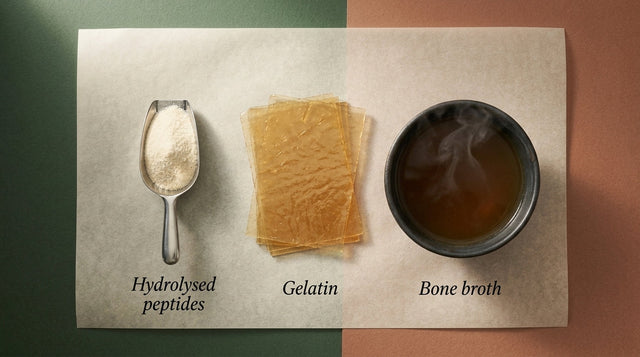
Collagen for Skin: Do Hydrolysed Collagen Peptides Help?
Several trials report improvements in skin hydration, elasticity or wrinkles, but newer funding- and quality-sensitive reviews lower confidence. Here’s the full evidence.
 By
Dr. Khaled Mahmoud, MBBCh
Critical Care Medicine, Longevity Science & Editorial Direction
By
Dr. Khaled Mahmoud, MBBCh
Critical Care Medicine, Longevity Science & Editorial Direction
 Reviewed by
Dr. Amr Yasser, PhD
Cardiometabolic, Musculoskeletal, Gut & Bioavailability
Reviewed by
Dr. Amr Yasser, PhD
Cardiometabolic, Musculoskeletal, Gut & Bioavailability
 Reviewed by
Dr. Abdulla Mostafa, PhD
Cellular Senescence, Neurological, Mitochondrial & Brain-Ageing Biology
Reviewed by
Dr. Abdulla Mostafa, PhD
Cellular Senescence, Neurological, Mitochondrial & Brain-Ageing Biology
- Published
- Last reviewed
- Reading time
- 6 min
- Sources cited
- 13

On this page
Hydrolysed collagen has produced improvements in skin hydration, elasticity and some wrinkle measures in several trials, generally over 8–12 weeks. The size and reliability of those benefits are uncertain: newer analyses find that results weaken or disappear when funding and trial quality are taken into account. It may be an optional addition to proven skincare, not a substitute for sun protection or prescribed treatment.
What does the trial evidence actually show?
The 2021 de Miranda meta-analysis pooled 19 randomised trials involving 1,125 participants and found favourable average skin outcomes [1]. A 2023 meta-analysis by Pu and colleagues included 26 trials and 1,721 participants and also reported improvements in hydration and elasticity [2]. These reviews overlap in their underlying trials: their participant counts must not be added together.
The important counterevidence: a 2025 meta-analysis of 23 trials (1,474 participants) found favourable results overall, but not in the non-industry-funded or higher-quality subgroups [8]. A 2026 systematic review found positive results in many individual trials but judged most included trials to be at high risk of bias [9]. Another 2026 updated meta-analysis reported favourable pooled hydration and elasticity results, although pooling more trials does not by itself resolve the underlying quality concerns [10]. Taken together, the evidence supports a possible modest effect, not a guaranteed skin improvement.
Human pharmacokinetic research shows that some hydroxyproline-containing peptides appear in blood after collagen ingestion [3]. Cell and animal studies suggest possible signalling effects on fibroblasts. Absorption is not proof that the same signalling mechanism produces meaningful skin changes in people, and collagen also supplies amino acids that the body can use elsewhere. See our explanation of collagen absorption.
What do newer individual trials add?
A 2025 double-blind trial tested 5 g/day of bioactive collagen peptides for 12 weeks followed by a four-week washout. It reported improvements in hydration, transepidermal water loss and dermal density versus placebo, with some effects persisting after supplementation stopped. Three authors were employees of Shanghai Meifute Biotechnology, so this is useful but not independent evidence [11].
An August 2026 RCT randomized 140 Thai adults to HYCOS or placebo. HYCOS contained 5 g hydrolysed collagen, 250 mg glutathione and 11.5 mg vitamin E. Some elasticity and crow's-feet roughness measures improved versus placebo, while hydration did not; because three active ingredients were combined, the trial cannot establish a collagen-specific effect. The trial was funded in part by Blackmores Institute [12].
A separate 2024 three-arm RCT compared 5 g hydrolysed collagen + 80 mg vitamin C with the same formulation plus 30 mg hyaluronic acid and with placebo. Both active arms improved some dermal-density, texture and wrinkle measures, but neither improved hydration or elasticity versus placebo, and adding HA did not produce a superior effect [13]. This is useful negative evidence against assuming that every collagen combination improves every skin endpoint.
What happens to skin hydration?
A randomised trial of low-molecular-weight collagen peptides found hydration rose significantly from baseline by 6 and 12 weeks, with the between-group gain over seven times greater than placebo at 6 weeks [4]. Separately, ex vivo and clinical trial evidence links oral collagen peptide supplementation to measurable changes in the dermal collagen network alongside improved skin moisture [5]. Subjectively, this tends to feel like slightly less tightness after cleansing rather than a dramatic change — it won't replace a moisturiser.
What happens to skin elasticity?
In a placebo-controlled trial using an 8-week course of a specific bioactive collagen peptide, both 2.5 g/day and 5 g/day groups showed favourable elasticity findings versus placebo [6]. The study did not establish a general rule that 2.5 g of any collagen product is equivalent to 5 g, and its post-treatment observations do not prove how long effects persist with other preparations. Skin roughness did not improve significantly in that trial.
What happens to wrinkles?
A separate 114-woman trial of a specific 2.5 g/day peptide reported lower eye-area wrinkle volume versus placebo after 4 and 8 weeks [7]. A biopsy subgroup also showed higher procollagen I and elastin markers, which is consistent with a dermal biological response but does not establish that every collagen powder produces the same structural effect. The LMWCP trial above also reported improvement in visual crow's-feet grading and instrumental wrinkle parameters by 12 weeks [4].
What doesn't improve
Loose skin from significant weight loss, deep-set wrinkles from years of sun damage, cellulite and stretch marks all have weak-to-no supporting evidence from collagen trials. Marketing sometimes implies otherwise; the trial evidence doesn't back it.
What dose and duration should you use?
Skin trials use different named preparations across roughly 1–10 g/day, with many studies lasting about 8–12 weeks. These are studied protocols rather than a validated dose-response rule. A low dose that worked for one proprietary peptide should not be assumed equivalent to the same gram amount of another powder. If you choose to trial collagen for skin, match the serving as closely as practical to the preparation and outcome you are relying on and reassess after the study-like timeframe. See the dosage article.
Where does collagen sit in the skin-lever stack?
An evidence-based skin-ageing plan starts with measures whose benefits are established independently of collagen: regular broad-spectrum sun protection, avoiding smoking and, where appropriate, evidence-based topical treatment such as a retinoid under suitable guidance. Oral collagen sits in a lower-certainty adjunctive category. Trials have not established that adding it to an already effective skincare regimen reliably produces a clinically meaningful additional benefit.
Should you stack it with vitamin C or hyaluronic acid?
Vitamin C is required for normal collagen synthesis, but extra vitamin C has not been shown necessary when intake is already adequate. Oral hyaluronic acid has its own controlled skin studies, but a 2024 three-arm trial found no added benefit from 30 mg HA when it was added to 5 g collagen plus 80 mg vitamin C on the outcomes measured [13]. Do not assume that combining collagen, vitamin C and HA creates a synergistic skin effect. See the stacking article.
Who does this actually help?
The trials do not identify a reliable “best responder” profile. Many studies enroll middle-aged women, so evidence is strongest descriptively in populations similar to those participants, but that is not proof that age 40 or 50 is a biological threshold. Collagen is more defensible as an optional adjunct for someone with realistic expectations than as a substitute for established skincare or a treatment for loose skin, deep photoageing, cellulite or stretch marks.
What we still don't know
Funding- and quality-sensitive analysis has already challenged the positive pooled results [8]. The outstanding question is whether independently funded, adequately blinded trials of well-characterised preparations can reproduce clinically meaningful benefits. We also lack convincing head-to-head evidence that one collagen source or molecular-weight range delivers better clinical outcomes, or that any benefit persists over years.
Buying for this goal? Our best collagen for skin guide explains how to compare source, serving, testing documentation and molecular-weight claims without assuming that a “beauty” label makes a product more effective.
Bottom line
Several trials report improved hydration, elasticity or wrinkle measures over 8–12 weeks, but confidence falls when study quality and funding are considered. Oral collagen is an optional adjunct with uncertain clinical benefit, not a substitute for daily sun protection or dermatology treatments. Specific branded peptides tested in trials are not proof of equivalent effects from every bovine or marine collagen powder. Read the full collagen guide for other indications and the limitations of the evidence.
Frequently asked questions
How much collagen should I take for skin?
How long until I see results?
Is marine collagen better than bovine for skin?
Does hydrolysed collagen help with loose skin after weight loss?
Can hydrolysed collagen replace my retinoid?
Do I need vitamin C alongside collagen?
Are collagen peptides and hydrolysed collagen the same thing for skin?
Sources & article history
Sources (13)
-
Effects of Hydrolyzed Collagen Supplementation on Skin Aging: A Systematic Review and Meta-Analysis International Journal of Dermatology. 2021;60(12):1449-1461.
-
Effects of Oral Collagen for Skin Anti-Aging: A Systematic Review and Meta-Analysis Nutrients. 2023;15(9):2080.
-
Identification of food-derived collagen peptides in human blood after oral ingestion of gelatin hydrolysates Journal of Agricultural and Food Chemistry. 2005;53(16):6531–6536.
-
Oral Intake of Low-Molecular-Weight Collagen Peptide Improves Hydration, Elasticity, and Wrinkling in Human Skin: A Randomized, Double-Blind, Placebo-Controlled Study Nutrients. 2018;10(7):826.
-
The Effect of Oral Collagen Peptide Supplementation on Skin Moisture and the Dermal Collagen Network: Evidence from an Ex Vivo Model and Randomized, Placebo-Controlled Clinical Trials Journal of Cosmetic Dermatology. 2015;14(4):291-301.
-
Oral supplementation of specific collagen peptides has beneficial effects on human skin physiology: a double-blind, placebo-controlled study Skin Pharmacology and Physiology. 2014;27(1):47–55.
-
Oral intake of specific bioactive collagen peptides reduces skin wrinkles and increases dermal matrix synthesis Skin Pharmacology and Physiology. 2014;27(3):113–119.
-
Effects of Collagen Supplements on Skin Aging: A Systematic Review and Meta-Analysis of Randomized Controlled Trials The American Journal of Medicine. 2025;138(9):1264–1277.
-
Efficacy and safety of hydrolyzed collagen supplementation on skin health outcomes: a systematic literature review of randomized controlled trials European Journal of Clinical Nutrition. 2026;80(9):867–885.
-
Oral Collagen Peptides and Skin Rejuvenation: A Systematic Review and an Updated Meta-Analysis of Randomized Controlled Trials Journal of Cosmetic Dermatology. 2026;25(7):e71041.
-
The Sustained Effects of Bioactive Collagen Peptides on Skin Health: A Randomized, Double-Blind, Placebo-Controlled Clinical Study Journal of Cosmetic Dermatology. 2025;24(12):e70565.
-
Safety and Efficacy of a Hydrolyzed Collagen Formulation (HYCOS) for Facial Skin Elasticity and Wrinkles: A Randomized, Double-Blind, Placebo-Controlled Trial Journal of Cosmetic Dermatology. 2026;25(9):e71121.
-
The Effects of Dietary Supplementation with Collagen and Vitamin C and Their Combination with Hyaluronic Acid on Skin Density, Texture and Other Parameters: A Randomised, Double-Blind, Placebo-Controlled Trial Nutrients. 2024;16(12):1908.
Article history (2)
- Content refreshed for accuracy. Citations updated to reflect current research on hydrolysed collagen for skin hydration, elasticity and wrinkle depth.
- Skin evidence updated with 2025–2026 meta-analyses, funding and risk-of-bias considerations, and clearer limits on product-level generalization.