Collagen vs Hyaluronic Acid: Skin & Joint Evidence
Collagen and oral hyaluronic acid have separate evidence bases. A direct combination trial did not show added benefit from 30 mg HA over collagen plus vitamin C on the measured outcomes.
 By
Dr. Khaled Mahmoud, MBBCh
Critical Care Medicine, Longevity Science & Editorial Direction
By
Dr. Khaled Mahmoud, MBBCh
Critical Care Medicine, Longevity Science & Editorial Direction
 Reviewed by
Dr. Amr Yasser, PhD
Cardiometabolic, Musculoskeletal, Gut & Bioavailability
Reviewed by
Dr. Amr Yasser, PhD
Cardiometabolic, Musculoskeletal, Gut & Bioavailability
 Reviewed by
Dr. Abdulla Mostafa, PhD
Cellular Senescence, Neurological, Mitochondrial & Brain-Ageing Biology
Reviewed by
Dr. Abdulla Mostafa, PhD
Cellular Senescence, Neurological, Mitochondrial & Brain-Ageing Biology
- Published
- Last reviewed
- Reading time
- 4 min
- Sources cited
- 17
On this page
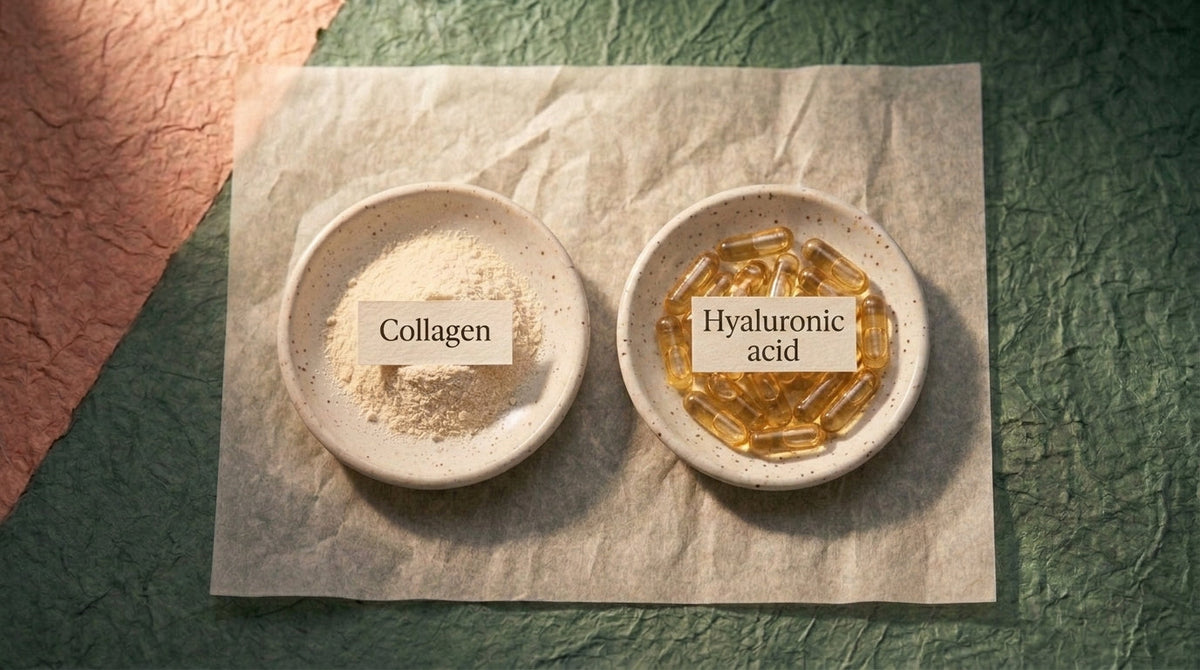
Collagen peptides and oral hyaluronic acid are often sold for the same goals—skin and joints—but they are not interchangeable ingredients. Collagen provides hydrolyzed protein peptides and amino acids. Hyaluronic acid (HA; hyaluronan) is a glycosaminoglycan involved in extracellular-matrix hydration and synovial biology. Their doses, mechanisms and human evidence are different.
The most useful comparison is therefore not “which ingredient is better?” in the abstract. It is which evidence base better matches your goal.
For the underlying oral HA trials, see the Hyaluronic Acid Research Data Center. For the broader collagen literature, use our Hydrolysed Collagen Peptides Data Center.
Collagen vs hyaluronic acid at a glance
| Hydrolysed collagen peptides | Oral hyaluronic acid | |
|---|---|---|
| What it is | Hydrolyzed collagen protein | Glycosaminoglycan / hyaluronan |
| Typical oral study dose | Often gram-scale, commonly about 2.5–15 g/day depending on outcome and product | Often about 60–200 mg/day in modern skin and joint trials; some studies use 240 mg/day |
| Skin evidence | Hydration, elasticity and wrinkle-related outcomes, with formulation and funding sensitivity | Strongest oral evidence for hydration, elasticity and wrinkle depth |
| Joint evidence | Mixed across collagen forms, populations and exercise/rehabilitation protocols | Promising but heterogeneous; many OA studies use combinations or co-interventions |
| Key formulation issue | Collagen source, peptide preparation, dose and co-ingredients | Dose, molecular weight, source and whether HA is isolated or part of a mixture |
What does collagen do?
Hydrolysed collagen contains enzymatically fragmented collagen proteins. Digestion releases amino acids and hydroxyproline-containing peptides that can be detected in human blood after ingestion. Human trials have evaluated skin hydration and elasticity, exercise-related connective-tissue outcomes, joint symptoms, bone measures and body-composition endpoints.
But “collagen” is not one standardized intervention. Fish, bovine and porcine sources, branded peptide preparations, collagen type, hydrolysis profile and dose can differ. That is why results from one specific collagen preparation should not automatically be assigned to every collagen powder.
What does oral hyaluronic acid do?
Oral HA is a different molecule and works through a different evidence base. It is found naturally in skin, synovial fluid and other connective tissues, but swallowing HA does not mean intact polymer is simply deposited into skin or joints.
Modern oral trials span a wide molecular-weight range—from approximately 2 kDa to 1.8 MDa—and mechanistic research suggests gut-microbial processing contributes to oral bioavailability. That is why we do not treat “low molecular weight” as an automatic marker of a better supplement.
A 2025 meta-analysis of seven randomized oral HA trials found significant pooled improvements in skin hydration, elasticity and wrinkle depth. Pooled firmness, wrinkle volume and transepidermal water loss did not reach statistical significance. For the detailed skin evidence, see Hyaluronic Acid for Skin.
Which has better evidence for skin?
Both have human evidence, but there is no large, definitive head-to-head trial showing that oral collagen is categorically superior to oral HA—or vice versa.
Collagen trials often use gram-scale doses and focus on collagen-derived peptides, dermal structure and elasticity. Oral HA trials use milligram-scale doses and are especially consistent around hydration, elasticity and wrinkle-depth outcomes.
If the primary goal is a low-capsule-burden oral supplement for skin hydration, HA is practical because the studied doses are small. If the goal is to supplement collagen peptides themselves, especially in a broader connective-tissue or protein context, collagen is the more direct ingredient.
Which has better evidence for joints?
The answer is less clean than many supplement pages suggest.
Collagen joint research varies by collagen form and study design. Some trials use undenatured type II collagen, others hydrolysed peptides, and some combine supplementation with exercise or rehabilitation. Those interventions should not be treated as identical.
For oral HA, a 2024 systematic review identified 11 oral HA or HA-containing studies involving 597 patients across osteoarthritis and low-back-pain contexts. The limitation is that many of those studies used combination products, proprietary extracts, rehabilitation or other co-interventions. Direct oral HA trials around roughly 111–200 mg/day report encouraging knee-discomfort or osteoarthritis signals, but the evidence is not definitive.
See Hyaluronic Acid for Joints & Knee Pain for the full breakdown, including null and combination trials.
Can you take collagen and hyaluronic acid together?
Yes. They are mechanistically different and are commonly combined. The more important question is whether combining them has been shown to outperform either ingredient alone.
A 2024 randomized trial by Žmitek and colleagues tested 5 g fish collagen plus 80 mg vitamin C, with or without an additional 30 mg HA. The collagen-containing groups improved selected skin outcomes, but adding 30 mg HA did not clearly produce an additional benefit across the measured endpoints compared with collagen plus vitamin C alone.
That does not prove collagen + HA is pointless. It means the specific 30 mg add-on in that trial did not establish a strong synergy claim.
For the stack evidence, see Collagen and Vitamin C: Hyaluronic Acid Stack Evidence.
How do the doses compare?
Collagen and HA should not be compared milligram-for-milligram. Their effective study doses are on completely different scales.
- Collagen peptides: usually measured in grams per day.
- Oral HA: usually measured in tens to hundreds of milligrams per day.
Modern oral HA studies commonly use about 60–200 mg/day, with 120 mg appearing repeatedly and 200 mg represented in both skin and joint research. See our HA dosage guide.
Which one should you choose?
Choose collagen first if:
- you specifically want collagen peptides rather than a glycosaminoglycan;
- your goal includes tendon, bone or resistance-training-related connective-tissue research;
- you are comfortable with gram-scale powder dosing; or
- you prefer a protein-derived intervention with a broader collagen-specific evidence base.
Choose oral HA first if:
- your main goal is skin hydration, elasticity or wrinkle-depth evidence;
- you prefer a capsule-scale milligram dose;
- you want an ingredient with direct oral skin RCTs across multiple molecular weights; or
- you are also interested in the emerging oral knee-discomfort evidence.
Use both if:
You prefer a combined connective-tissue strategy and accept that current evidence does not prove the combination is synergistic. In that case, choose doses that can be mapped to each ingredient's own human literature instead of assuming a token amount of HA is enough because it appears on the label.
Bottom line
Collagen peptides and oral hyaluronic acid overlap in skin and joint marketing, but they are biologically and clinically distinct. Oral HA currently has a particularly coherent evidence base for hydration, elasticity and wrinkle depth at milligram doses. Collagen has a much broader protein-peptide literature across skin, connective tissue, training and selected joint outcomes.
Neither automatically replaces the other, and the existing combination trial does not prove a special synergy. The strongest decision is to match the ingredient, dose and exact formulation to the human outcome you actually care about.
Frequently asked questions
Is collagen or hyaluronic acid better for skin?
Can I take collagen and hyaluronic acid together?
Is oral hyaluronic acid actually absorbed?
How much hyaluronic acid should I take?
Does hyaluronic acid help with joint pain like collagen does?
Which is cheaper, collagen or hyaluronic acid?
Do I need vitamin C with hyaluronic acid?
Sources & article history
Sources (17)
-
Effects of Oral Collagen for Skin Anti-Aging: A Systematic Review and Meta-Analysis Nutrients. 2023;15(9):2080.
-
Ingested Hyaluronan Moisturizes Dry Skin Nutrition Journal. 2014;13:70.
-
Oral Hyaluronan Relieves Wrinkles and Improves Dry Skin: A 12-Week Double-Blinded, Placebo-Controlled Study Nutrients. 2021;13(7):2220.
-
Effect of collagen supplementation on osteoarthritis symptoms: a meta-analysis of randomized placebo-controlled trials International Orthopaedics. 2019;43(3):531–538.
-
Specific Collagen Peptides Improve Bone Mineral Density and Bone Markers in Postmenopausal Women — A Randomized Controlled Study Nutrients. 2018;10(1):97.
-
Vitamin C–Enriched Gelatin Supplementation before Intermittent Activity Augments Collagen Synthesis American Journal of Clinical Nutrition. 2017;105(1):136-143.
-
Effects of Collagen Supplements on Skin Aging: A Systematic Review and Meta-Analysis of Randomized Controlled Trials The American Journal of Medicine. 2025;138(9):1264–1277.
-
Efficacy and safety of hydrolyzed collagen supplementation on skin health outcomes: a systematic literature review of randomized controlled trials European Journal of Clinical Nutrition. 2026;80(9):867–885.
-
The Effects of Dietary Supplementation with Collagen and Vitamin C and Their Combination with Hyaluronic Acid on Skin Density, Texture and Other Parameters: A Randomised, Double-Blind, Placebo-Controlled Trial Nutrients. 2024;16(12):1908.
-
Oral Hyaluronic Acid Supplement: Efficacy in Skin Hydration, Elasticity, and Wrinkle Depth Reduction Journal of Drugs in Dermatology. 2025;24(9):910-919.
-
Oral sodium hyaluronate improves skin hydration, barrier function and signs of aging: a randomized, double-blind, placebo-controlled trial in 150 healthy adults Scientific Reports. 2025;16:2941.
-
Oral Hyaluronic Acid in Osteoarthritis and Low Back Pain: A Systematic Review Mediterranean Journal of Rheumatology. 2024;35(4):557-562.
-
Oral sodium hyaluronate relieves knee discomfort: A 12-week double-blinded, placebo-controlled study Experimental and Therapeutic Medicine. 2023;27(2):64.
-
Oral administration of polymer hyaluronic acid alleviates symptoms of knee osteoarthritis: a double-blind, placebo-controlled study over a 12-month period The Scientific World Journal. 2012;2012:167928.
-
Oral administration of hyaluronic acid to improve skin conditions via a randomized double-blind clinical test Skin Research and Technology. 2023;29(11):e13531.
-
Oral hyaluronan relieves wrinkles: a double-blinded, placebo-controlled study over a 12-week period Clinical, Cosmetic and Investigational Dermatology. 2017;10:267-273.
-
Ingestion of hyaluronans (molecular weights 800 k and 300 k) improves dry skin conditions: a randomized, double blind, controlled study Journal of Clinical Biochemistry and Nutrition. 2015;56(1):66-73.
Article history (2)
- Content refreshed for accuracy. Citations updated to reflect current research comparing collagen and hyaluronic acid across skin, joint, bone and tendon outcomes.
- Collagen-versus-hyaluronic-acid comparison updated to distinguish separate evidence bases and the lack of proven oral combination synergy.