How to Take Collagen Peptides: Coffee, Mixing & Storage
A practical guide to mixing hydrolysed collagen without clumps, plus storage, taste and travel tips.
 By
Dr. Khaled Mahmoud, MBBCh
Critical Care Medicine, Longevity Science & Editorial Direction
By
Dr. Khaled Mahmoud, MBBCh
Critical Care Medicine, Longevity Science & Editorial Direction
 Reviewed by
Dr. Amr Yasser, PhD
Cardiometabolic, Musculoskeletal, Gut & Bioavailability
Reviewed by
Dr. Amr Yasser, PhD
Cardiometabolic, Musculoskeletal, Gut & Bioavailability
 Reviewed by
Dr. Abdulla Mostafa, PhD
Cellular Senescence, Neurological, Mitochondrial & Brain-Ageing Biology
Reviewed by
Dr. Abdulla Mostafa, PhD
Cellular Senescence, Neurological, Mitochondrial & Brain-Ageing Biology
- Published
- Last reviewed
- Reading time
- 5 min
- Sources cited
- 3
On this page
If you're wondering how to take collagen peptides, there is no special ritual: hydrolysed collagen can be mixed into water, coffee, tea or smoothies. A 2025 randomized crossover study found broadly similar exposure to measured collagen-derived peptides when bovine hydrolysate was taken in coffee versus water. For clumping, add powder to the empty vessel before the liquid and stir or shake well.
What is the powder actually like?
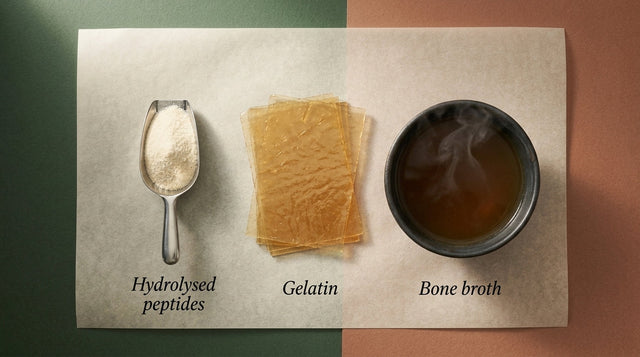
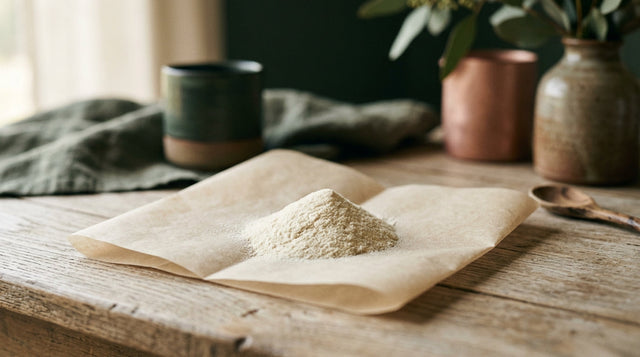
Hydrolysed collagen is usually sold as a fine, light-coloured powder. Hydrolysis breaks native collagen into a smaller, more soluble peptide mixture, but molecular-weight distribution varies by product rather than falling into one universal range [1]. Some hydroxyproline-containing peptides, including Pro-Hyp, are detectable in blood after ingestion [2]; that supports oral bioavailability but does not prove that those peptides alone drive clinical effects.
How do you stop it clumping?
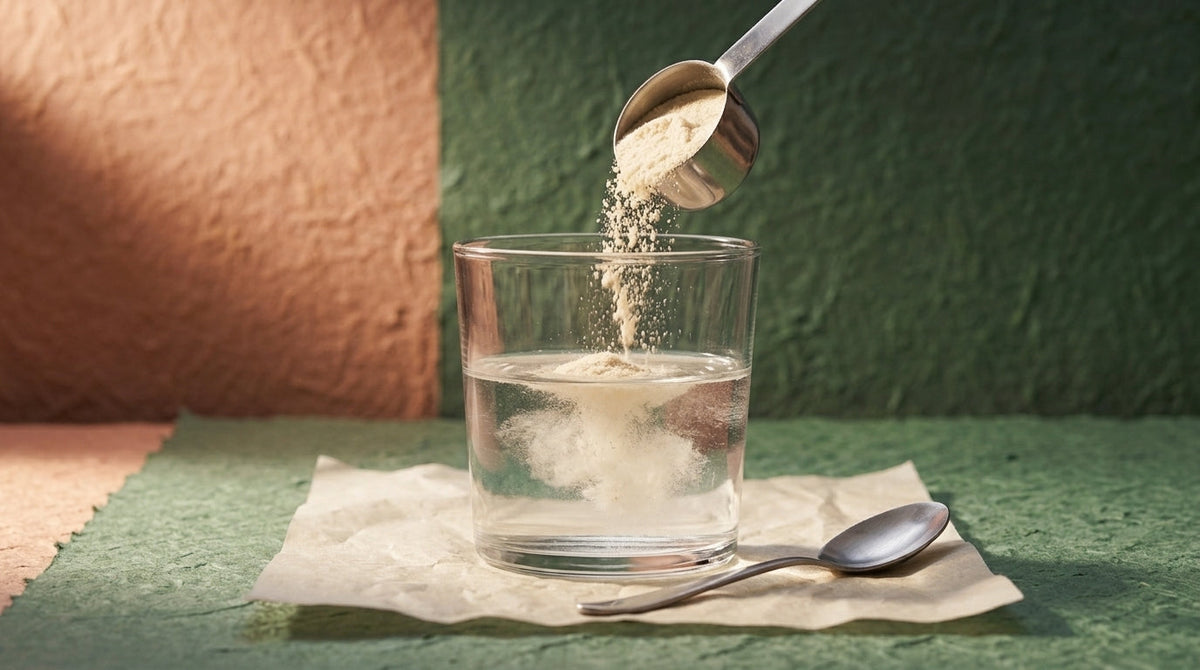
Mixing behaviour varies by brand and liquid. A practical approach is to add the powder gradually while stirring, or use a shaker bottle for cold liquids. If your product dissolves more easily when added to the empty vessel first, that is fine too; clumping is a formulation and mixing issue, not evidence that the collagen has lost efficacy.
For a morning coffee: scoop the powder into the empty mug, pour in the coffee, and stir briefly — a few seconds is enough for hot liquids, no shaker needed. The same works for cold water in a glass. If you'd rather add powder to already-poured liquid, a shaker bottle with a wire ball or mesh screen breaks up clumps quickly; either approach works, powder-first is just slightly faster.
Thick, already-mixed liquids — smoothies, cooked porridge, yoghurt — are the one situation where clumping is genuinely hard to avoid, because the powder can't disperse cleanly through a thick medium. Mix the collagen into a small amount of water or milk first to make a thin slurry, then stir that into the thicker preparation.
Does coffee change collagen absorption?
A 2025 randomized crossover pharmacokinetic study compared bovine collagen hydrolysate taken in coffee versus water. The profiles of some free amino acids differed, but exposure, peak concentration and timing for measured collagen-derived peptides were broadly similar between the two matrices [3]. This supports coffee as a reasonable delivery matrix, but it was a single-dose mechanistic study with no skin, joint or bone outcome and several authors employed by the collagen manufacturer.
What does it pair well with?
Coffee and tea both work well — the peptides tolerate everyday drinking temperatures, and any faint neutral flavour disappears under coffee or tea's own taste. Plain water shows the neutral collagen taste more than flavoured drinks; a squeeze of lemon covers it if that bothers you, and sparkling water works too, though pouring gently reduces foaming during mixing. Smoothies mask any flavour completely — add the collagen with your other dry ingredients before blending. Porridge, oatmeal and yoghurt all work if you stir the powder in after cooking and slightly cooling, or stir gradually rather than dumping it in. Juice works, though citrus and other acidic juices bring out the faint taste more than milder juices like apple or pomegranate.
Baking changes proteins and peptides through heat and food-matrix reactions, but there is not enough clinical evidence to state that ordinary baking temperatures destroy a specific percentage of collagen's clinically relevant activity. If you want to match oral supplement trials most closely, mixing the powder into a beverage or food without prolonged high-heat processing is the simpler approach.
How should you store it?
Follow the storage directions and expiry date on the specific product. In general, keeping a powder tightly sealed and dry helps preserve handling quality, but there is no single evidence-based temperature or after-opening window that applies to every collagen product. If the powder develops an unusual odour, visible contamination or a major unexplained change in appearance, follow the manufacturer's guidance rather than relying on a generic rule.
What about taste?
Well-made hydrolysed collagen is close to flavourless in coffee, tea, and smoothies. In plain water or acidic juice, some people notice a faint neutral protein taste — mild, and more common with lower-quality products carrying trace processing residues. If taste is an issue: switch to a warm or flavoured drink, add a small amount of citrus juice, try a different collagen source (marine versus bovine can taste subtly different), or consider capsules, which cost more per gram but remove the taste question entirely.
How do you keep it up while travelling?
For travel, single-serve sachets or a clean, dry, well-sealed container can make dosing easier. Clinical trials study repeated supplementation over weeks or months; they do not tell us the exact consequence of missing one or two doses. If you miss a dose, resume your usual schedule rather than doubling the next serving.
What about children, older adults, or those who dislike the taste?
Dedicated supplementation trials in children are scarce, so routine pediatric use should not be inferred from adult collagen studies. Older adults are represented in some skin, bone and exercise trials, but collagen is an incomplete protein and should not displace complete dietary protein when muscle preservation is the goal. For either age group, the appropriate product and dose depend on the reason for use and the wider diet.
Related reading: daily dose, timing, and our collagen peptide buyer's guide.
Bottom line
Hydrolysed collagen can be mixed into water, coffee, tea or other foods according to the product's directions. A 2025 human crossover study found broadly similar exposure to measured collagen-derived peptides when bovine hydrolysate was taken in coffee versus water, so coffee is a reasonable practical option. Follow the package expiry and storage instructions rather than applying a universal shelf-life rule, and avoid treating untested cooking methods as equivalent to the formulations used in clinical trials.
Frequently asked questions
How do I stop my collagen from clumping?
Can I mix collagen with hot coffee?
Does collagen dissolve in cold water?
How should I store collagen powder?
Does collagen have a taste?
Can I cook or bake with collagen?
Can I mix collagen with my protein shake?
Sources & article history
Sources (3)
-
Hydrolyzed Collagen—Sources and Applications Molecules. 2019;24(22):4031.
-
Identification of food-derived collagen peptides in human blood after oral ingestion of gelatin hydrolysates Journal of Agricultural and Food Chemistry. 2005;53(16):6531–6536.
-
Unravelling the bioavailability of amino acids and bioactive peptides from collagen hydrolysate in coffee in healthy volunteers Food Research International. 2025;211:116478.
Article history (2)
- Content refreshed for accuracy. Citations updated to reflect current research on collagen solubility, bioavailability, and practical everyday use.
- Practical-use guidance updated with 2025 coffee bioavailability research and more cautious statements about heat, storage and clinical equivalence.