Collagen in Pregnancy: Are Collagen Peptides Safe?
No trials exist for collagen in pregnancy or breastfeeding. Here's the honest evidence gap, and when to talk to your obstetrician.
 By
Dr. Khaled Mahmoud, MBBCh
Critical Care Medicine, Longevity Science & Editorial Direction
By
Dr. Khaled Mahmoud, MBBCh
Critical Care Medicine, Longevity Science & Editorial Direction
 Reviewed by
Dr. Amr Yasser, PhD
Cardiometabolic, Musculoskeletal, Gut & Bioavailability
Reviewed by
Dr. Amr Yasser, PhD
Cardiometabolic, Musculoskeletal, Gut & Bioavailability
 Reviewed by
Dr. Abdulla Mostafa, PhD
Cellular Senescence, Neurological, Mitochondrial & Brain-Ageing Biology
Reviewed by
Dr. Abdulla Mostafa, PhD
Cellular Senescence, Neurological, Mitochondrial & Brain-Ageing Biology
- Published
- Last reviewed
- Reading time
- 5 min
- Sources cited
- 4
On this page
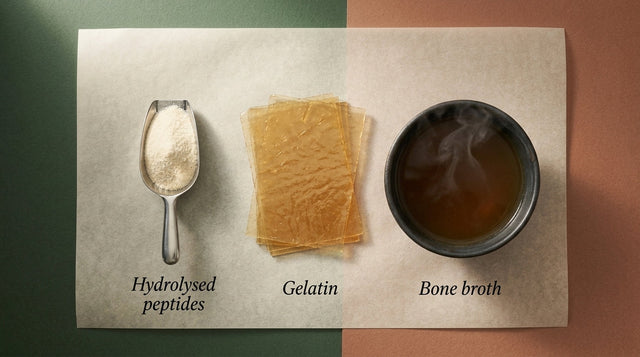
There are no adequate clinical trials establishing the safety or benefit of hydrolysed collagen supplements during pregnancy or breastfeeding. Collagen is a food-derived protein, but concentrated supplements are not identical to eating collagen-containing foods: source, dose, contaminants and added ingredients all matter. Discuss non-essential supplementation with your obstetric or maternity-care team.
Why is there no direct evidence here?
Trials of supplements in pregnant women are difficult to run, ethically and practically. Researchers default to excluding pregnant women from a trial unless the product being tested is specifically meant to treat a pregnancy-related condition. Hydrolysed collagen has no pregnancy-specific indication, so nobody has run the trial. What exists instead is non-pregnant adult trial data, plus the general food-safety background for collagen as a dietary ingredient.
That's the honest answer to "is hydrolysed collagen safe in pregnancy?" — there's no direct trial answer either way. Anyone giving you a confident yes or no is going beyond what's actually been studied.
What does the food context tell us?
Collagen-containing foods are routinely eaten during pregnancy, and hydrolysed collagen ultimately contributes amino acids and small peptides. That background is reassuring at a general nutritional level, but it cannot establish the safety of every concentrated supplement, dose, source or contaminant profile. Product testing and the absence of unnecessary added ingredients therefore matter.
How does collagen fit into pregnancy protein intake?
Protein requirements increase during pregnancy, but exact needs vary with pre-pregnancy body size, trimester, overall diet and clinical circumstances. Collagen is an incomplete protein and should not displace complete or complementary protein sources that supply all essential amino acids. If protein intake is a concern, address the overall diet with the maternity team or a qualified dietitian rather than using collagen as the primary solution.
Situations worth a direct conversation with your obstetrician
If you were already taking collagen before pregnancy
Whether to continue is a judgement call, not an evidence-based mandate. Some obstetricians recommend stopping all non-essential supplements during pregnancy; others treat a food-grade ingredient like collagen as low concern. Follow your own obstetrician's guidance rather than a generic rule.
If you have recurrent calcium-oxalate stones or hyperoxaluria
Collagen is rich in hydroxyproline, which can be metabolised to oxalate. Direct human studies show that high gelatin or isolated-hydroxyproline exposure can increase urinary oxalate [3] [4], but they were not pregnancy studies and did not measure stone recurrence. Do not infer a pregnancy-specific safe dose. People with recurrent stones or known hyperoxaluria should individualise the decision with their obstetric and renal teams.
If you have a source-specific allergy
Avoid a collagen source to which you are allergic. Fish allergy is relevant to fish-derived marine collagen; shellfish allergy does not automatically mean fish allergy, and bovine or porcine products have their own source-specific considerations.
If you have a pregnancy complication or kidney disease
Gestational diabetes, hypertensive disorders, kidney disease and other pregnancy complications require individualized nutrition and supplement advice. There is no evidence-based rule that collagen itself is contraindicated solely because of gestational diabetes or hypertension, but non-essential supplements should be reviewed with the clinical team managing the condition.
If you're considering starting collagen during pregnancy
The conservative default is to wait until after pregnancy and breastfeeding, unless your obstetrician sees a specific reason to start now. There's no demonstrated pregnancy-specific benefit, so there's no strong case for starting during it.
What about breastfeeding?
Dedicated lactation trials are also lacking. Collagen-derived amino acids are ordinary dietary nutrients, but no study establishes an optimal supplement dose, effect on breast-milk composition or benefit for the infant. If you choose to use a product while breastfeeding, prioritize a simple formulation with transparent sourcing and contaminant testing, and discuss it with your healthcare professional if you or the infant has relevant allergy, kidney or metabolic concerns.
Does it help with postpartum recovery?
The postpartum period brings its own connective-tissue and skin questions, and the honest answer across most of them is that direct evidence is thin to absent. Diastasis recti and abdominal wall recovery may theoretically benefit from adequate protein, but no trial has tested collagen specifically for this. Stretch marks and skin laxity have essentially no supporting evidence for collagen reversing them once established — skin elasticity gains from collagen generally are modest even outside pregnancy (see our skin article). Perineal or caesarean recovery depends on adequate overall nutrition and clinical care; collagen has not been shown to accelerate healing in this setting. Postpartum hair shedding is a hormonal shift that resolves on its own; collagen has, at best, a minor role.
The honest framing: collagen is a reasonable general supplement to consider after obstetric clearance, but don't expect it to meaningfully speed up any of the specific tissue changes that come with having had a baby.
What we still don't know
Whether continuous collagen supplementation during pregnancy has any measurable effect, positive or negative, on maternal or fetal outcomes — this simply hasn't been studied. Whether the oxalate rise seen in non-pregnant women translates to a similar magnitude during pregnancy's altered kidney physiology. Whether hydrolysed collagen affects breast milk composition in any way. And whether postpartum tissue recovery genuinely benefits from collagen specifically, rather than from adequate total protein more generally.
Related reading: collagen safety, kidney-stone evidence, and the complete HCP guide.
Bottom line
Pregnancy and breastfeeding safety for hydrolysed-collagen supplements has not been established in dedicated trials. A food-derived protein background is reassuring but is not equivalent to product-specific safety. Do not use a universal pregnancy dose, and do not infer safety from ordinary food exposure alone. Prioritize adequate overall nutrition, verified product quality if supplementing, and individualized advice for allergy, kidney disease, recurrent calcium-oxalate stones or pregnancy complications.
Frequently asked questions
Is hydrolysed collagen safe during pregnancy?
Can I take collagen while breastfeeding?
Should I stop taking collagen if I get pregnant?
Does collagen help with postpartum recovery?
Will collagen help with stretch marks?
Can collagen affect my baby's development?
Is marine collagen safer than bovine collagen during pregnancy?
Sources & article history
Sources (4)
-
Hydrolyzed Collagen—Sources and Applications Molecules. 2019;24(22):4031.
-
Relationship of Protein Intake to Urinary Oxalate and Glycolate Excretion Kidney International. 1993;44(2):366-372.
-
Hydroxyproline ingestion and urinary oxalate and glycolate excretion Kidney International. 2006;70(11):1929–1934.
-
A single-blind, parallel trial of l-hydroxyproline in healthy adult subjects Urolithiasis. 2015;43(3):289–292.
Article history (2)
- Content refreshed for accuracy. Citations updated to reflect current research on collagen's food-safety background and protein-oxalate relationship, in the context of pregnancy and breastfeeding.
- Pregnancy and breastfeeding guidance updated to separate food exposure from supplement-specific safety and to avoid unsupported universal dosing.