Hydrolysed Collagen and Gut Health: The Honest Evidence Gap

The gut health claim is the weakest evidence link in the hydrolysed collagen category. The mechanistic story is plausible (glycine and glutamine support the mucosal barrier), but direct human trials are essentially absent. Do not take collagen primarily for gut health — better-supported alternatives exist. Here is the honest state of the evidence.

Editorial still life representing considered gut health nutrition with collagen powder
On this page

Key takeaways

        Direct human trial evidence for hydrolysed collagen specifically improving gut barrier function is essentially absent.

        The mechanistic story rests on glycine (abundant in collagen) supporting mucosal repair and glutamine (small amount in collagen) supporting enterocyte metabolism — both extrapolative to collagen (1).

        "Leaky gut" is a poorly-defined syndrome with limited clinical criteria; interventions targeting it lack strong evidence (3).

        Bloomer 2022 compared collagen versus rice protein on GI permeability markers in healthy adults — no significant differences (2). Suggestive that collagen is not obviously superior to other protein sources for gut outcomes.

        Do not take hydrolysed collagen primarily for gut health. Take it for its stronger indications (skin, joints, bones); any gut benefit is a bonus.

        Better-supported alternatives for gut symptoms: dietary fibre, probiotic foods (yoghurt, kefir), addressing underlying conditions (IBS, IBD, coeliac). See a gastroenterologist for persistent symptoms.

Quick answer

The evidence for hydrolysed collagen improving gut health is essentially the weakest link in the entire collagen literature. The mechanistic story — collagen provides glycine and glutamine that support mucosal repair — is biologically plausible but rests almost entirely on extrapolation from studies of these amino acids given separately, not from collagen trials. One head-to-head trial (Bloomer 2022) found no significant difference between collagen and rice protein on GI permeability markers, suggesting collagen is not obviously superior to other protein sources for gut outcomes. Do not take hydrolysed collagen primarily for gut health. For persistent gut symptoms, see a gastroenterologist; for general gut wellness, dietary fibre and fermented foods have stronger evidence.

The mechanistic story that gets extrapolated

Consumer marketing for collagen frequently claims support for gut health, gut barrier integrity, and management of "leaky gut." The mechanistic story typically proceeds as follows:

        Collagen is rich in glycine (~33% by weight).

        Glycine has been shown in animal and cell-culture studies to support mucosal barrier function and tight junction integrity.

        Collagen also contains some glutamine (~4–6%), and glutamine is the primary metabolic fuel for enterocytes (small intestine cells) (1).

        Therefore, collagen should support gut barrier function and mucosal integrity.

The problem with this argument is not the biology of glycine and glutamine — that story is real. The problem is the extrapolation from "glycine (or glutamine) supports gut barrier in isolated study" to "collagen delivers enough of these amino acids to reproduce that effect at supplement doses in humans." That extrapolation has not been directly tested in trials of hydrolysed collagen specifically.

What direct human trials actually show

Direct clinical trials of hydrolysed collagen for gut outcomes in humans are rare. The most relevant published trial is Bloomer 2022 in the International Journal of Medical Sciences (2).

Bloomer 2022 design: Healthy adults were randomised to hydrolysed collagen versus rice protein for daily supplementation, with gastrointestinal permeability assessed by lactulose-mannitol ratio (a standard measure of small-intestine "leakiness"). This design directly tests whether collagen has specific advantages over another protein source for the gut-barrier claim.

Result: No significant differences between collagen and rice protein on GI permeability markers. Both were well tolerated; neither produced a specifically gut-barrier-improving signal in healthy adults.

This is one trial in healthy adults (not a symptomatic gut patient population), and it does not exclude the possibility that collagen benefits specific gut conditions. But it is directly informative for the marketing claim that collagen has unique gut-barrier benefits — and the direct comparison does not support that claim. Collagen, in this trial, behaved comparably to another protein source.

The "leaky gut" question

A significant portion of collagen-for-gut marketing invokes "leaky gut" — a syndrome positioned as intestinal barrier dysfunction underlying various chronic symptoms. A 2019 review in Gut examined the state of the scientific evidence for "leaky gut" as a clinical entity (3). The paper concluded that:

        Increased intestinal permeability is measurable in some patients with well-defined gastrointestinal conditions (inflammatory bowel disease, coeliac disease, food allergies).

        "Leaky gut" as a stand-alone syndrome — increased permeability driving diffuse non-GI symptoms like fatigue, joint pain, or brain fog — lacks robust clinical criteria and specific validated tests.

        Interventions specifically marketed for "leaky gut" (glutamine supplements, gut-repair blends, and by extension collagen) have limited evidence for improving well-defined outcomes in humans.

The honest reading: increased gut permeability is a real biological phenomenon in specific clinical contexts. "Leaky gut" as marketed by many wellness sources is a poorly-defined syndrome that has generated considerable supplement marketing without correspondingly strong evidence. Do not choose collagen based on "leaky gut" claims; the underlying framework is contested.

Where collagen might modestly help

Two contexts where collagen may have some gut-related benefit worth mentioning honestly:

Post-antibiotic or GI recovery

After significant GI insult (antibiotic courses, food poisoning episodes, GI surgeries), mucosal repair benefits from adequate protein and amino acid substrate. Collagen contributes to this generic recovery process. It is not obviously superior to a complete protein source for this purpose, but it is not obviously inferior either. Some readers report subjective GI comfort improvements during recovery when adding collagen. Treat this as suggestive individual response rather than validated intervention.

As part of an anti-inflammatory dietary approach

Some inflammatory-bowel-disease dietary approaches (specific carbohydrate diet, modified FODMAP protocols) include bone broth or collagen-rich foods as a component. This is culinary tradition and gentle-food positioning rather than specific collagen-supplement evidence. If you enjoy bone broth as part of an anti-inflammatory diet, it is a legitimate food choice; do not confuse this with clinical evidence for supplement-scale collagen dosing.

Better-supported alternatives for gut symptoms

For general gut wellness

        Adequate dietary fibre — 25–35 g/day from varied plant sources. Supports gut microbiome diversity, regular bowel function, and mucosal health. Larger effect than any supplement.

        Fermented foods — yoghurt, kefir, sauerkraut, kimchi, tempeh. Deliver live cultures and support microbiome diversity. Evidence for general gut and immune outcomes.

        Adequate hydration — supports normal gut motility and stool consistency.

        Physical activity — supports gut motility and microbiome diversity through mechanisms not fully understood.

For persistent gut symptoms

        See a gastroenterologist. Persistent bloating, abdominal pain, altered bowel habits, or unintentional weight loss warrant proper evaluation for IBS, IBD, coeliac disease, food intolerances, or other conditions. Collagen supplementation is not a substitute for diagnosis.

        Targeted probiotic strains with evidence for specific conditions — e.g. Bifidobacterium infantis for IBS. Discuss with a gastroenterologist.

        Elimination diets under supervision where food intolerances or coeliac disease are suspected. Do not self-diagnose.

The honest positioning of collagen for gut

If you are already taking hydrolysed collagen for stronger indications (skin, joints, bone), any modest gut benefit is a welcome bonus — take it as such. If you are considering starting collagen primarily for gut health outcomes, the evidence does not really support this positioning; consider whether your primary goal might be better served by dietary changes, fermented food incorporation, or gastroenterology evaluation for persistent symptoms.

Do not read marketing for "gut-supporting collagen" as clinical evidence. Marketing runs ahead of trials in this indication more than in most others. The stronger collagen indications (skin, joints, bones) have their own honest caveats but stand on more direct trial evidence than gut claims do.

What we still don't know

        Whether hydrolysed collagen provides meaningful gut-barrier benefit in symptomatic populations (IBS, IBD, food intolerances). Trials in these populations are limited.

        Whether specific molecular weight fractions or peptide profiles produce different gut outcomes. Not systematically studied.

        Whether combining collagen with dedicated gut-focused ingredients (specific probiotic strains, prebiotic fibres) produces additive effects. Not directly tested.

        Whether the Bloomer 2022 null result generalises to larger and more diverse populations. Only one direct comparison exists.

Bottom line

The gut health claim is the weakest evidence link in the entire hydrolysed collagen category. Direct human trials are essentially absent; the mechanistic story rests on extrapolation from glycine and glutamine research; the one direct comparison against another protein source found no specific gut advantage for collagen. Do not take hydrolysed collagen primarily for gut health. If you take it for its stronger indications (skin, joints, bones), any modest gut benefit is a bonus. For persistent gut symptoms, see a gastroenterologist rather than escalating supplements. For general gut wellness, dietary fibre, fermented foods, and hydration have stronger evidence bases. See our full pillar guide for the honest picture across indications.

Frequently asked questions

Does hydrolysed collagen actually improve gut health?

Direct human trial evidence is essentially absent. The mechanistic story is plausible but extrapolative. The one direct comparison against another protein source (Bloomer 2022) found no specific advantage for collagen on gut permeability markers (2). Take collagen for its stronger indications; do not choose it primarily for gut outcomes.

Can collagen help with leaky gut?

"Leaky gut" as a stand-alone clinical syndrome lacks robust criteria and specific validated tests (3). Interventions marketed for it have limited evidence. If you have specific GI symptoms, see a gastroenterologist for proper evaluation rather than self-diagnosing leaky gut.

Does collagen help with IBS or IBD?

No direct trial evidence supports collagen for IBS or IBD. Both conditions have specific evidence-based interventions — dietary approaches (low-FODMAP for IBS), targeted probiotics for some patients, pharmacotherapy where indicated. Discuss with a gastroenterologist. Do not substitute collagen for proper condition management.

Can I take collagen to help with gut recovery after antibiotics?

Adequate protein supports mucosal repair generically; collagen contributes to that. Whether it is specifically superior to any other protein source for post-antibiotic recovery is not established. Probiotic foods (yoghurt, kefir) have more specific evidence for post-antibiotic microbiome restoration.

Does bone broth help gut health more than collagen powder?

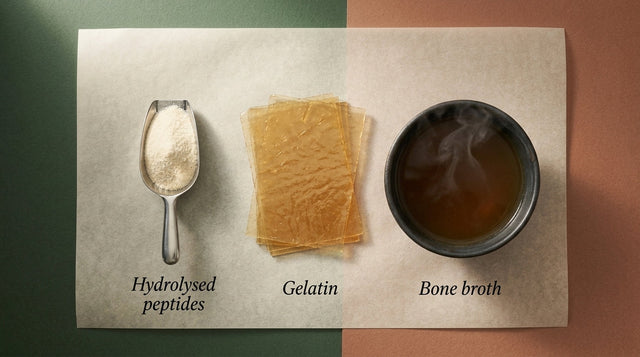
Bone broth is a food; collagen powder is a supplement. Both deliver collagen and amino acids. Bone broth may deliver additional gut-relevant compounds (mucin-supporting glycoproteins, minerals) but at much lower collagen concentration. If you enjoy bone broth, treat it as a good food; do not treat it as clinical intervention.

What is the best supplement for gut health?

Not collagen. Dietary fibre, fermented foods (yoghurt, kefir), and hydration have stronger evidence for general gut wellness. Specific probiotic strains have targeted evidence for specific conditions. For persistent symptoms, gastroenterology evaluation matters more than supplement optimisation.

How much collagen should I take if I want gut benefits?

If you are taking collagen for other primary indications (skin, joints, bones) at 5–10 g/day, any potential gut benefit is included. Do not increase dose beyond your indication-anchored range hoping for extra gut effect — the evidence does not support this.

References

1. Wang B, Wu G, Zhou Z, et al.. Glutamine and intestinal barrier function. Amino Acids 2015. https://pubmed.ncbi.nlm.nih.gov/25501610/

2. Bloomer RJ, Butawan M, Yates CR, van der Merwe M. Comparative effects of daily supplementation with collagen protein versus rice protein on postprandial gastrointestinal permeability. Int J Med Sci 2022. https://pubmed.ncbi.nlm.nih.gov/35342351/

3. Camilleri M. Leaky gut: mechanisms, measurement and clinical implications in humans. Gut 2019. https://pubmed.ncbi.nlm.nih.gov/31076401/

4. Melendez-Hevia E, De Paz-Lugo P, Cornish-Bowden A, Cardenas ML. A weak link in metabolism: the metabolic capacity for glycine biosynthesis does not satisfy the need for collagen synthesis. J Biosci 2009. https://pubmed.ncbi.nlm.nih.gov/20208089/

Shop on DoNotAge

Use Discount Code